
What is the location and importance of Hull?
AQA GCSE Geography > Urban Issues and Challenges > Hull case study > What is the location and importance of Hull?
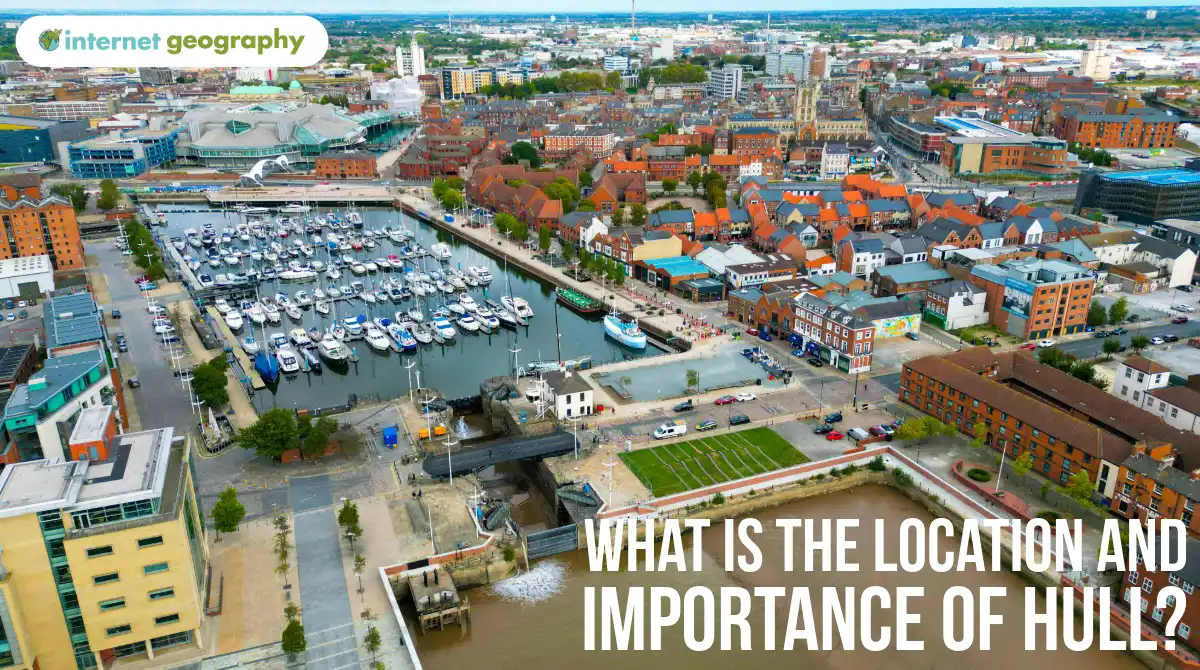
What is the location and importance of Hull?
Kingston upon Hull, usually called Hull, is a major port city in northern England. It is located in East Yorkshire, in the Yorkshire and the Humber region. Hull is built on the north bank of the Humber Estuary, where the River Hull meets the Humber, around 20 miles from the North Sea. This coastal and estuary location has shaped Hull’s development as a trading, fishing, industrial and cultural city.
Hull had a population of about 267,000 in 2021, an increase of about 10,600 since 2011. This makes it an important urban area in eastern England, providing jobs, services, education, transport links and cultural activities for people across the city and the wider Humber region.
Where is Hull located?
Hull is located:
- in East Yorkshire
- on the north bank of the Humber Estuary
- at the point where the River Hull flows into the Humber
- around 20 miles from the North Sea
- east of major northern cities such as Leeds, Sheffield and Manchester
- close to the Humber Bridge, which links East Yorkshire with North Lincolnshire
Hull’s location has helped it become an important gateway between the UK and the wider world. The Humber Estuary provides access to the North Sea and European trade routes, while road links such as the A63 and M62 connect Hull to the rest of northern England and the wider UK motorway network. The port is also connected to inland waterways, helping goods move between the coast and inland areas.
Why is Hull important in the UK?
Hull is important in the UK because it is a major port, a centre for renewable energy, a regional service centre and a city with a growing cultural reputation.
One of Hull’s most important roles is as a port city. The Port of Hull is part of the Humber ports complex, one of the UK’s busiest trading gateways. Associated British Ports describes Hull as a key gateway on the Humber, supporting around 12,000 jobs and contributing over £800 million to the economy each year.
The port handles a wide range of goods, including containers, timber, steel, bulk products, ferry traffic and offshore wind-related cargo. It is also described by Associated British Ports as the UK’s leading softwood timber port and an important focus for the offshore wind sector on the Humber.
Hull is also important because of its role in the UK’s renewable energy industry. The Green Port Hull development at Alexandra Dock includes Siemens Gamesa’s wind turbine blade manufacturing facility. This links Hull to the growth of offshore wind power in the North Sea and supports the UK’s move towards lower-carbon energy.
The city also provides important services for the wider region. Hull has hospitals, shopping areas, cultural venues, schools, colleges and the University of Hull. The university gives the city a national and international role in education and research, helping attract students, staff and investment.
Why is Hull important to the wider world?
Hull’s global importance is strongly linked to its port, renewable energy industry, maritime history and cultural reputation.
The Port of Hull connects the UK to international markets. Goods can be imported and exported through the Humber Estuary, making Hull part of global trade networks. Its location close to the North Sea means it is well placed for trade with Europe and for supporting offshore industries.
Hull also has a growing role in the global renewable energy sector. Wind turbine blades made at Siemens Gamesa’s Hull factory are used in major offshore wind projects, including projects designed to generate electricity for large numbers of homes. This means Hull contributes to international efforts to develop cleaner energy sources and reduce carbon emissions.
Hull’s cultural importance has also increased. In 2017, Hull was the UK City of Culture. More than 2,800 events, exhibitions and cultural activities took place during the year, and the programme was experienced 5.3 million times by audiences. More than 9 in 10 residents took part in at least one cultural activity.
The long-term impact of City of Culture helped improve Hull’s image and attract investment. Hull City Council reported that the University of Hull evaluation found an estimated £676 million of new public and private investment was generated for the city.
Hull’s profile as a visitor destination has continued to grow. National Geographic named Hull as one of its Top 25 global destinations to visit in 2026, highlighting the city’s maritime history and cultural regeneration.
Why has Hull’s location influenced its growth?
Hull’s location has been important throughout its history. Its position on the Humber Estuary gave it access to the North Sea and made it a suitable place for trade. Historically, Hull developed as a port involved in wool exports, fishing, whaling and later industrial activity. Although some traditional industries have declined, its port location remains a major advantage today.
The Humber Estuary also gives Hull a strong link to offshore wind. The shallow waters and strong winds of the North Sea have encouraged the growth of wind farms, while Hull’s port provides space for manufacturing, storage, assembly and transport. This has helped the city move from older maritime industries towards newer green industries.
Key facts about Hull
- Hull is officially called Kingston upon Hull.
- It is located in East Yorkshire, in the Yorkshire and the Humber region.
- It is built on the north bank of the Humber Estuary.
- The River Hull flows through the city and joins the Humber there.
- Hull had a population of about 267,000 people in 2021.
- The Port of Hull supports around 12,000 jobs and contributes over £800 million to the economy each year.
- Hull is an important centre for the offshore wind industry.
- Hull was the UK City of Culture in 2017.
- National Geographic included Hull in its Best of the World 2026 list.
Summary
Flashcards
Quiz
Coming soon