
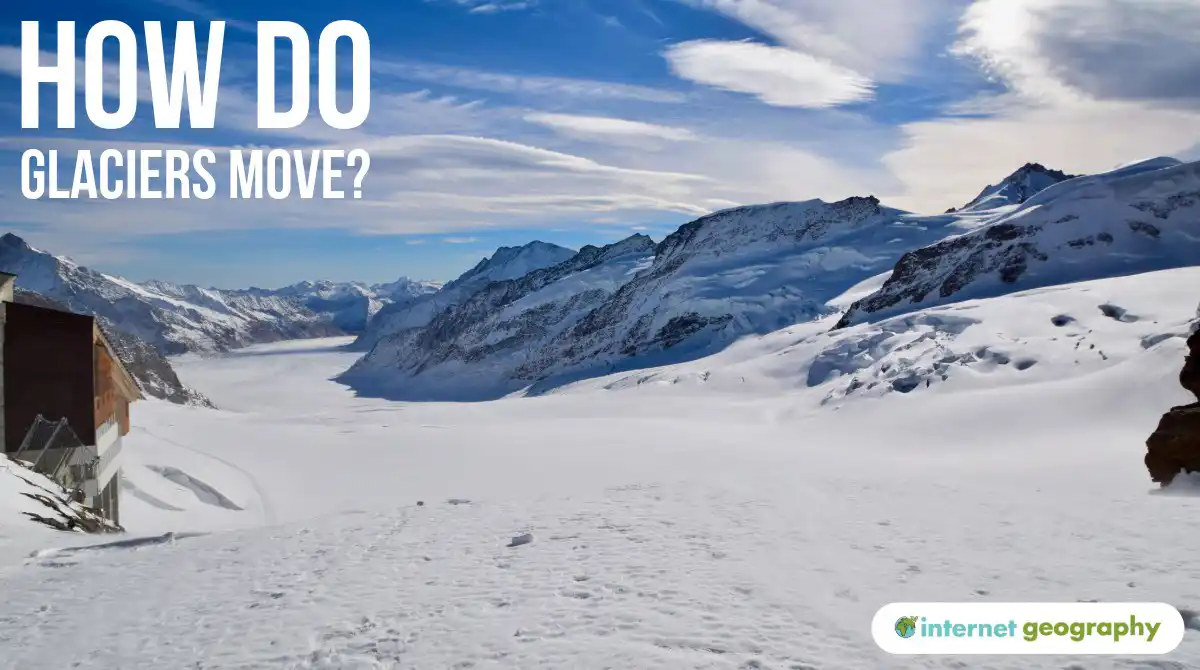
How do glaciers move?
Glaciers may look static, but they move constantly. They flow downhill under gravity, from where ice has accumulated in upland areas to lowland areas.
The speed at which a glacier flows varies. Some glaciers move only a few centimetres each year, whereas others can move much faster. The movement of ice is not the same throughout a glacier either. Due to friction, the sides and the base typically move more slowly than the centre and the surface.
Why do glaciers move?
A glacier forms when snow builds up over many years and compresses into ice. As more snow accumulates, the ice becomes thicker and heavier until the weight of ice and gravity causes the glacier to flow downhill. There are two main ways a glacier moves:
- internal deformation
- basal sliding
Both processes often happen at the same time.
What is internal deformation?
Although glacier ice is solid, under great pressure it can slowly change shape and flow, a process called internal deformation. The enormous weight of the ice presses down on the layers below, forcing ice crystals to change shape and move past one another, which allows the glacier to gradually flow downhill. Internal deformation is particularly important within thick glaciers, where the pressure is greatest.
What is basal sliding?
Basal sliding is when a glacier moves by sliding over the rock beneath it. Pressure from the weight of ice can generate heat, leading to the production of meltwater under the glacier. This water acts as a lubricant, reducing friction between the glacier and bedrock. The glacier can then slide more easily over the bedrock. Where there is more meltwater, basal sliding is more effective.
Does all of the glacier move at the same speed?
Different parts of a glacier move at different speeds. The sides and the base typically move more slowly than the surface and centre due to friction with the valley floor and sides. The difference in speed puts the ice under stress, resulting in the formation of crevasses on the glacier’s surface.
What is rotational movement?
In some places, ice moves in a curved or rotational direction rather than flowing straight downhill. This type of movement is particularly important in corries, where ice moves in a circular motion within a hollow. Rotational movement helps deepen the hollow through plucking and abrasion, contributing to the development of the characteristic bowl shape of a corrie.
What affects the speed of a glacier?
Glaciers do not always move at the same speed. Several factors can affect how quickly they move:
- Gradient – glaciers generally move faster down steeper slopes because gravity has a greater influence.
- Ice thickness – thicker ice creates greater pressure, which can increase internal deformation.
- Meltwater – water beneath a glacier can reduce friction and increase basal sliding.
- Friction – contact with the valley floor and sides slows the movement of the ice.
Changes in temperature and snowfall can therefore affect both the size of a glacier and the way it moves.


