
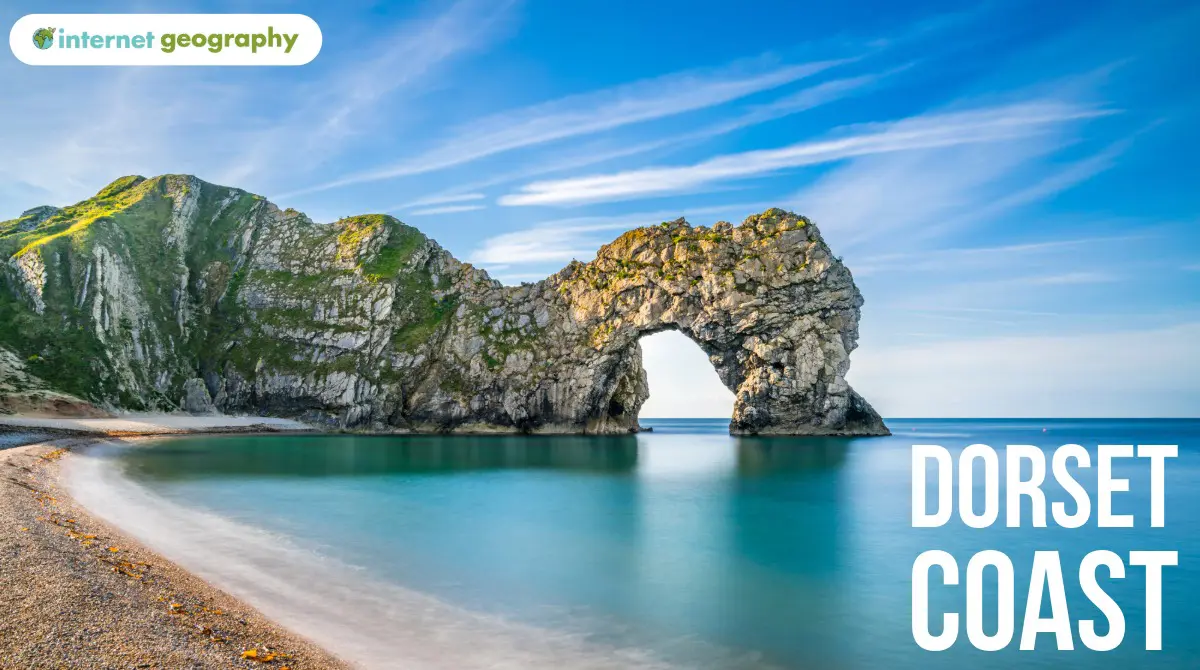
Dorset Coast
The Dorset coast is famous for its beauty. It forms part of the Jurassic Coast, extending from Exmouth in East Devon to Old Harry Rocks in Purbeck. UNESCO awarded the Jurassic Coast World Heritage Site status for being a place of ‘outstanding universal value’. Through its geology, cliffs, arches, stacks, and stumps, the coast represents 185 million years of the Earth’s history.
The Dorset Coast, located in the south of England on the English Channel, runs from Lyme Regis in the west, past Old Harry Rocks in Purbeck to Highcliffe in the east. Excluding the shoreline of Poole Harbour, the Dorset coastline is 142 kilometres (88 mi) long.
Along the east coast of the Isle of Purbeck, the alternating layers of hard (more resistant) and soft (less resistant) rock run at right angles to the sea, creating a bay and headland formation. This is typical of a discordant coastline.
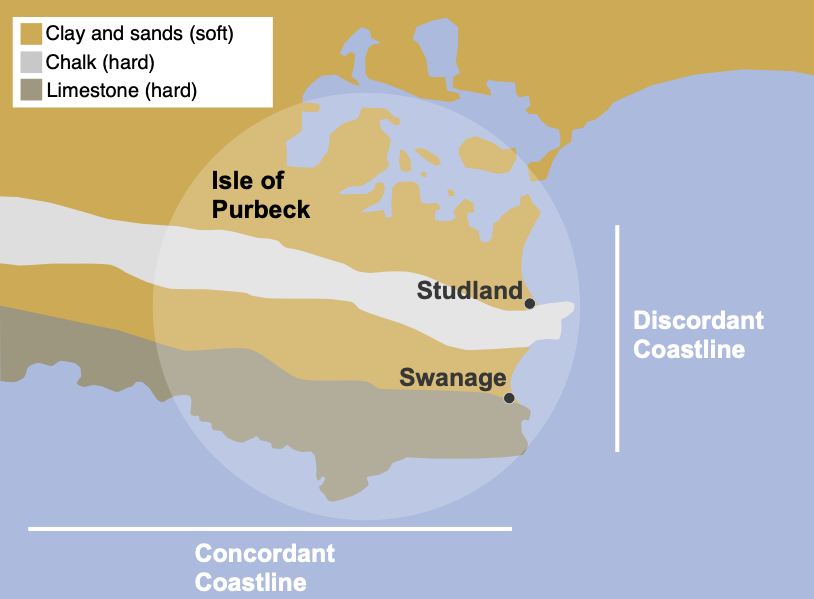
The Dorset Coast
In contrast, limestone runs parallel along the southern coastline, forming a concordant coastline. The southern coast is relatively smooth in shape, whereas the rock is uniform. However, at Lulworth, a cove has formed where waves have broken through a weakness in the cliffs.
The diagram below explores a range of coastal erosion and deposition landforms along the Dorset Coast.
The interactive map below shows some of the coastal landforms affected by erosion and deposition on the Dorset Coast. Click the icon at the top right corner to view it in full screen.
Explore locations along the Dorset Coast in more detail:


