What is a settlement hierarchy?

We can categorise settlements according to their size and shape. The result is a settlement hierarchy. A settlement hierarchy is found by putting settlements in a region or country into a rank order either by population or type and range of services.
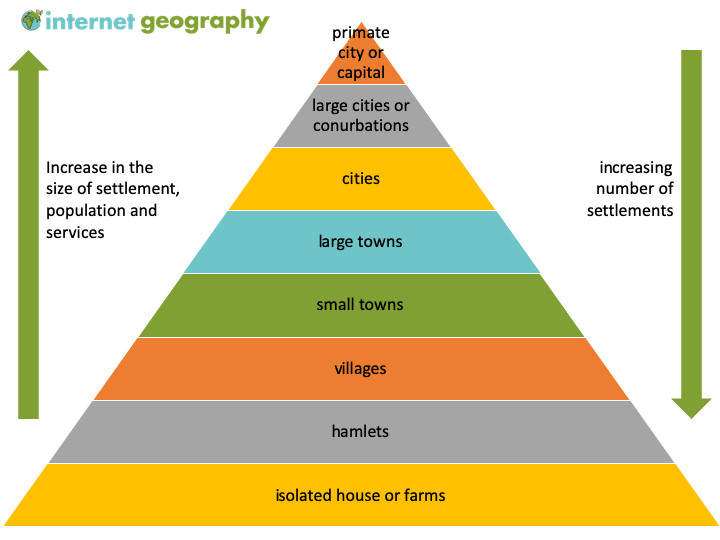
A settlement hierachy
As you move up the settlement hierarchy the size of the settlement increases, as does the population and the range of services available. Smaller settlements tend to provide only low order services such as a post office and newsagents. Whereas, larger settlements have more high order services such as leisure centres and chain stores. As a result of this the larger the settlement, the greater the range of services and therefore the market area or sphere of influence. This is the market area that a settlement services (the distance people will travel to use services).
High order services usually have a high threshold. This means they need a higher number of people to use the service in order to remain profitable. This means high order service such as department stores need a greater number of customers than a low order service such as a newsagent. This is why there are so few department stores in villages!
The size of a sphere of influence will depend on factors such as:
Services and goods have a threshold population to support them. Examples of threshold populations include:




Use the images below to explore related GeoTopics.


