Changing rates of rainforest deforestation

How are rates of rainforest deforestation changing?



Changing rates of rainforest deforestation

Where are the world’s largest primary tropical rainforests located?

Before we examine the changing rates of rainforest deforestation, it would be helpful to recap the distribution of tropical rainforests. The graph below shows the world’s largest primary tropical rainforests in 2020.

Tropical rainforest is found within the borders of 62 countries. The graph below shows the top 25 countries.

Rates of tropical rainforest deforestation

It is estimated by the UN Food and Agriculture Organization that about half the world’s tropical rainforest has been cleared.

The graph below shows the annual deforestation of primary rainforest by area between 2002 and 2022.

The moving average indicates an increase in the rates of tropical rainforest deforestation globally.

Today, the global rate of rainforest clearance is estimated to be:

  • 1 hectare a second
  • 60 hectares per minutes
  • 86,000 hectares per day (an area larger than New York City)
  • 31 million hectares per year (an area larger than Poland)

The map below shows the % of land covered in forest between 1990 and 2015 for countries worldwide. By hovering over a country, you can see the proportion of land covered by forest. Clicking a country will display a graph showing changes in forest cover between 1990 and 2015. Exploring the countries located along the equator, it is clear that in most cases, forest cover is reducing due to deforestation. This includes countries with large rainforest areas, such as Brazil, the Democratic Republic of Congo, Peru and Indonesia. There are some exceptions; for example, forest cover in Gabon has increased.

Rates of deforestation vary between countries. The graph below shows the total forest loss by rainforest cover in the top 24 countries between 2001 and 2018.
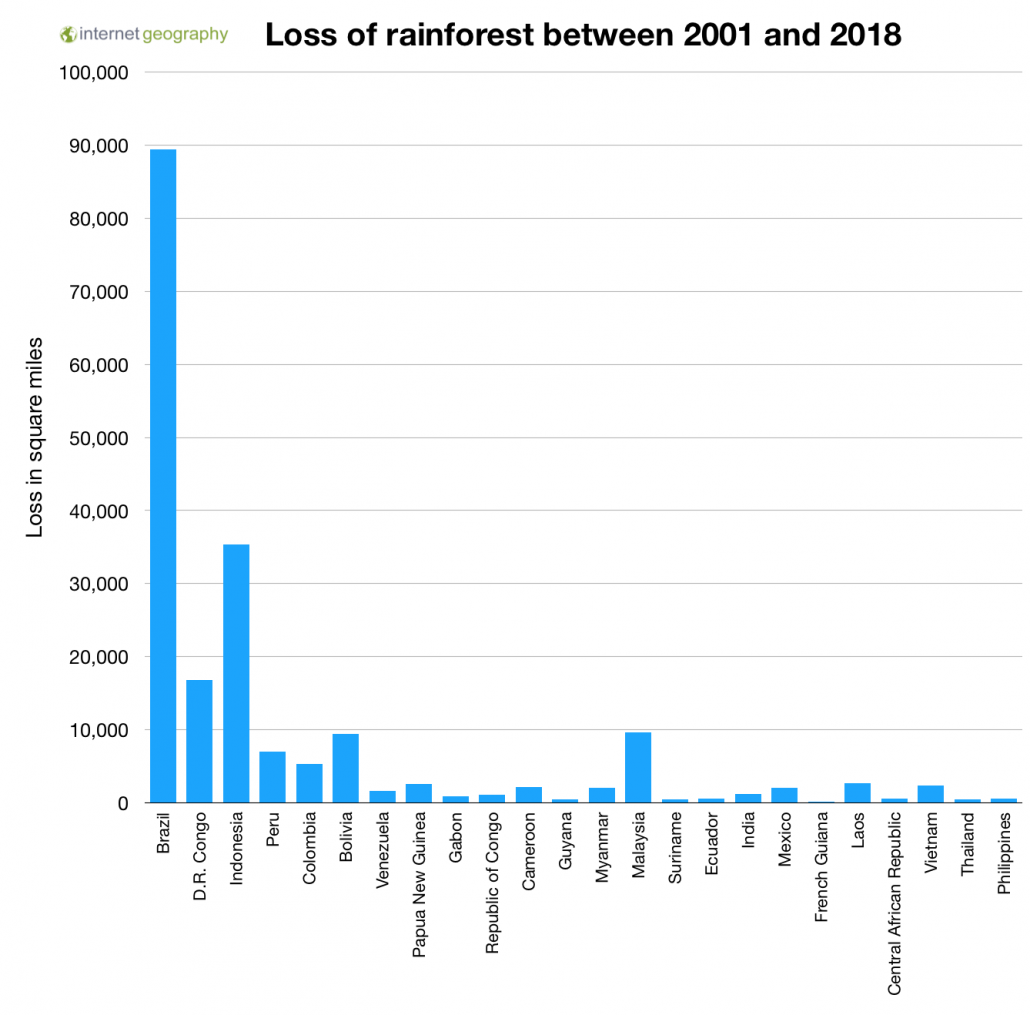
Loss of rainforest between 2001 and 2018

Loss of rainforest between 2001 and 2018

In focus: Changing rates of tropical rainforest deforestation in the Amazon Rainforest

The graph below shows deforestation rates in the Amazon rainforest between 2001 and 2024.

The graph shows a high level of deforestation in the early 2000s, peaking in 2003 when deforestation was the highest ever recorded rate. After this peak, there was a marked decrease in deforestation, which reached its lowest level around 2009. Following this low, the annual rates fluctuate, with some years showing slight increases and others showing decreases. There is a noticeable increase in 2016, followed by a trend of variable rates for the next few years. 2020 shows an uptick in deforestation compared to the previous year. The overall trend shows a general decrease from the early 2000s peak, although there are several years when the rates have risen.

The graph below shows rates of Amazon deforestation by country between 2001 and 2020.

The highest rate of Amazon rainforest deforestation occurs in Brazil. The graph below shows changing deforestation rates in Brazil between 1988 and 2024.

Since 1970, over 20% of the Amazon rainforest has been deforested, covering an area of 761,000 square kilometres (about three times the size of the United Kingdom).
In 2009, Brazil experienced a historic low in deforestation rates, with estimates suggesting that approximately half of the remaining rainforest was under some form of protection. This was due to greater government protection. However, 2016 saw a significant increase in deforestation. By 2018, Brazil’s newly elected government had shifted policies to promote increased forest clearing by farmers, miners, and loggers. This resulted in the increased rate of deforestation shown on the graph.
The government was replaced in 2023. Brazil’s new government unveiled plans to meet a pledge to eliminate deforestation in the Amazon by 2030, using strengthened law enforcement against environmental crimes and other measures in the world’s largest tropical rainforest. The rate of deforestation has already started to decrease.

Summary

  • Global Perspective

    About half of the world’s tropical rainforests have been cleared, with the largest primary tropical rainforests located within the borders of 62 countries, including significant areas in Brazil, the Democratic Republic of Congo, Peru, and Indonesia. The global rate of rainforest clearance is alarmingly high, estimated at 31 million hectares per year—an area larger than Poland.

  • Deforestation Rates Increase

    Between 2002 and 2022, there has been an increase in the rates of tropical rainforest deforestation globally, with the annual deforestation of primary rainforest showing a moving average that indicates rising deforestation rates.

  • Country-Specific Trends

    Rates of deforestation vary significantly between countries. While some countries like Gabon have seen an increase in forest cover, major rainforest countries such as Brazil, the Democratic Republic of Congo, Peru, and Indonesia have experienced reduced forest cover due to deforestation.

  • Amazon Rainforest Focus

    In the Amazon, deforestation rates peaked in 2003 but significantly decreased to a historic low in 2009. Since then, rates have fluctuated, with an overall trend of variable rates and a noticeable increase in deforestation in 2016. Over 20% of the Amazon rainforest has been deforested since 1970.

  • Brazil’s Deforestation Dynamics

    Brazil has the highest rate of Amazon rainforest deforestation, with over 761,000 square kilometres (three times the size of the UK) cleared since 1970. Deforestation rates dropped to a historic low in 2009 but increased significantly in 2016 due to policy shifts by the newly elected government promoting forest clearing.

  • Recent Developments

    In 2023, Brazil’s new government announced plans to eliminate Amazon deforestation by 2030 through strengthened law enforcement against environmental crimes, leading to a decrease in the rate of deforestation. This shift highlights the impact of governmental policies on deforestation rates.

Internet Geography Plus

Related Topics

Use the images below to explore related GeoTopics.

Pin It on Pinterest

Share This