
Venezuela Earthquake 2026
Blog > 2026 > Geography in the News > Venezuela Earthquake 2026
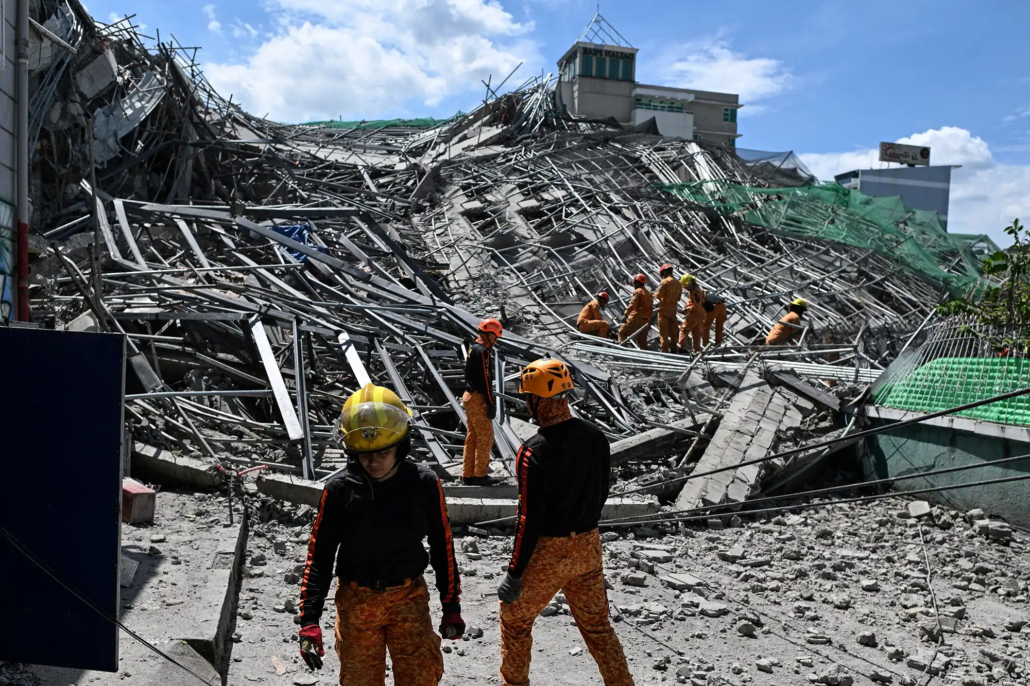
Emergency services work at the site of a collapsed building following the earthquakes in Caracas – Credit: mytaj1 / Shutterstock.com
Last updated: 04 July 2026
Powerful Earthquakes Strike Venezuela
Two powerful earthquakes struck northern Venezuela on Wednesday evening, causing buildings to collapse, damaging transport links and sending frightened residents into the streets.
The earthquakes hit on 24 June 2026, shortly after 6 pm local time. Early reports suggest the first earthquake had a magnitude of 7.2, followed less than a minute later by a stronger one with a magnitude of 7.5. The epicentres were reported near Morón, west of Caracas, along Venezuela’s Caribbean coast.
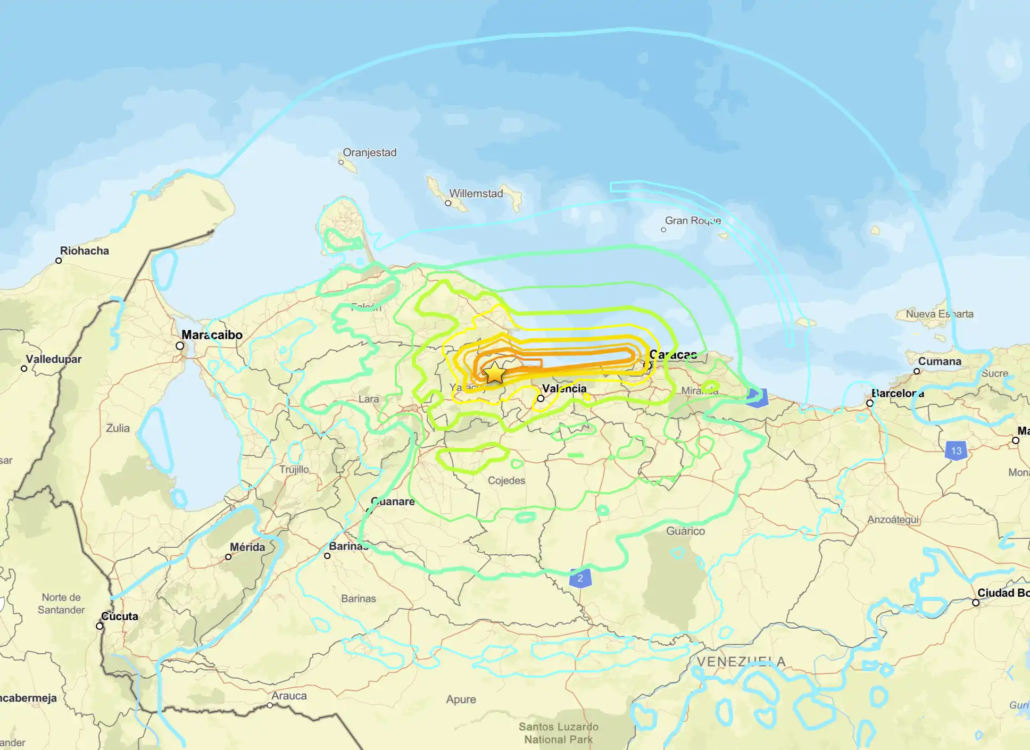
Map by the USGS showing the second earthquake event in the doublet – Click to view the interactive version – there is also an interactive map for the 7.2 foreshock.
The full scale of the disaster is still emerging. Rescue teams are searching through damaged buildings and rubble, while hospitals are treating hundreds of injured people. Officials have warned that the number of casualties may rise as emergency workers reach the worst-affected areas.
What caused the earthquakes?
The earthquakes occurred because Venezuela lies near an active plate boundary between the Caribbean Plate and the South American Plate. This boundary runs along northern Venezuela and into the southern Caribbean, making the region vulnerable to powerful earthquakes.
This is mainly a conservative or transform plate margin. At this type of margin, plates move sideways past each other rather than one plate simply moving beneath another. However, the plate boundary in northern Venezuela is complex, so there can also be some compression where the plates push into each other at an angle.
The Caribbean Plate is moving eastwards relative to the South American Plate. As the plates try to move past each other, sections of rock along faults can become locked by friction. Pressure builds up over time because the plates continue to move, but the fault does not move smoothly.
Eventually, the stress becomes too great. The locked section of the fault suddenly slips, releasing stored energy as seismic waves. These seismic waves spread out through the Earth and cause the ground to shake.
The earthquakes were particularly damaging because they were shallow-focus earthquakes. This means the point where the fault slipped was relatively close to the surface. Shallow earthquakes often produce stronger shaking at ground level, especially near the epicentre.
The first earthquake may have weakened buildings, roads and other structures. The second, stronger earthquake followed very soon afterwards, causing further shaking before damaged buildings could be made safe. This made the event especially dangerous for people living in affected areas.
Effects so far
The most serious impacts have been reported in and around Caracas and in coastal areas near the epicentres. Buildings have collapsed or been severely damaged, leaving people trapped and forcing many residents to remain outside for fear of aftershocks.
At least 2,595 people have been reported dead so far, with around 12,400 people injured. These figures are expected to change as rescue work continues, and more information becomes available from damaged communities.
The earthquakes have damaged important infrastructure. Simón Bolívar International Airport, which serves Caracas, was closed because of damage. Public transport, including metro services, was also disrupted. Power cuts, communication problems and damage to roads and buildings also occurred.
Hospitals are under pressure as large numbers of injured people arrive for treatment. Medical staff have been called in to support emergency care. Some people are being treated outside damaged or overcrowded buildings. One estimate, based on satellite data, suggests more than 58,000 buildings have been damaged or destroyed.
The psychological impact is also significant. Many residents spent the night outdoors, afraid that aftershocks could bring down weakened buildings. Aftershocks remain a major hazard because they can trigger further collapses, especially where structures have already been cracked or destabilised.
Emergency response
Venezuela’s government has declared a state of emergency. Emergency services, police, firefighters, medical teams and civil protection authorities have been deployed to affected areas.
The immediate priorities are search and rescue, treating the injured, assessing damaged buildings and keeping people away from unsafe structures. Rescue teams are working to find survivors trapped in rubble, while officials have urged residents to stay outside buildings that may have been weakened by the shaking.
Schools have been closed, and transport services have been suspended in some areas while engineers and emergency teams assess the damage. The closure of the main airport could make it harder to move people, equipment and supplies quickly, although alternative routes may be used for aid and rescue support.
Temporary shelter, clean water, food, medical supplies and safe sanitation are likely to become urgent needs, especially for people whose homes have been destroyed or are too dangerous to return to.
International response and aid
Offers of international help have begun to arrive. Several governments have expressed sympathy and offered support, including emergency aid, medical supplies, logistics and search-and-rescue assistance.
The United States has said it is ready to support relief efforts. Other countries in Latin America and beyond have also offered assistance as the scale of the disaster becomes clearer.
Aid agencies are beginning to mobilise. The Red Cross has said it is responding as needs emerge, while medical and humanitarian organisations are preparing to provide support to affected communities. Direct Relief has reported that it is mobilising medical aid, including emergency medicines and supplies, which are often needed after earthquakes. Global Empowerment Mission has also announced an immediate response to assess needs and support affected families.
The response is likely to develop over the coming days. Once search-and-rescue work moves into recovery, attention will shift towards shelter, healthcare, rebuilding damaged infrastructure and supporting people who have lost homes or relatives.
What happens next?
The situation remains fast-moving. The number of deaths and injuries may increase as rescuers reach collapsed buildings and remote areas. Aftershocks could cause further damage, especially to buildings already weakened by the first two earthquakes.
The coming days will be critical. Emergency teams will focus on finding survivors, treating the injured and making damaged areas safe. Aid agencies and international partners are expected to support Venezuela with medical help, temporary shelter, food, water and specialist rescue equipment.
This is already one of the most serious earthquake events to affect Venezuela in recent history. The final impact will depend on how quickly rescue teams can reach survivors, how well hospitals cope with casualties and whether damaged infrastructure can be stabilised before further aftershocks occur.
Online Resources
Official earthquake data – main earthquake
USGS event page: M 7.5, 16 km SW of Morón, Venezuela
Best for the key earthquake facts: magnitude, location, depth, time, coordinates and review status. USGS lists the event as M 7.5, 10.401°N, 68.321°W, at 10 km depth, on 24 June 2026 at 22:05 UTC. Find out more.
USGS PAGER page
Useful for estimating likely impacts, exposure and vulnerability. This helps explain why the earthquake could be highly destructive, especially where buildings are vulnerable to shaking. Find out more.
USGS ShakeMap page
Useful for mapping the likely intensity of shaking and showing where the strongest shaking occurred. Find out more.
USGS ShakeMap metadata
Best for precise mapping details, including the USGS GPS location, depth and event ID. Find out more.
USGS region information page
Useful for nearby settlements and population context around the epicentre, including Morón and Montalbán. Find out more.
USGS significant earthquakes 2026 list
Useful for checking whether the event appears among the year’s globally significant earthquakes. Find out more.
Official earthquake data – 7.2 foreshock
USGS event page: M 7.1, 21 km W of Morón, Venezuela
Best for the key earthquake facts about the earlier foreshock: magnitude, location, depth, time, coordinates and review status. USGS lists the event as M 7.1, 10.500°N, 68.400°W, at 10 km depth, on 24 June 2026 at 22:04:31 UTC. Find out more.
News and rolling updates
Reuters: Two major earthquakes strike Venezuela
A reliable news source for early confirmed information on casualties, damage, rescue efforts, disruption and government response. Find out more.
Reuters: US mobilising assistance
Useful for international response, especially the US offer of support. Find out more.
BBC News live updates
Follow BBC News live updates for the latest information on the earthquakes in Venezuela, including impacts, rescue efforts and official responses. Find out more.
The Guardian live updates
Useful for rolling updates, changing casualty figures, international aid offers and emergency response developments. Find out more.
Al Jazeera report
Useful for a concise news summary and international perspective on impacts and warnings about possible casualty levels. Find out more.
El País report
Useful Spanish-language coverage with regional detail, including affected areas and the description of the event as a “doblete sísmico”, or seismic doublet. Find out more.