
GCSE Geography Case Study: Sustainable Food Supplies in a LIC – Makueni, Kenya
Sustainable Food Supplies in a LIC: Makueni, Kenya
Makueni County in eastern Kenya is an example of a sustainable strategy to increase food supply in a low-income country. The Makueni Food and Water Security Programme shows how small-scale, community-led projects can improve access to water, increase crop yields and reduce food insecurity.
GCSE Geography case study summary
Location: Makueni County, eastern Kenya
Country classification: Low-income country
Main issue: Food insecurity caused by low and unreliable rainfall
Strategy: Makueni Food and Water Security Programme
Main organisations involved: Just a Drop and the African Sand Dam Foundation
Main methods: Sand dams, rainwater harvesting, farmer training and tree planting
Specification link: A sustainable strategy to increase food supply in a LIC or NEE
Where is Makueni?
Makueni County is located in eastern Kenya, around 200 kilometres south-east of Nairobi. It is mainly rural, with many people living in small, scattered villages. The county has a population of around 885,000 people.
Makueni is a semi-arid area. This means rainfall is low and unreliable. The area receives about 500 mm of rainfall each year, but this rainfall is not evenly spread throughout the year. Long dry periods make farming difficult and can lead to crop failure.
What food is grown in Makueni?
Many people in Makueni depend on small-scale farming. Crops grown in the area include:
- maize
- beans
- millet
- sorghum
- cassava
- sweet potatoes
The area has dark, nutrient-rich volcanic soils, which can support crop growth. However, the main problem is the lack of reliable water. When rainfall is low, crops do not grow well. This reduces food supply and can increase the risk of hunger and malnutrition.
Why is food insecurity a problem in Makueni?
Food insecurity means people do not have reliable access to enough safe, nutritious and affordable food.
Makueni experiences food insecurity for several reasons:
- The rainfall is low and unreliable, so crops often fail.
- Many people depend on small-scale farming, so poor harvests directly affect families.
- Water sources can dry up during long dry periods.
- Collecting water can take a long time, especially for women and children.
- Limited access to clean water can increase the risk of water-borne disease.
- Livestock also need water, so drought can reduce milk, meat and income from animals.
- These problems mean that improving water supply is essential for improving food security.
The Makueni Food and Water Security Programme
The Makueni Food and Water Security Programme began in 2014. It involved the charity Just a Drop working with the African Sand Dam Foundation to support two villages, Musunguu and Muuo Wa Methovini, which had a combined population of around 800 people. The project also supported Kanyenyoni Primary School, which had around 463 pupils.
The aim was to improve food and water security by providing a more reliable water supply and helping local people use water more sustainably.
The programme included:
- building sand dams in the villages
- installing a rainwater harvesting tank at the school
- improving water supply for crop irrigation
- improving water supply for livestock
- training farmers in sustainable farming methods
- planting trees to reduce soil erosion, improve biodiversity and provide useful products
What are sand dams?
Sand dams are small concrete walls built across seasonal river channels. During the rainy season, water flows down the river channel and carries sand and sediment with it. Over time, sand builds up behind the dam. Water is stored in the spaces between the grains of sand.
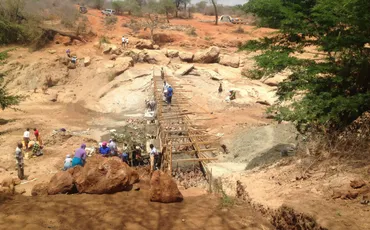
A sand dam in Keyna – source https://watertogo.eu/partnerships/justadrop/
This creates an underground water store. The sand helps protect the water from evaporation and filters it as it moves through the sediment.
Local people can then access the stored water by digging shallow wells or using pumps. The water can be used for drinking, cooking, washing, livestock and crop irrigation.
Why are sand dams an appropriate technology?
Sand dams are an example of appropriate technology. Appropriate technology means using methods that suit the needs, skills and resources of local people.
Sand dams are appropriate for Makueni because:
- they are relatively cheap to build compared with large-scale water schemes
- they use simple materials and do not require complex machinery
- local people can be involved in construction and maintenance
- they store water close to the community
- they reduce water loss by storing water underground
- they can provide water during dry periods
- they support farming without relying on expensive irrigation systems
This makes them more sustainable than large, expensive schemes that may require specialist skills, imported parts or high running costs.
Rainwater harvesting at Kanyenyoni Primary School
A rainwater harvesting tank was installed at Kanyenyoni Primary School. Rainwater is collected from the roof of the school building and stored in a tank.
This gives pupils and staff access to a cleaner and safer water supply. It also reduces the time children spend collecting water from distant sources. This can improve attendance and allow pupils to spend more time learning.
Rainwater harvesting is another example of appropriate technology because it is simple, relatively low-cost and easy to maintain.
Farmer training
The project also included training for local farmers. This helped farmers make better use of limited water supplies and improve crop production.
Training can help farmers to:
- choose crops better suited to dry conditions
- use water more efficiently
- protect soil from erosion
- improve soil fertility
- manage crops and livestock more sustainably
This is important because providing water alone is not enough. Farmers also need the knowledge and skills to use that water effectively.
Tree planting and environmental benefits
Tree planting was another important part of the programme. Trees help to protect the environment and support food security.
Trees reduce soil erosion because their roots bind the soil together. This is important in dry areas where heavy rainfall after long dry periods can wash loose soil away.
Trees also provide shade, which can reduce evaporation from the soil. Leaf litter from trees adds organic matter to the soil, improving soil fertility over time.
Some trees can provide fruit, animal fodder or medicinal products. This gives local people extra resources and can help to improve diets and incomes.
Tree planting also increases biodiversity by creating habitats for plants, insects, birds and other animals.
How has the project improved food security?
The Makueni Food and Water Security Programme has helped to improve food security in several ways.
A more reliable water supply means farmers can grow more crops and reduce the risk of crop failure. This increases the amount of food available to local families.
Water from sand dams can be used for livestock, helping families maintain animals during dry periods. Livestock provide food, income and manure for farming.
Improved access to clean water can reduce water-borne diseases. Healthier people are better able to work, farm and attend school.
Less time spent collecting water means women and children have more time for education, paid work and farming.
Tree planting reduces soil erosion and helps maintain soil fertility, making farming more productive in the long term.
Why is the Makueni project sustainable?
The Makueni Food and Water Security Programme is sustainable because it aims to meet people’s needs now without damaging the ability of future generations to meet their needs.
Small scale
The project works at the village and school level. This makes it easier to manage and more closely match the needs of the local community. It does not require a large, expensive regional water transfer scheme.
Community involvement
Local people are involved in the project. This is important because people are more likely to use and maintain a scheme when they understand how it works and have helped to develop it.
Appropriate technology
Sand dams and rainwater harvesting tanks use simple technology. They are cheaper to operate and easier to maintain than large-scale engineering schemes.
Environmental protection
Tree planting reduces soil erosion, improves soil quality and increases biodiversity. This helps protect the natural environment while also supporting farming.
Long-term benefits
The scheme does not just provide emergency food aid. It helps people produce more food for themselves by improving access to water, knowledge and farming conditions.
Reduced dependence
By improving local water and food production, the project can reduce reliance on outside support during dry periods.
Limitations of the project
Although the project has many benefits, it also has some limitations.
Sand dams only work well in places with suitable geology and seasonal river channels. They must be carefully planned and built in the right location.
The project supports individual communities, but it does not solve food insecurity across all of Kenya.
Rainfall is still unreliable, so long droughts can continue to put pressure on water supplies.
The scheme needs local management. If maintenance is not carried out, the benefits may decline over time.
Community agreement is important. If people disagree about where dams are built or how water is shared, it can undermine the project’s success.
Overall evaluation
The Makueni Food and Water Security Programme is a good example of a sustainable strategy to increase food supply in an LIC. It tackles one of the main causes of food insecurity in the area: unreliable access to water.
The project is sustainable because it is small-scale, low-cost, community-based and uses appropriate technology. It improves food supply by making water more reliable for crops and livestock. It also improves health, education and the local environment.
However, the project is not a complete solution to food insecurity. It only works in suitable locations and needs careful planning and local maintenance. Even so, it shows how sustainable water management can improve food security in rural communities.
GCSE exam focus
This case study could be used in an exam question about a sustainable strategy to increase food supply in an LIC or NEE.
A strong answer should include:
- the location of Makueni in eastern Kenya
- the problem of low and unreliable rainfall
- the role of the Makueni Food and Water Security Programme
- how sand dams work
- how the project improves water supply
- how better water supply increase food production
- why the project is sustainable
- some limitations of the strategy
Example exam question
Assess the effectiveness of a sustainable strategy used to increase food supply in a LIC or NEE.
The Makueni Food and Water Security Programme in eastern Kenya is a sustainable strategy used to increase food supply. Makueni is a semi-arid rural area with low, unreliable rainfall of around 500 mm per year. This makes farming difficult and can lead to crop failure.
The programme involved Just a Drop and the African Sand Dam Foundation working with local communities. Sand dams were built in the villages of Musunguu and Muuo Wa Methovini. These store water underground in sand, reducing evaporation and providing a more reliable water supply during dry periods. This water can be used for crops and livestock, helping to improve food security.
The project also included a rainwater-harvesting tank at Kanyenyoni Primary School, farmer training, and tree planting. Farmer training helped local people use water more effectively and improve farming methods. Tree planting reduced soil erosion, improved soil quality and increased biodiversity.
The strategy is sustainable because it is small-scale, low-cost and based on appropriate technology. Local people can help manage and maintain the scheme, which makes it more likely to continue in the future. It has improved crop yields, reduced time spent collecting water and provided safer water supplies.
However, the scheme has limitations. Sand dams only work in areas with suitable seasonal rivers and geology. The project also supports individual communities rather than the whole country. Overall, the strategy is effective because it improves water and food security in a way that is affordable, community-led and environmentally sustainable.
Key terms
Food security
Reliable access to enough safe, nutritious and affordable food.
Sustainable food supply
A food supply that meets people’s needs now without damaging the ability of future generations to meet their needs.
Appropriate technology
Technology suited to local needs, skills, and resources.
Sand dam
A small dam built across a seasonal river channel that stores water in sand behind the dam.
Rainwater harvesting
Collecting and storing rainwater for later use.
Semi-arid
A dry area that receives low rainfall but is not a full desert.
Soil erosion
The removal of soil by wind, water or human activity.
NGO
A non-governmental organisation, usually a charity or independent organisation that supports development projects.