
What is freeze-thaw weathering?
Freeze-thaw weathering is a process that breaks down rock in cold environments. It is common in glaciated upland areas, where temperatures regularly rise above and fall below 0°C.
Unlike erosion, weathering does not involve the movement of broken material. Instead, the rock is broken down in situ (in the place where it happens).
How does freeze-thaw weathering work?
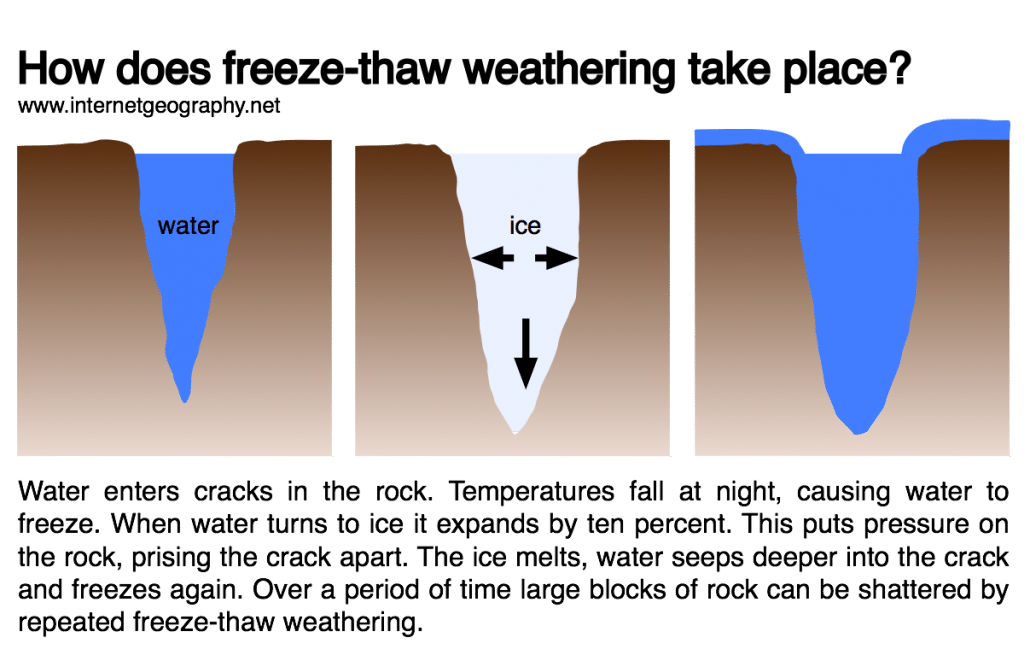
Freeze-thaw weathering occurs when water repeatedly freezes and thaws within cracks, known as joints, in the rock.
The process takes place in several stages:
1. Water enters cracks
Rainwater or meltwater enters joints and cracks in exposed rock.
2. The temperature falls below 0°C
The water freezes and expands by around 9%.
3. The crack widens
As the ice expands, it puts pressure on the surrounding rock, widening the crack.
4. The temperature rises
When the ice melts, it allows water to enter the enlarged crack.
5. Freezing and thawing are repeated
Repeated cycles of freezing and thawing gradually weaken the rock.
6. Pieces of rock break away
Eventually, fragments of rock break away from the rock face.
Freeze-thaw weathering
Where is freeze-thaw weathering most effective?
Freeze-thaw weathering is most effective in environments where temperatures frequently fluctuate above and below 0°C. If temperatures remain permanently below freezing, there is little thawing. If they remain above freezing, water cannot freeze. There must also be a supply of water and cracks or joints for the water to enter. This makes freeze-thaw weathering particularly important in upland and mountainous environments, including areas that have been shaped by glaciers.
What happens to the broken rock?
Freeze-thaw weathering can produce large quantities of loose, angular rock. On steep slopes, this material may fall under gravity and accumulate at the bottom of a slope. These accumulations of broken rock are known as scree. Freeze-thaw weathering therefore continues to shape glaciated landscapes even after the glaciers themselves have disappeared.
What is the difference between weathering and erosion?
Weathering and erosion are closely related, but they are not the same process. Weathering is the breakdown of rock in situ (place). The material does not have to be transported for weathering to occur.
Erosion involves the wearing away and removal of rock by a moving agent, such as a glacier.
In glacial environments, the main processes of erosion are plucking and abrasion.
A useful way to remember the difference is:
- Weathering = breaking down
- Erosion = wearing away and removing
How are freeze-thaw weathering and glacial erosion linked?
Weathering and erosion can work together to shape glacial landscapes.
Freeze-thaw weathering can weaken rock and loosen fragments, particularly where the rock contains many joints.
A glacier can then remove some of this weakened material through plucking. Once rock fragments have been incorporated into the glacier, they can scrape against the bedrock as the ice moves, causing abrasion.
The interaction between weathering and erosion helps glaciers create distinctive landforms such as corries, arêtes, pyramidal peaks and glacial troughs.


