
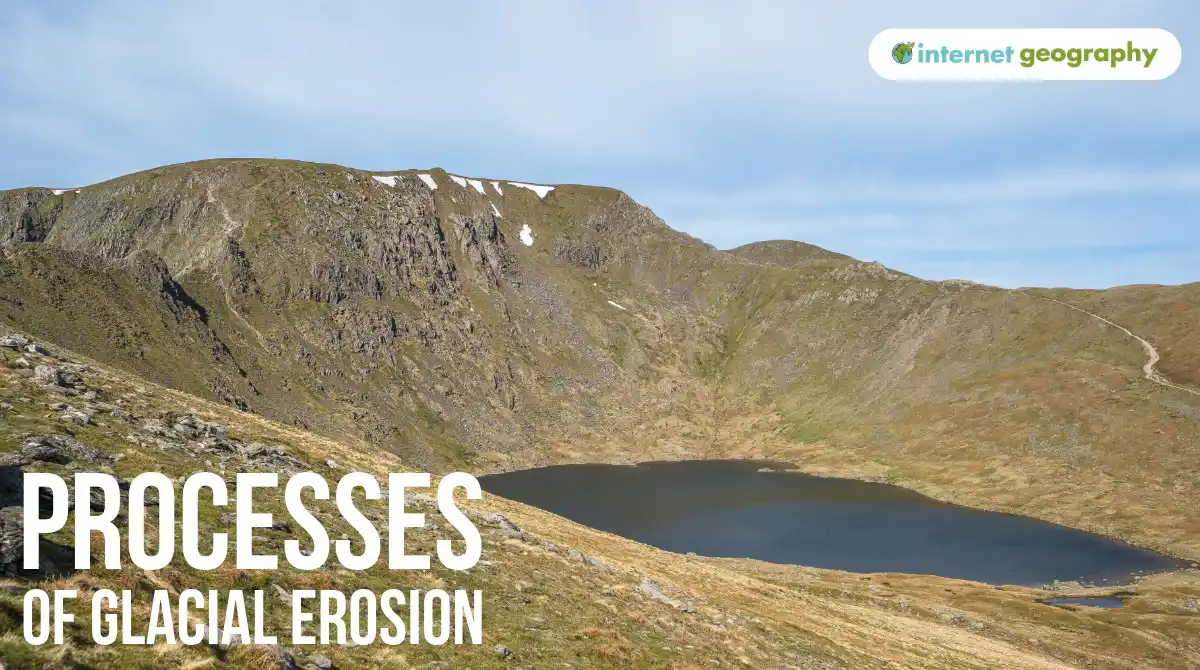
How do glaciers erode the landscape?
As a glacier moves downhill under the influence of gravity, it erodes the rock beneath and around it.
The two main processes of glacial erosion are:
- plucking
- abrasion
These processes remove rock and create glacial landforms.
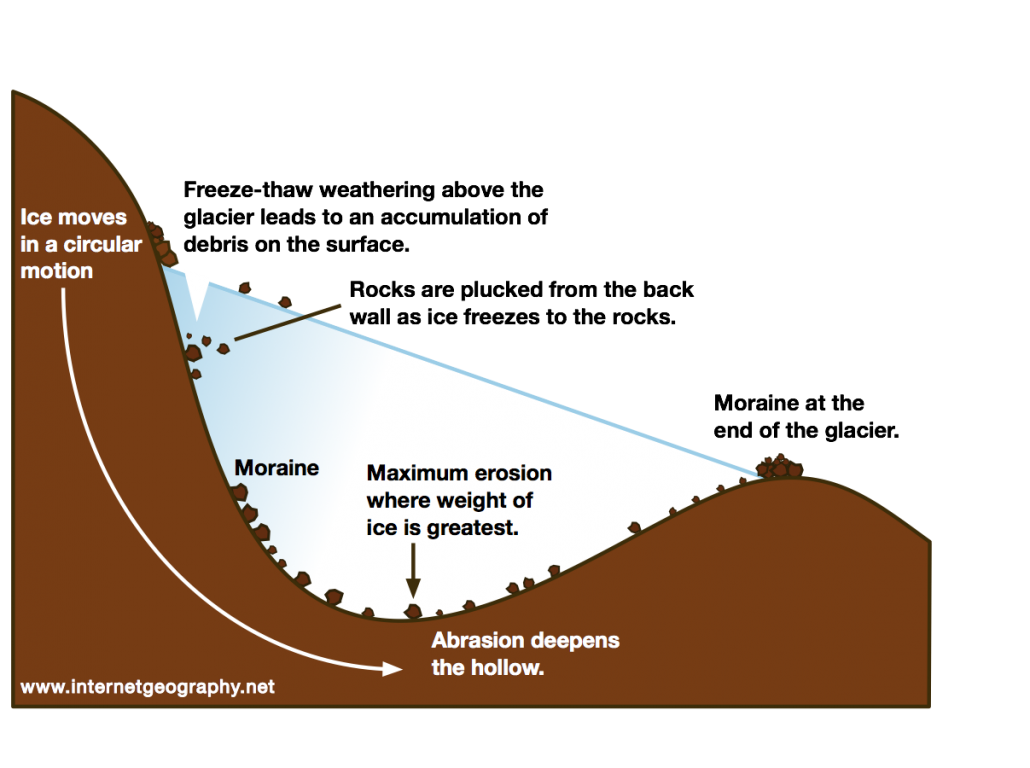
Processes of erosion and weathering in an upland glaciated environment
What is plucking?
Plucking involves a glacier freezing onto rock and pulling pieces of it away as the ice moves. Rock beneath and alongside a glacier often contains weaknesses such as joints, which are cracks in the rock. Water can enter these cracks and freeze. This helps loosen blocks of rock. Meltwater beneath the glacier can also freeze onto the rock. As the glacier moves, the frozen rock becomes attached to the ice and is plucked away from the bedrock. The glacier then transports the pieces of rock downhill.
Plucking is highly effective where the bedrock is well jointed, as blocks of rock can be removed more easily.
What is abrasion?
Abrasion occurs when pieces of rock and sediment carried at the base of a glacier scrape and grind against the bedrock as the glacier moves. The material carried by the glacier acts like sandpaper, wearing away the rock beneath it. Larger fragments can gouge grooves and scratches into the bedrock. These scratches are known as striations. Striations can provide evidence of the direction in which a glacier once moved.
How are plucking and abrasion linked?
Rock removed by plucking can freeze to the base and sides of the glacier. As the glacier moves, the rock can scrape the valley floor and sides, causing abrasion.
What affects the rate of glacial erosion?
The amount of erosion caused by a glacier varies. Erosion is generally greater when:
- The glacier moves faster – debris at its base is dragged across the bedrock more rapidly.
- The glacier contains more rock debris – more material is available to scrape and grind against the bedrock.
- The ice is thicker – greater pressure at the base can increase contact between the glacier, its debris and the bedrock.
- Where bedrock contains joints, blocks of rock can be removed more easily by plucking.
- Over thousands of years, these processes can greatly change the shape of the landscape.
Plucking or abrasion?
A useful way to remember the difference is:
Plucking = pulling rock away
Abrasion = scraping rock away
Both processes occur as glaciers move and are responsible for creating many of the erosional landforms found in glaciated upland areas of the UK.


