
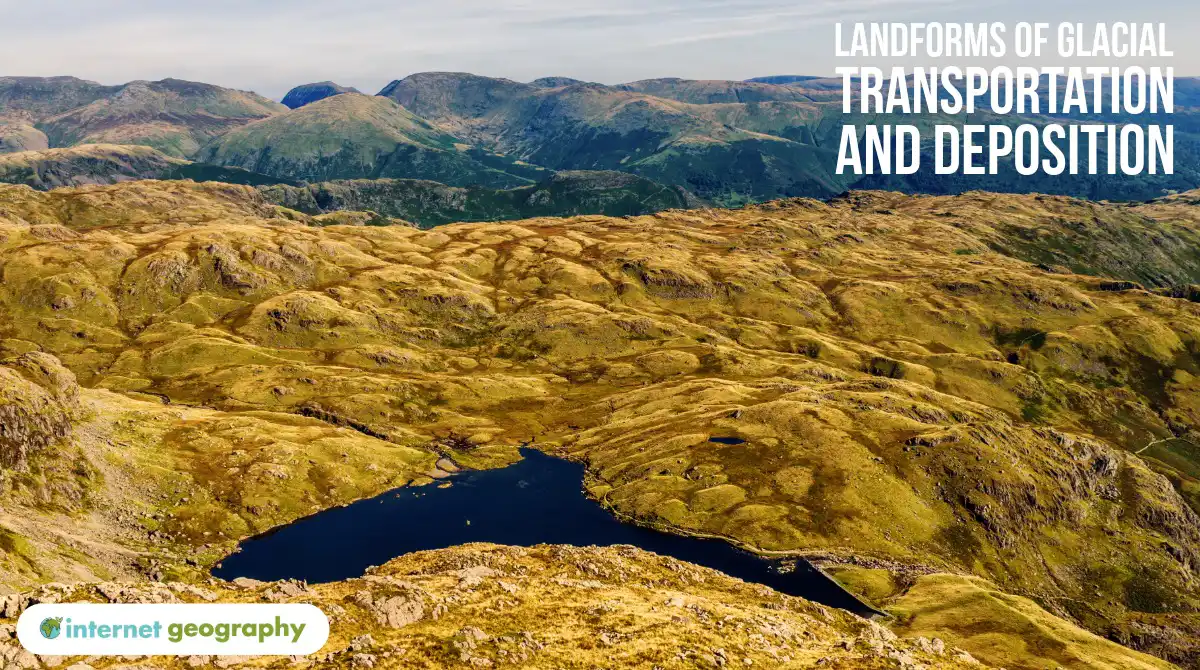
What landforms are created by glacial transportation and deposition?
Glaciers do more than erode the landscape. As they move, they carry large quantities of rock and sediment. When the ice melts, this material is deposited, creating a range of distinctive glacial landforms.
Material carried by a glacier can range from tiny particles of clay to huge boulders. Unlike a river, a glacier can transport material of many different sizes at the same time.
How do glaciers transport material?
Much of the material transported by a glacier comes from erosion. Plucking removes blocks of rock from the landscape, while abrasion produces smaller fragments. Freeze-thaw weathering can also cause pieces of rock to fall from valley sides onto the surface of a glacier.
Once this material has been picked up, it can be transported on top of the glacier, within the ice or at its base.
Large boulders can be carried considerable distances from where they were originally eroded. Material dragged along beneath the glacier may become smaller and more rounded as it is crushed and worn down.
How do glaciers deposit material?
A glacier deposits material when it loses the ability to carry it. This usually happens when the ice melts.
The material deposited directly by a glacier is known as till. It is a mixture of different-sized material, including clay, sand, gravel and large rocks.
Unlike sediment deposited by a river, till is generally unsorted. Large and small pieces of material can be deposited together because they are released from the melting ice rather than being sorted by flowing water.
Deposited glacial material can create landforms including erratics, drumlins and moraines.
Erratics
Erratics are pieces of rock that have been transported by a glacier and deposited in an area where the underlying geology is different.
They vary greatly in size. Some are small rocks, while others are enormous boulders weighing many tonnes.
A glacier may pick up a block of rock through plucking and transport it within, beneath or on top of the ice. When the glacier melts, the rock is deposited.
What makes an erratic distinctive is that its rock type does not match the local bedrock. Geologists can sometimes identify where an erratic originally came from by matching it with rock found elsewhere.
Erratics therefore provide useful evidence of the direction in which former glaciers moved.
The Norber Erratics in the Yorkshire Dales are a well-known UK example. Blocks of Silurian sandstone were transported by ice and deposited on younger Carboniferous limestone.
Shap granite erratics can be found around Shap in Cumbria. During the last ice age, glaciers transported these distinctive pink granite boulders away from the Shap area. Some were carried many kilometres before being deposited as the ice melted. Their location provides evidence of the direction in which the ice once moved.
Drumlins
Drumlins are smooth, elongated hills formed beneath moving ice. They are commonly made from glacial till and often occur in large groups known as drumlin swarms.
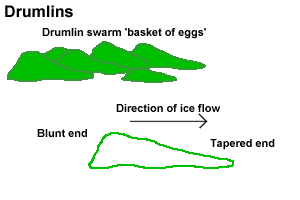
The main features of a drumlin
A typical drumlin has a rounded, steeper end and a longer, gentler slope. Its long axis is aligned with the direction in which the ice moved.
Drumlins are associated with the movement and deposition of sediment beneath a glacier. As the ice moves over glacial material, sediment can accumulate and be moulded into a streamlined shape beneath the glacier.
Their exact formation can be complex, and not all drumlins form in exactly the same way. However, their streamlined shape reflects the movement of the ice over them.
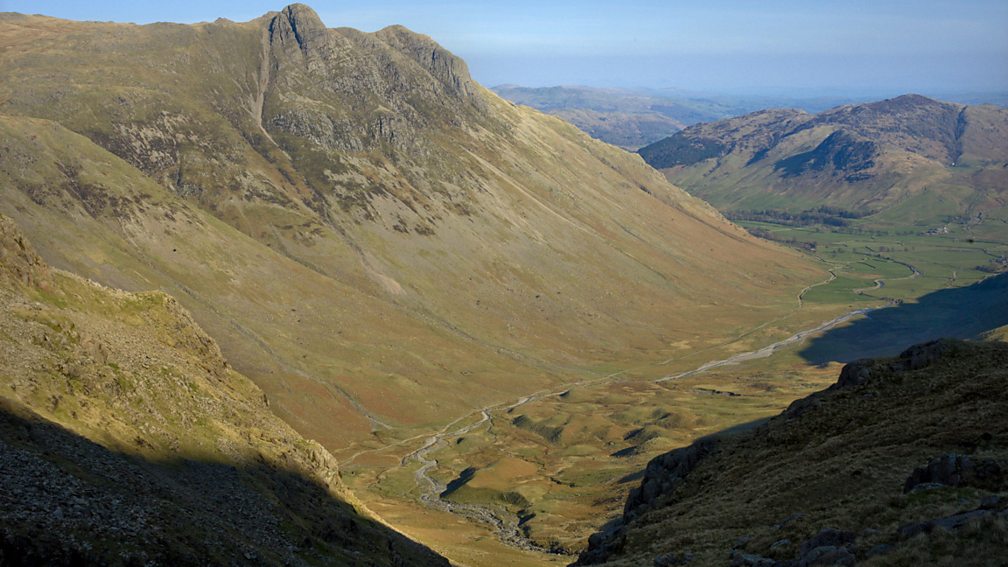
Drumlins at Langdale
Because drumlins are usually aligned with former ice flow, they can help geographers reconstruct the direction in which a glacier or ice sheet once moved.
Large drumlin swarms can be found in areas of northern England, Scotland and Northern Ireland.
Moraines
A moraine is an accumulation of rock and sediment transported and deposited by a glacier.
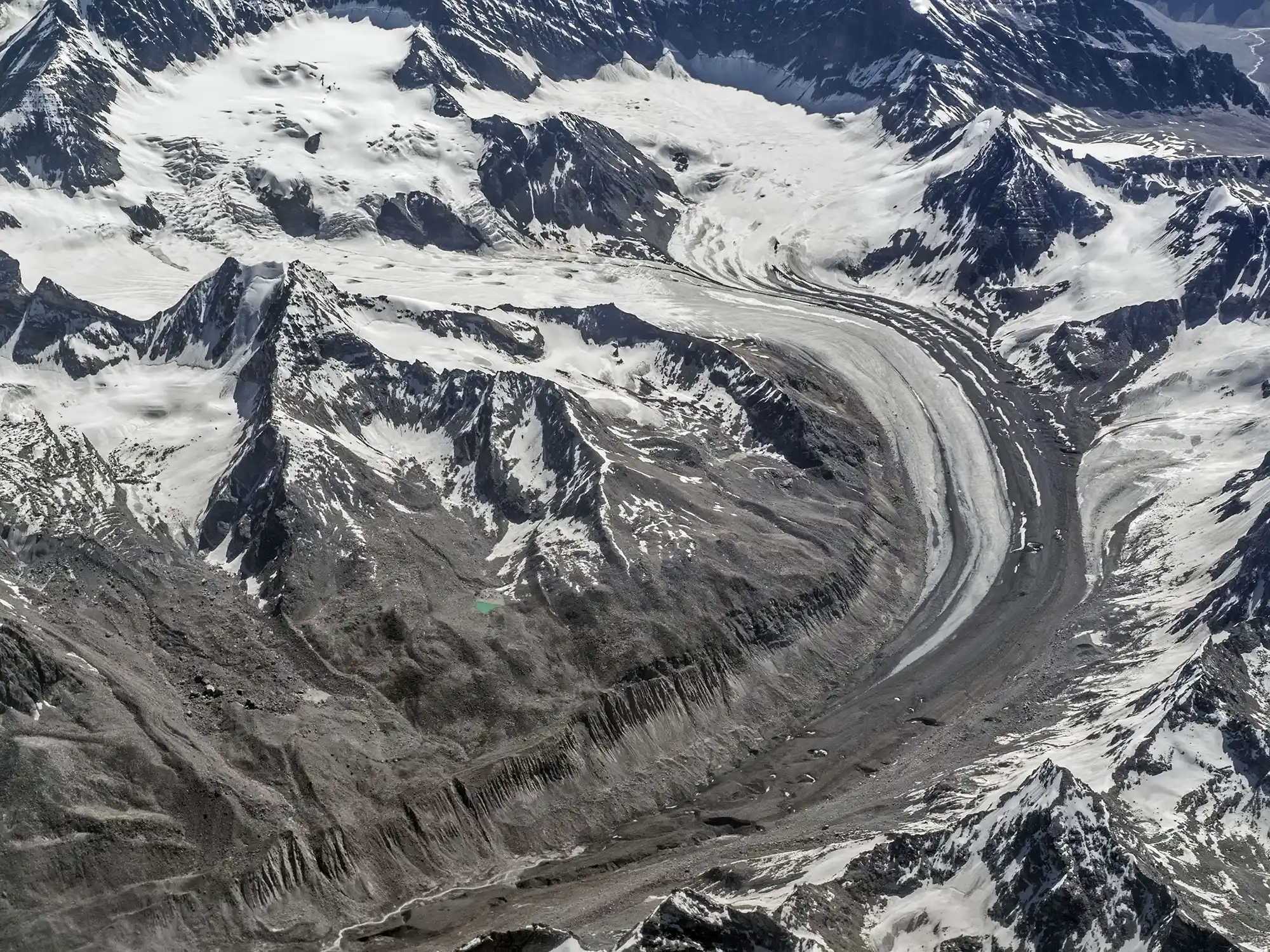
Glacial moraine
Moraines are made from glacial debris and can contain material ranging from fine sediment to large boulders. Their position in the landscape depends on where the material was transported and deposited by the glacier.
There are several different types of moraine.
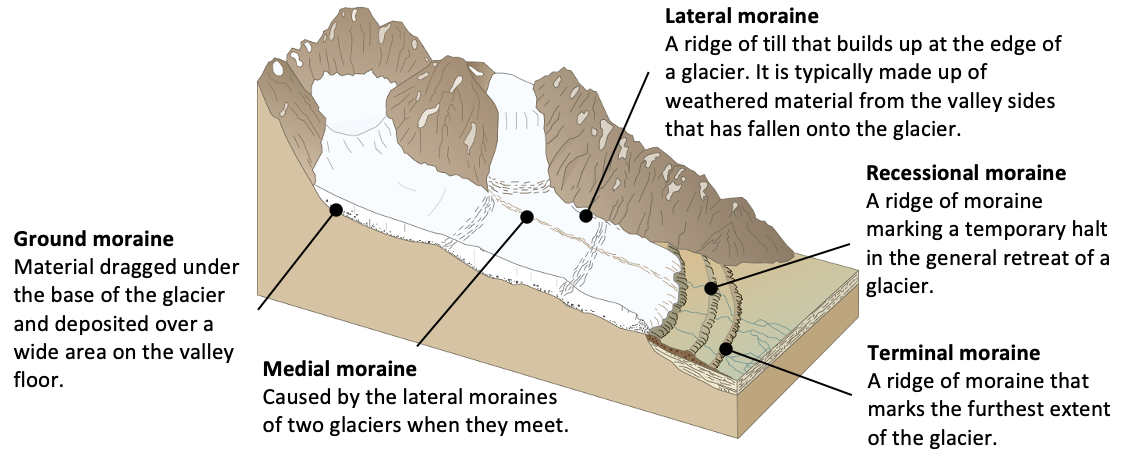
What are the different types of glacial moraine?
Lateral moraine
Lateral moraine forms along the sides of a glacier.
Freeze-thaw weathering can loosen rock from the steep valley sides. This material falls onto the edges of the glacier and is carried downhill on the ice.
When the glacier melts, the debris is deposited along the sides of the valley, sometimes forming long ridges.
Lateral moraines therefore mark the former edges of a glacier.
Medial moraine
Medial moraine is a line or ridge of debris found along the middle of a glacier.
It forms when two glaciers join together. The lateral moraines on the sides where the two glaciers meet are brought together. The debris is then carried down the centre of the combined glacier.
When the ice melts, this material is deposited, leaving a line or ridge of sediment along the valley floor.
A glacier can have several medial moraines if a number of tributary glaciers join the main glacier.
Terminal moraine
Terminal moraine, sometimes called end moraine, forms at the furthest point reached by a glacier.
As a glacier moves forward, it transports and pushes material towards its snout. If the glacier remains in roughly the same position for some time, debris can accumulate at its end.
When the glacier eventually retreats, a ridge of sediment is left across the valley.
Terminal moraines are particularly useful because they can show the maximum extent of a former glacier.
Recessional moraine
As a glacier retreats, its snout does not always move backwards continuously. There may be periods when melting and ice movement are roughly balanced and the glacier’s end remains in a similar position.
During these pauses, material can accumulate at the snout and form a ridge.
These ridges are called recessional moraines. A series of them along a valley can show stages in the retreat of a glacier.
Ground moraine
Not all moraine forms a distinct ridge.
Ground moraine is material deposited beneath a glacier as the ice melts. It can form a widespread, uneven layer of till across the landscape.
Ground moraine may contain a mixture of clay, sand, gravel and larger rocks, reflecting the range of material that was transported by the glacier.
What can glacial deposits tell us about the past?
Glacial deposits provide valuable evidence of landscapes that were once covered by ice.
The location and rock type of erratics can help identify where ice came from and the direction in which it travelled. The orientation of drumlins can also indicate the direction of former ice movement.
Different types of moraine can show the position of a glacier at different times. Terminal moraine can mark its maximum extent, while recessional moraines can provide evidence of stages in its retreat.
Together, these landforms help geographers build a picture of how glaciers moved across the UK during the last ice age and what happened as the ice eventually disappeared.


