
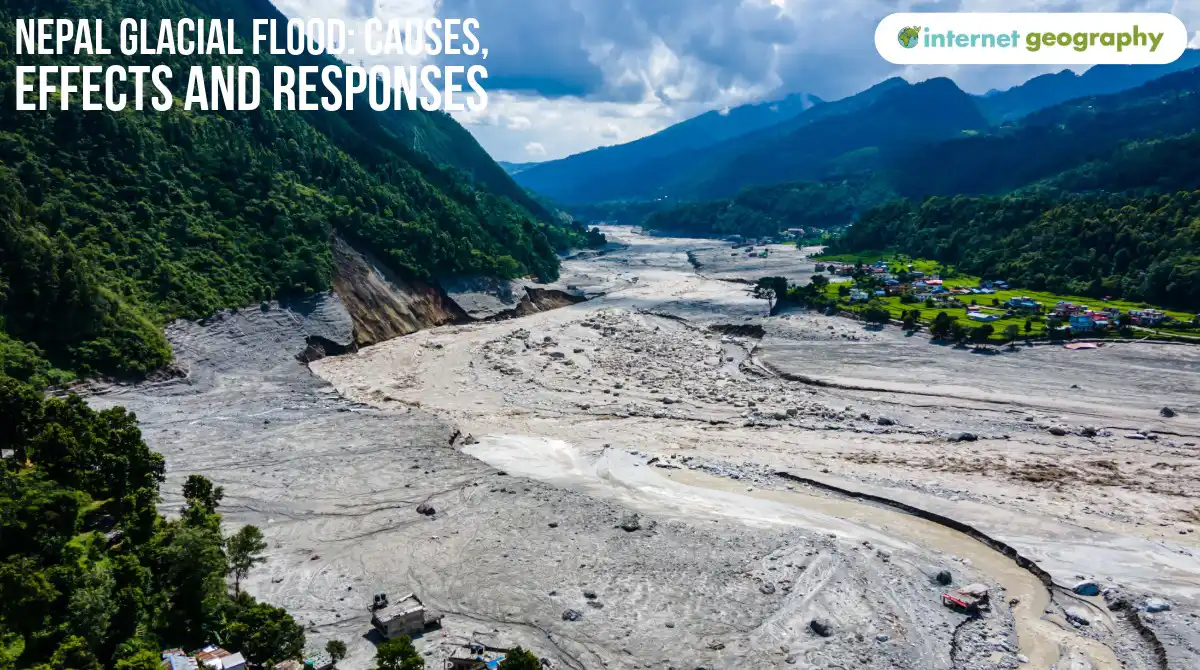
At around 9.10 am on 26 August, the phone calls started.
Rajendra Dawadi, headteacher of Tribhuvan Trishuli Secondary School in Nuwakot, Nepal, received four warnings from different people within minutes. A major flood was moving rapidly down the Trishuli Valley towards his school.
Some of the callers brought particularly worrying news: floodwater had already swept through Betrawati, a settlement further upstream.
Dawadi had around 900 pupils at school that morning. At first, there was no sign of the flood from the school itself. But the warnings told him that something disastrous was moving towards them.
High in the Himalayas, a chain of events had already begun.
A disaster begins high in the mountains
The flood began after a glacier collapsed close to the border between Nepal and Tibet.
A glacier is a huge mass of ice that slowly moves downhill under gravity. In high mountain environments such as the Himalayas, glaciers exist alongside extremely steep slopes, loose rock and frozen ground.
When part of the glacier collapsed, an enormous quantity of ice, rock and debris suddenly moved downhill. Gravity accelerated the material down the steep slopes, creating an avalanche and debris flow – a fast-moving mixture of water, mud, rock, ice and other material.
The debris entered the river system, sending a surge of water and sediment racing downstream through the valleys below.
This developed into a flash flood – a flood that occurs extremely quickly and can leave people with very little time to escape.
Why was the flood so destructive?
The physical geography of the Himalayas made the event particularly dangerous.
The region has extremely high relief, with mountains rising thousands of metres above narrow river valleys. The steep slopes allow ice, rock, mud and water to move downhill rapidly under gravity.
Many settlements, roads and businesses are located on valley floors because this is where flatter land is available. Rivers are also important for water supplies and hydroelectric power, while roads through the valleys connect communities and provide important trading routes.
However, this creates vulnerability. People and infrastructure become concentrated in the same narrow valleys through which floods, landslides and debris flows travel.
Tribhuvan Trishuli Secondary School was located close to the Trishuli River. When the flood reached it, the school was destroyed.
Communities swept away
The effects spread far beyond the area where the glacier collapsed.
By 6 September, more than 1,300 people had died, and more than 5,000 remained missing across Nepal and Tibet. Homes and settlements were destroyed, thousands of people were displaced, and at least 69 schools were damaged or destroyed, affecting the education of nearly 19,000 children.
Transport and electricity supplies were badly affected too. Roads and bridges were washed away or buried, cutting off communities and making rescue work more difficult. Several hydroelectric power projects were damaged, with hundreds of workers trapped or missing inside tunnels.
The flood also disrupted trade and tourism. The important Gyirong border crossing between Nepal and China was destroyed, affecting the movement of goods, tourists and pilgrims. Rebuilding homes, roads, bridges, schools and power infrastructure will cost billions.
The physical landscape was transformed too. Huge quantities of mud, boulders, ice and sediment were deposited across valley floors. Vegetation was buried, river channels changed, and unstable debris increased the risk of further landslides and flooding.
One event high in the mountains had created a chain of impacts many kilometres downstream.
Did climate change cause the flood?
Scientists are still investigating exactly why this particular glacier collapsed, so it is too simple to say that climate change directly caused this individual disaster.
However, climate change is altering mountain environments across the Himalayas.
As global temperatures rise, glaciers lose ice and frozen ground can begin to thaw. This can destabilise steep slopes. Melting ice can also create or enlarge glacial lakes, increasing the risk of sudden flooding.
Scientists are concerned that glacier collapses, glacial lake outburst floods, rockfalls and landslides could become more frequent as the Himalayan region warms.
The disaster therefore shows that climate change can affect more than temperatures. It can alter physical processes and increase the hazard risk faced by communities living downstream.
Responding to the disaster
Thousands of emergency workers were deployed following the flood.
Rescue teams searched damaged settlements, river valleys and tunnels, while helicopters were used to reach communities cut off by damaged roads and bridges. Nepal also received international assistance.
Particular attention was focused on hydroelectric power stations, where hundreds of workers were feared to be trapped underground. Remarkably, two workers were rescued alive from a hydropower tunnel nine days after the disaster.
The longer-term recovery will take years. Homes, roads, bridges, power stations and schools will need to be rebuilt. An important part of reducing future risk will be deciding where to rebuild.
Tribhuvan Trishuli Secondary School is expected to be reconstructed on higher, safer ground, rather than beside the river where it was previously located.
But at that school, the most important response to the disaster happened before the flood even arrived.
Four calls and minutes to make a decision
Back at Tribhuvan Trishuli Secondary School, Rajendra Dawadi could not see the approaching flood.
All he had were the warnings.
Four different people had contacted him within minutes. One warning told him that floodwater had already swept through Betrawati upstream.
Dawadi decided he could not afford to wait and see whether the flood would appear.
He stopped lessons.
The school bell was sounded, and pupils were told to leave immediately and move towards higher ground.
He also contacted buses that were still bringing pupils to school and ordered them to turn around. Pupils already at school escaped by bus, motorbike or on foot.
The decision came just in time.
The flood reached the area only about 10 minutes later. One pupil later told the BBC that she and her friends escaped with only seconds to spare.
Around 900 pupils and 16 members of staff escaped.
From higher ground, Dawadi watched water, mud, rocks and debris sweep through the place where he worked. The school was destroyed.
But the pupils who had been sitting inside it only minutes earlier were safe.
Dawadi later explained that waiting another ten minutes could have produced a very different outcome.
His decision demonstrates one of the most important lessons in hazard management: natural hazards cannot always be prevented, but early warnings, preparedness, evacuation and fast decision-making can save lives.