
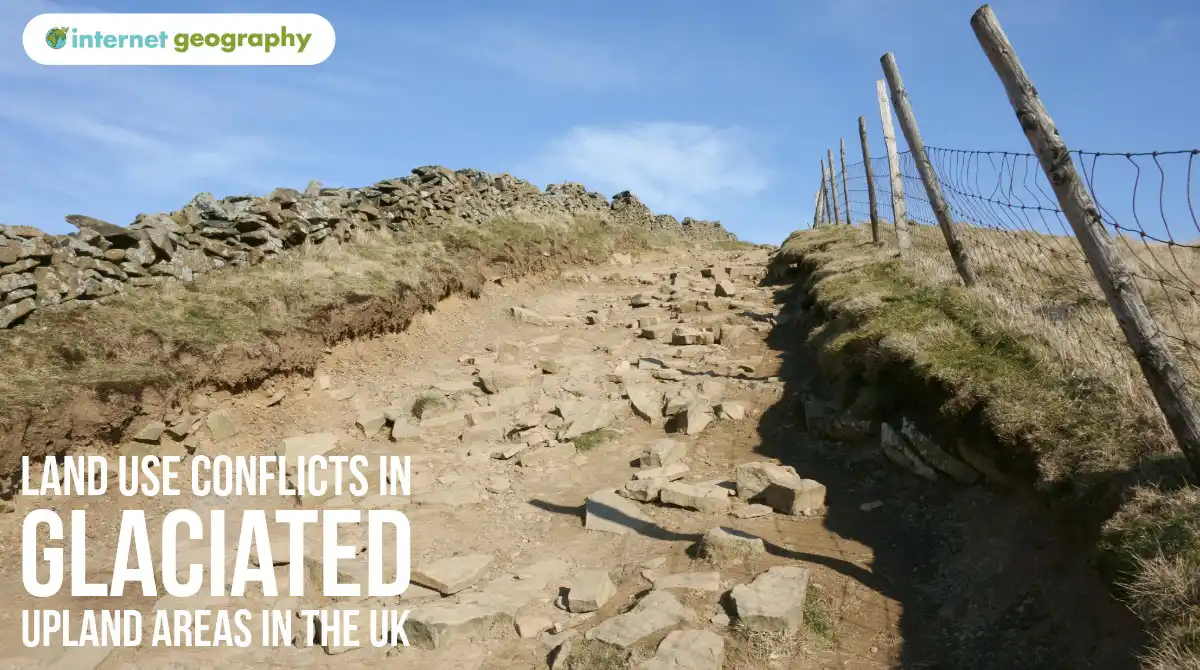
Land use conflicts in glaciated upland areas in the UK
Glaciated upland areas are used by many different groups of people. Farmers use the land for grazing, forestry companies grow timber, quarrying companies extract rock, and tourists visit to enjoy the landscape. Upland areas may also be used for reservoirs, renewable energy and military training.
These activities bring important economic and social benefits, but they do not always work well together. A land use conflict occurs when different groups want to use the same area in ways that are difficult to combine.
Conflict can also develop between development and conservation. New developments can provide jobs, energy and other benefits, but may damage the landscape and natural environment that people want to protect.
Why do land use conflicts occur in glaciated upland areas?
Glaciated upland areas contain valuable resources but are also important landscapes for wildlife, recreation and tourism.
Much of the UK’s upland landscape is sparsely populated, but this does not mean that there are few demands on the land. The same valley might be used for farming, walking and forestry, while also providing a possible location for a reservoir or renewable energy development.
National Parks, such as the Lake District, make these decisions particularly challenging. The landscape attracts tourists and supports local businesses, but its scenery, habitats and cultural heritage also need to be protected.
As a result, decisions about land use often involve balancing economic development, the needs of local communities and environmental conservation.
How can tourism cause land use conflict?
Tourism is an important source of income and employment in many glaciated upland areas. Visitors spend money in hotels, cafés, restaurants, shops and visitor attractions.
However, large numbers of visitors can place pressure on the landscape.
Popular footpaths can become eroded as walkers repeatedly cross the same ground. Vegetation may be trampled and soil exposed, particularly on steep slopes. Cars can cause congestion in small villages and increase pressure on car parks, while litter can affect the appearance of the landscape.
Conflict can therefore develop between tourists and conservationists, who want to protect the environment. There can also be conflict with local residents, particularly where congestion, parking and large visitor numbers affect everyday life.
The challenge is that restricting tourism too much could reduce the income and employment it provides.
How can farming cause land use conflict?
Farming has shaped upland landscapes for centuries and remains an important source of income for rural communities.
Sheep farming is particularly common because sheep can graze steep slopes and rough grassland that would be unsuitable for growing crops.
However, intensive grazing can prevent vegetation from recovering. Where vegetation cover is reduced, soil is more easily eroded by rainfall and surface runoff. Grazing can also make it more difficult for woodland and other natural vegetation to regenerate.
Reducing sheep numbers may benefit conservation, but farmers may be concerned about the impact on their income and traditional way of life.
This can create conflict between farmers and conservation groups over how upland areas should be managed.
How can forestry cause land use conflict?
Commercial forestry can make productive use of steep upland land that may be unsuitable for crop farming. Coniferous trees grow relatively quickly in the cool, wet conditions and provide timber for a range of uses.
Forests can also provide employment and recreational opportunities.
However, large conifer plantations can change the appearance of an open upland landscape. Closely planted trees reduce the amount of light reaching the forest floor, which can limit the plants growing beneath them and affect habitats.
Forestry operations can also cause problems. When large areas are cleared, exposed soil may be more vulnerable to erosion and surface runoff can increase.
Conflict can therefore develop between the economic benefits of commercial forestry and the desire to protect scenery and biodiversity.
How can quarrying cause land use conflict?
Glaciated upland areas contain valuable rocks, including slate, limestone and igneous rocks. Quarrying these resources provides raw materials and supports employment.
However, quarrying can have a major impact on the surrounding area.
Removing rock changes the appearance of the landscape, while blasting and machinery can create noise and dust. Heavy lorries travelling to and from quarries may increase traffic on narrow rural roads.
This can create conflict with local residents, tourists and conservation groups. A quarry may provide jobs and valuable materials, but it can also damage the landscape that attracts visitors to the area.
The conflict is therefore between the economic value of extracting rock and the environmental value of conserving the upland landscape.
How can reservoirs cause land use conflict?
Deep glacial troughs can provide suitable locations for reservoirs because a dam can be built across a relatively narrow part of the valley.
Reservoirs provide important benefits. They can store water for homes and businesses, and some can be used to generate hydroelectric power.
However, creating a reservoir floods land behind the dam. Farmland, habitats, roads and buildings may be lost, and in some cases communities have had to relocate.
Reservoir development can therefore create conflict between the wider benefits of water supply and energy production and the impacts experienced by local people and the environment.
How can wind turbines cause land use conflict?
Upland areas are often exposed and windy, making them potentially suitable locations for wind turbines.
Wind power provides renewable electricity without burning fossil fuels. Increasing renewable energy production can help reduce reliance on fossil fuels and lower greenhouse gas emissions.
However, wind turbines are tall structures that can be visible across large areas. Some residents, walkers and tourists feel that wind farms reduce the natural appearance of upland landscapes.
Access roads and other infrastructure may also be required during construction.
This creates a conflict between the need to develop renewable energy and the desire to conserve the appearance and character of upland landscapes.
How can military training cause land use conflict?
Some upland areas are used by the military because they provide large, sparsely populated areas suitable for training.
Military training can involve low-flying aircraft and exercises on the ground. This can cause noise pollution, which may disturb residents, visitors and wildlife.
Access to some areas may also be restricted when military exercises are taking place, preventing walkers and other visitors from using the land.
This can lead to conflict between the needs of the military and those of local communities, tourists and conservationists.
How can development and conservation be balanced?
Stopping development completely would protect the landscape, but it could also reduce employment and limit opportunities for people living in upland communities. Allowing development without controls could damage the very environment that makes these areas valuable.
The aim is therefore to find a balance between development and conservation.
Planning controls can limit where developments such as quarries, forestry plantations and wind turbines are located. Particularly sensitive landscapes and habitats can be protected from development.
Visitor pressure can also be managed. Well-maintained paths can reduce erosion, while signs can encourage visitors to remain on designated routes. Access to particularly sensitive areas can be restricted temporarily to allow vegetation and habitats to recover. Activities such as camping, horse riding and motorcycling may also be limited to particular locations. These approaches develop the management measures already identified on the existing page.
Conservation does not necessarily mean preventing economic activity. Sustainable management aims to allow people to use upland areas while reducing damage to the landscape and environment.
Why is managing glaciated upland areas difficult?
There is rarely a solution that satisfies everyone.
A new quarry might provide employment but damage views. A wind farm may provide renewable electricity but change the appearance of the landscape. Reducing sheep grazing may allow habitats to recover but reduce a farmer’s income. Limiting visitor numbers may protect footpaths but reduce spending in local businesses.
Managing glaciated upland areas therefore involves making decisions about who benefits, who is affected and whether the environmental impacts can be reduced.
The overall challenge is to allow upland areas to support local communities and economic activity while conserving their distinctive landscapes for the future.


