On Sunday 28th June we’ll be hosting our ninth free online pub quiz for teachers.
To take part you’ll need to download the Zoom app for your phone/laptop/computer. Zoom is available for mobile devices from your app store. It is recommended that you download the app and install it prior to the quiz, especially if you are using a laptop or computer (if this is the case then set up a free account on Zoom.com now). You’ll also need access to Google Forms to record your answers.
At 7.50 pm the link and password to access Zoom will be published below. You can access the video stream from this time. The quiz will start at 8.15 pm to give those with children who have an 8 pm bedtime time to do the parenting thing.
Everyone will be muted during the quiz so that it doesn’t turn into carnage but you are welcome to use the text option to say hello etc.
Zoom Details (will be posted below at 7.50pm on Sunday)
Quizzer’s answers are final. Questions have been researched using (mostly) reliable sources.
The quiz only has limited connections and works on a first-come-first-served basis.
Be nice.
You can play as an individual or a team.
There will be a prize for the best team name (chosen by the quizzer)
There will be a prize for the winning team.
Over 18s and geography teachers only (trainees, teachers and retired welcome)
No Googling or cheating in any way. It’s a bit of fun and you’re only cheating yourself (said in best teacher voice).
The winner will be informed within 24hrs.
I’m the event of a tie the quizzer will choose the team with the best name.
You’ll need to include an email address and contact name so we can get in touch with the winner.
We’ll publish the results, though these will contain no personal information e.g. team name and score only.
We’ll run through the answers at the end of the quiz for those that want to hear them. Answers must be submitted by players before this is done. Answers submitted by Google forms after this point will not be counted.
The quiz (software and hardware) has been funded by payments for Internet Geography Plus. If you’ve not got a subscription there are lots of useful resources available for distance learning.
Internet Geography has a range of resources to support teachers and students in the event of school closures.
We have 19 Geography in the News assignments that can be downloaded and used by students to investigate events around the world that are relevant to their studies.
Students revising can use our structured guide to GCSE revision to help prepare for their exams. Take a look at the 3rs of Revision.
We are in the processes of developing a series of online lessons using Google My Maps. The first two are available to use now:
There are online resources covering the majority of the AQA GCSE course that students can use for revision.
Last summer we introduced Wider Geography, a summer project for students to participate in to broaden their geographical horizons. This is being updated over the next few days.
If you have any resources you are happy to share please send them to [email protected] and we will post them here.
https://www.internetgeography.net/wp-content/uploads/2020/03/Free-Image.jpg11941592Anthony Bennetthttps://www.internetgeography.net/wp-content/uploads/2024/01/Internet-Geography-Logo.pngAnthony Bennett2020-03-18 14:05:002020-03-18 14:05:00Free geography resources on Internet Geography in the event of school closures
In this lesson, you will investigate environmental quality in your local area. To do this you need a Google account. If you don’t have one through school, simply head over to Google.com and click the sign-in button. Then click create an account. Go through the process of setting up an account. You will also use Google Streetview to complete this investigation.
What is an environmental quality survey?
Environmental Quality Surveys are used to measure the ‘look and feel’ of a location. The technique is very subjective, which means people will have different views about an area. Some will find a location unattractive, while others may find the same place very attractive.
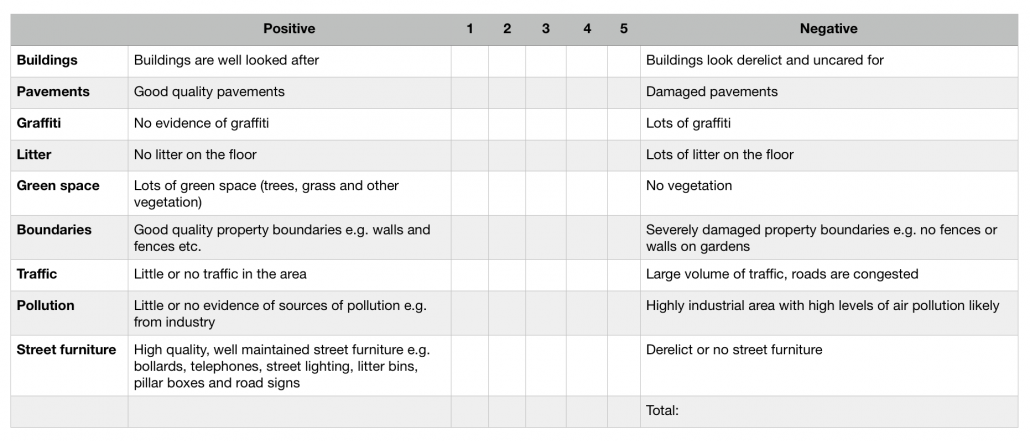
Below is the environmental quality survey you will use in this investigation. You are welcome to edit it and add more characteristics. You can download the table in MS Word.
Environmental quality survey
The Challenge
Your challenge is to complete environmental quality surveys in your local area and present the findings on Google Maps. You can either visit the locations and complete the environmental quality surveys if it is safe to do so. However, this guide will take you through the steps to complete the environmental quality surveys using Google Street. There are limitations to this such as the images may have been taken some time ago, however, it will be good practice for completing environmental quality surveys.
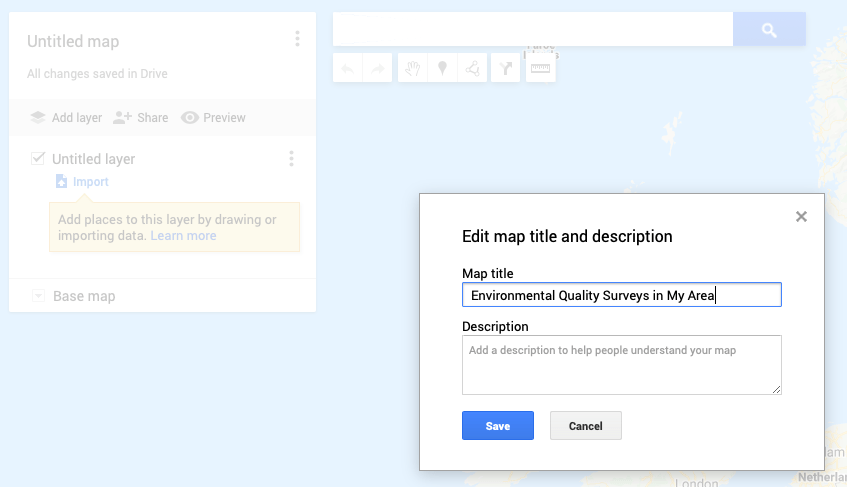
Click Untitled Map (top left corner) and give your map an appropriate title e.g. environmental quality surveys in my local area.
Naming your Google Map
Next, find your local area by typing in the name of your street in the search box. When it is displayed, click it, then the map will zoom into your local area.
You can share your map and work with other students at the same time. To do this click Share, in the Add people box add the email address of the person you want to share the map with. Then click send.
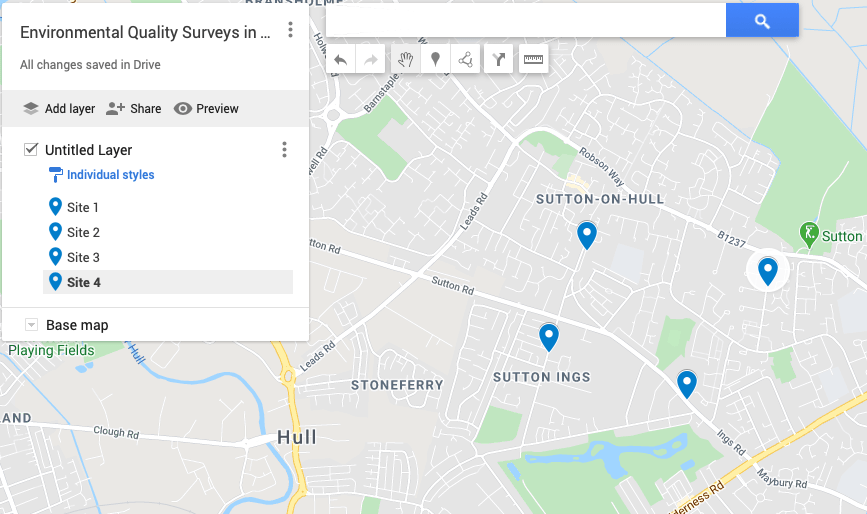
You need to identify the locations where you will complete your environmental quality surveys. You could choose the locations by using random, systematic or stratified sampling. In this example, we are going to use random sampling.
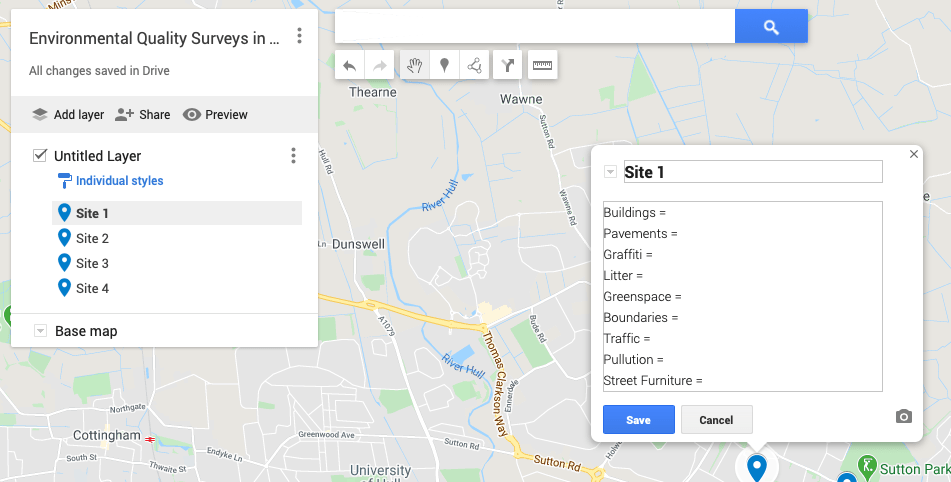
To do this, drop markers on the map in random areas in your local area where you will complete the environmental quality survey. Click the marker icon (upside-down tear) and click on your map. Repeat this at least 3 times. You can give each marker a name e.g. site 1, site 2 etc.
Identifying sites randomly
For each location you need to add the following information in each description to record your environmental quality survey scores:
Buildings =
Pavements =
Graffiti =
Litter =
Greenspace =
Boundaries =
Traffic =
Pullution =
Street Furniture =
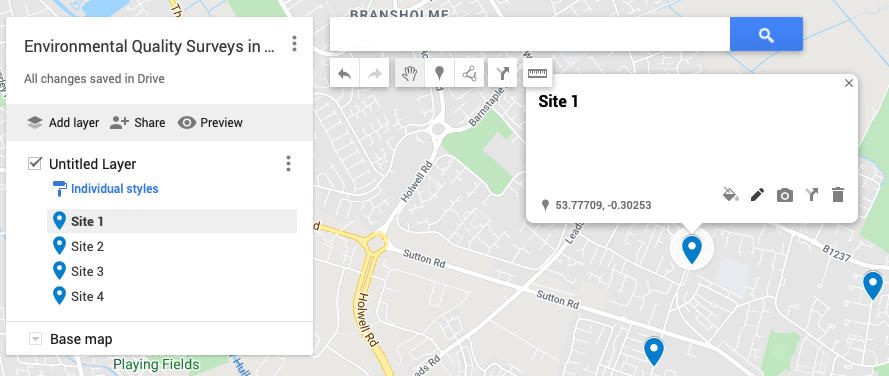
Total =To do this click on Site 1. Then click the edit button (pencil) to add the information.
Recording your environmental quality surveys
Below is a completed example:
Setting up markers for data
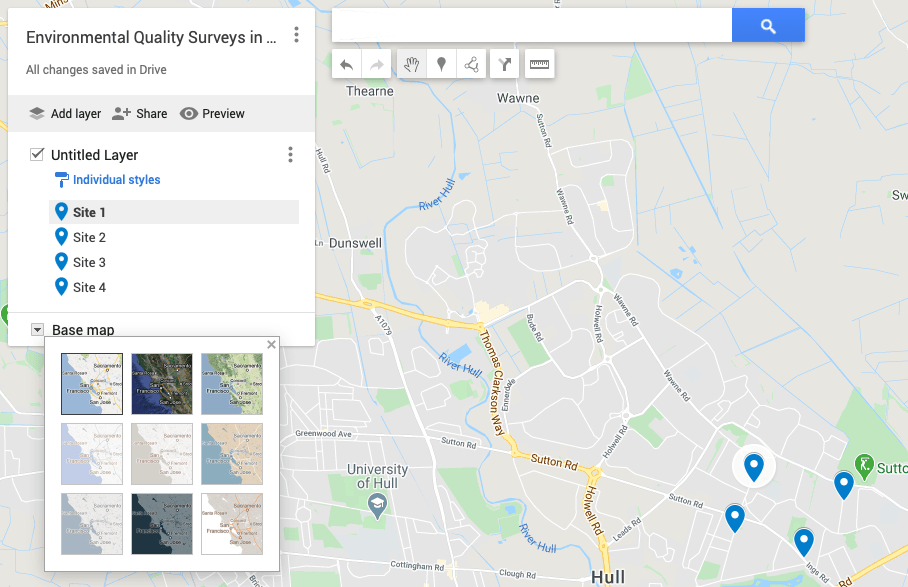
The next step is to complete the environmental quality survey for each location. If you are not visiting the locations you can use the satellite view on your map along with Google Street View to complete your environmental quality surveys.
To change your base map to a satellite image simply click the drop-down menu next to Base Map and select the satellite view.
Changing your base map
You can then zoom into your first location and view it in more detail. This could provide some help with completing your environmental quality survey, but you should also use Google Street View.
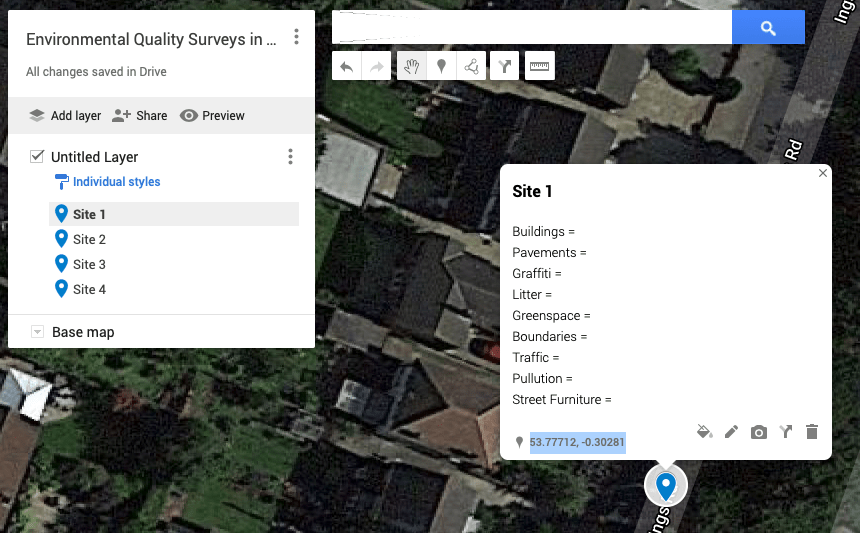
To use Google Street View you will need to open a new Google Map (this needs to be a Google Map NOT a new Google My Map). Locate your first marker by returning to your Google My Map, click on the first site and copy the latitude and longitude coordinates by highlighting them then right click and select copy.
Extracting latitude and longitude data
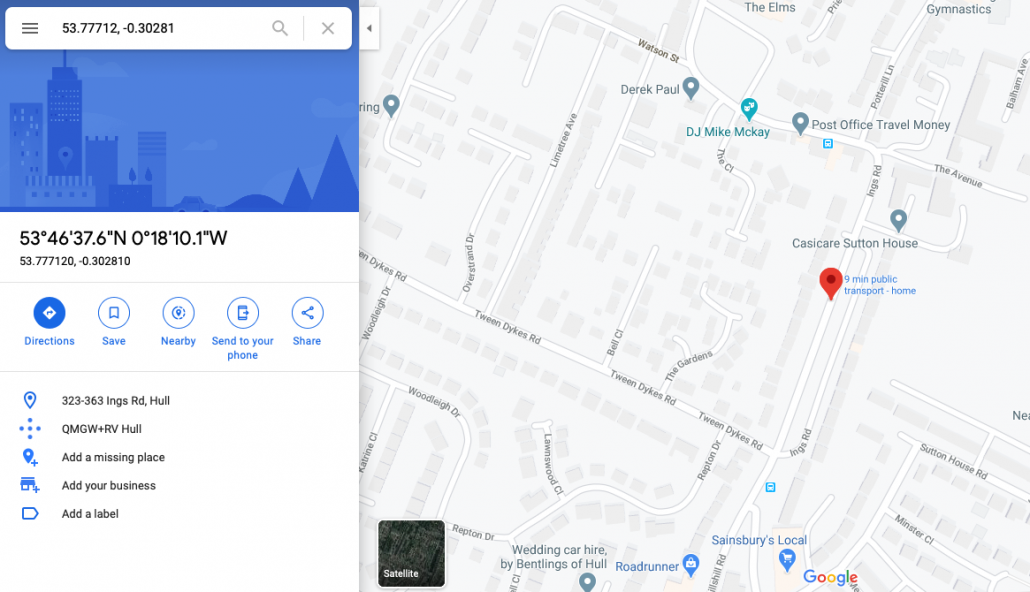
Return to Google Maps and paste the latitude and longitude data into the seach box. As you ocan see below Google Maps has dropped a marker.
Searching by latitude and longitude in Google Maps
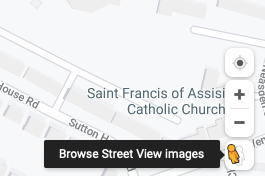
Next, grab the Street View icon in the bottom right (yellow figure) and drop it on your marker.
Opening Street View
You will now go to Street View and will be able to complete your environmental quality survey. Remember to add your data to your marker in Google My Maps. Repeat this for each site.
Taking it further
Compare environmental quality in your local area. This could include adding presenting your data in appropriate graphs and describing and explaining the differences. You could also complete environmental quality surveys between wealthy and less wealth areas within and between countries.
https://www.internetgeography.net/wp-content/uploads/2020/03/Extracting-latitude-and-longitude-data.png533860Anthony Bennetthttps://www.internetgeography.net/wp-content/uploads/2024/01/Internet-Geography-Logo.pngAnthony Bennett2020-03-18 13:03:342026-06-16 15:06:21Google My Maps Project – Environmental Quality Survey in My Local Area
Fed up of the same old revision? Why not organise an online revision party? It’s simple to organise, a great way to connect with others and helps share the workload!
How does it work?
Each party guest chooses an area of the course they will become experts in. They then spend some time planning a brief recap of the topic. This could be a PowerPoint containing images and a small amount of text.
Next, each party guest writes a selection of multiple-choice questions to go with their presentation.
Finally, connect with each other online, take it in turn to teach, quiz and answer questions.
There are lots of free online tools you can use to host your party. If you have a Google account, you could try a Google Hangout. Another great tool is Zoom.us which allows up to 40 minutes of video meetings per session. Both services allow you to share your screen with others in your group, along with video and audio.
It is worth trying out a video meeting before you host your revision party so you are not wasting time setting up before the revision party.
Make sure you know the people you are having your online revision party with. Stay safe online!
https://www.internetgeography.net/wp-content/uploads/2020/03/Hosting-an-Online-Revision-Party.png12001600Anthony Bennetthttps://www.internetgeography.net/wp-content/uploads/2024/01/Internet-Geography-Logo.pngAnthony Bennett2020-03-18 09:26:402020-03-18 09:27:15Hosting an Online Revision Party
In this lesson, you will map land use in your local area. To do this you need a Google account. If you don’t have one through school, simply head over to Google.com and click the sign-in button. Then click create an account. Go through the process of setting up an account.
What is land-use?
Land use is the function of land – what it is used for. Land use varies from area to area. In rural areas (countryside) land use can include forestry and farming. In urban areas (towns and cities) land use can include residential and business.
Land in urban areas is used for many different purposes:
leisure and recreation – may include open land, e.g. parks or built facilities such as sports centres
residential – the building of houses and flats
transport – road and rail networks, stations and airports
business and commerce – the building of offices, shops and banks
industry – factories, warehouses and small production centres
In rural areas land can be used for:
agriculture – growing crops and rearing animals
forestry – growing trees
military training
recreation
water supply
mining
quarrying
The Challenge
Your challenge is to map land use in your local area. You will use online satellite images and maps to create a land-use map of your local area. Below is a step-by-step guide on how to create a land-use map in Google Maps.
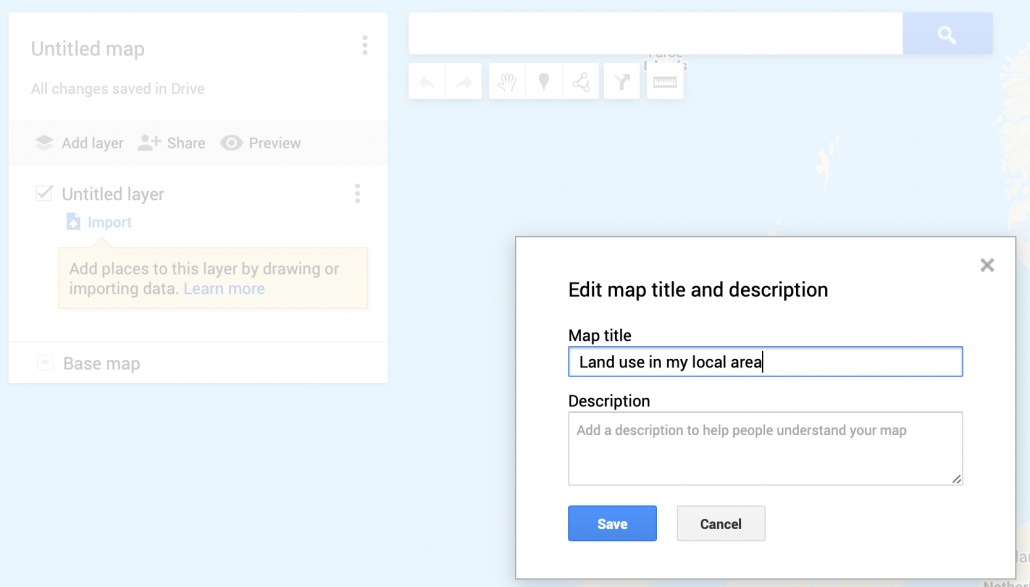
Click Untitled Map (top left corner) and give your map an appropriate title e.g. land use in my local area.
Naming your map in Google My Maps
Next, find your local area by typing in the name of your street in the search box. When it is displayed, click it, then the map will zoom into your local area.
You can share your map and work with other students at the same time. To do this click Share, in the Add people box add the email address of the person you want to share the map with. Then click send.
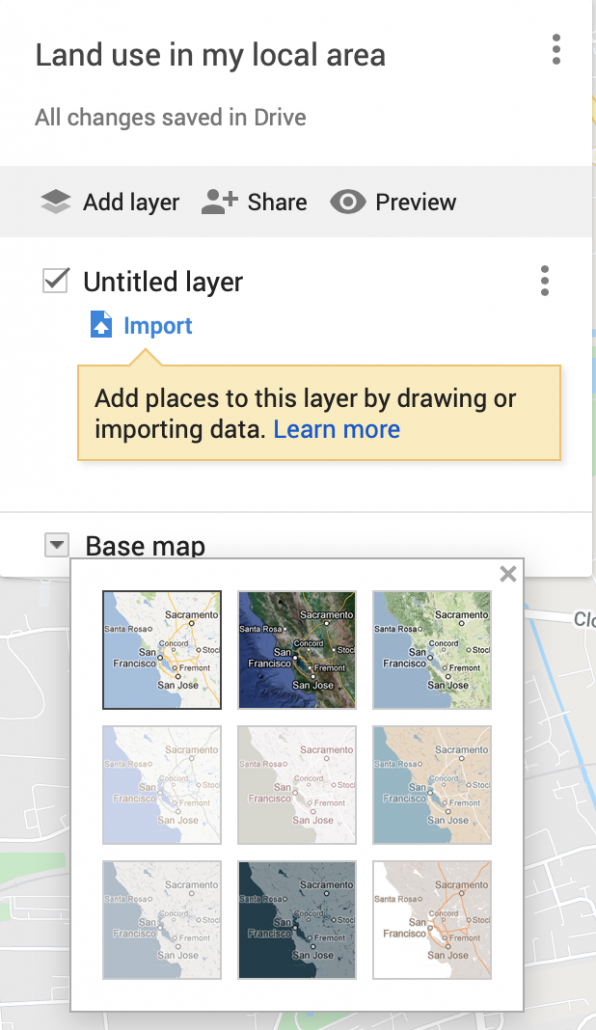
You can switch between the map view and other views, including satellite images, by clicking the drop-down menu next to Base Map. This will help when looking at different land uses.
Choosing a base map
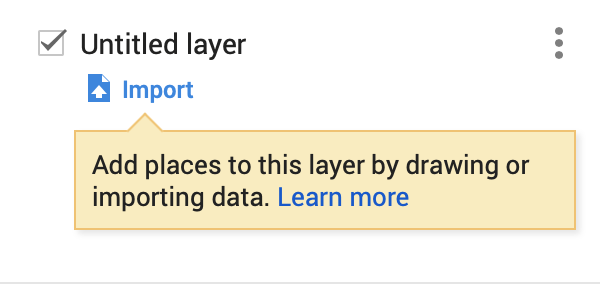
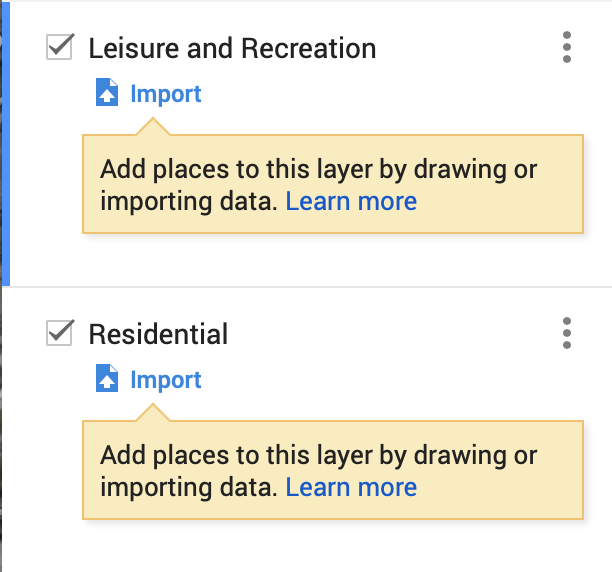
You can use layers to on your map to organise different features e.g. one layer for residential (housing) areas and another for industry (e.g. factories). You now need to create layers for each different land use that you can include on your map.To do this you need to start by naming the first layer that is already on your map. This is currently called Untitled Layer. Click this and name it Leisure and Recreation.
Naming a layer
Next, click add layer and name this layer Residential.
Repeat this until all the land use types are included from the list at the top of the page.
You are going to use the polygon tool to draw shapes over land use areas on your map. To get started, find an area of the same land use in your local area e.g. a housing estate, industrial area, shops etc. Click on the correct layer e.g. residential to map an area of housing, so you can draw on it. The layer will have a blue line next to it to show you have selected it. In the example below the Leisure and Recreation layer has been selected.
Selecting a layer
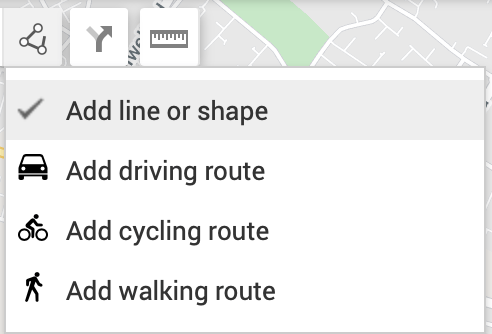
Next click on the Draw a line icon and select Add line or shape.
Draw a line tool
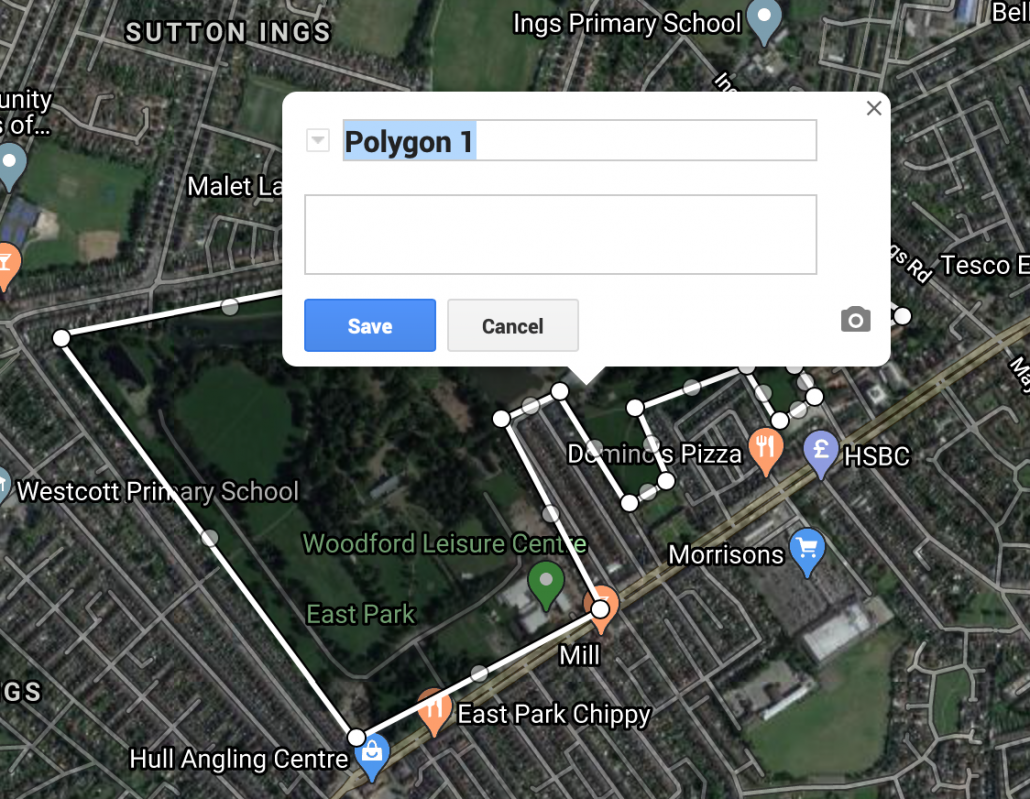
Next, draw a polygon around the area you are going to map. To do this click every time you get to a corner. The final click should be on the dot where you started. In the example below a polygon has been drawn around a public park. You will notice it is called Polygon 1. The layer needs renaming to something such as a public park.
Drawing a polygon
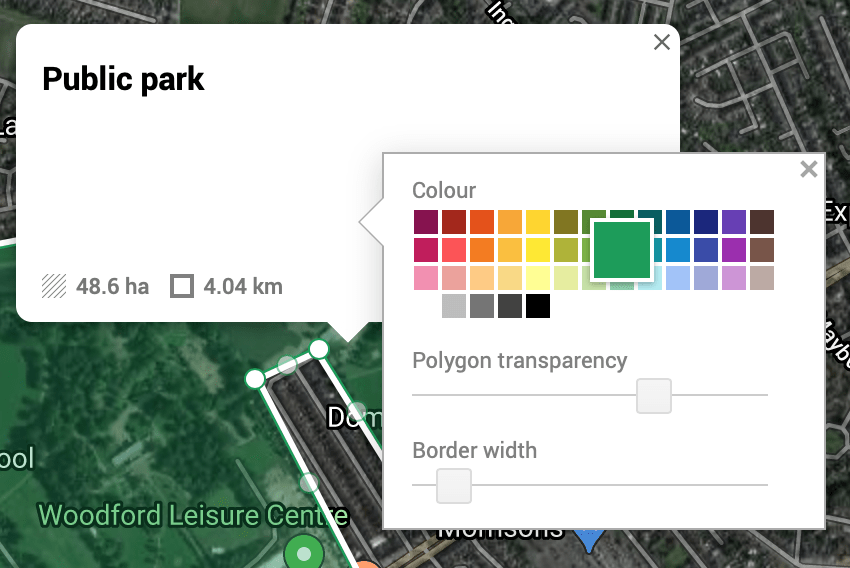
Next, click the fill button and select a colour you will use for all areas of Leisure and Recreation on your map. In the example below, Leisure and Recreation have been filled green.
Fill a polygon
As you can see in the image above the park covers an area of 4.04k㎡
Spend some time exploring your local area on the map and add any other Leisure and Recreation in the area in the same way as above. Remember to fill the polygons the same colour.
Once you have done this, click on the next layer e.g. Residential, and map the housing in your local area.
Repeat this for all other land uses in your local area.
Taking it further
Compare land use in your local area. This could include adding together the total area of land covered by each land use. You could present this on a graph and describe what the data shows.
https://www.internetgeography.net/wp-content/uploads/2020/03/Drawing-a-polygon.png8721124Anthony Bennetthttps://www.internetgeography.net/wp-content/uploads/2024/01/Internet-Geography-Logo.pngAnthony Bennett2020-03-17 16:55:112026-06-16 15:06:34Google My Maps Project – Mapping my local area
It’s looking increasingly likely that schools may close for a period of time due to Coronavirus. It’s clear from my Twitter feed that a number of schools are already planning for this eventuality. If you find yourself working from home and developing resources to share online with your students, there are a number of useful tools available to support you with this. In this blog post I’ll share a couple of useful tools you can use to create videos for direct instruction.
Screencasting
Screencasting involves recording what is shown on your computer screen. Most screencasting apps also allow you to record yourself narrating using a microphone (most laptops have this built-in). Once exported, the video can then be uploaded to your online portal or Youtube/Vimeo and shared with your students.
Screencastify
Screencastify is a useful app for screencasting. It allows you to create screencasts up to 5 minutes long for free! You’ll need the Google Chrome browser with the Screencastify plugin installed. Head over to https://www.screencastify.com/then click the button that says Add to Chrome. Once you launch the plugin, there is a quick set up process to go through and you will need a Google account. Once you’ve done this, you will be able to save your screencasts directly to Google Drive.
Quicktime Player
Quicktime Player is a media player that also lets you create screencasts. Open the app on your computer then go to File > New Screen recording. Then, from the options menu, you can select your audio recording option if you want to talk over your video.
Presentation Software
Presentation software such as Microsoft PowerPoint and Apple Keynote both allow you to record a narration. This is useful if you have presentations already created and you want to provide additional guidance/instruction to your students.
Microsoft PowerPoint
Microsoft has put together a useful guide for recording a slide show with narration. You can access it here. Additionally, you can insert a sound file containing your narration to each slide by going to Insert > Audio > Record Audio.
Apple Keynote
Apple Keynote allows you to record your presentation along with narration then export it to a video file. Open your Keynote then go to Play > Record Sideshow. Click the record button and talk away. When you have finished go to File > Export > Movie. Then upload your video file to your online repository.
iPad/iPhone Apps
There are a number of apps available to record yourself talking over a presentation. These include:
https://www.internetgeography.net/wp-content/uploads/2020/03/Direct-instruction-tools-for-teaching-during-school-closure-scaled.jpg12801600Anthony Bennetthttps://www.internetgeography.net/wp-content/uploads/2024/01/Internet-Geography-Logo.pngAnthony Bennett2020-03-11 21:21:532020-03-11 21:31:07Direct instruction tools for teaching during school closure
Geographical enquiry is a fundamental element of geography and is now firmly established in the geography curriculum, at least on paper, across Key Stages 2-5. There is little or no doubt that students who are involved in geographical enquiry will develop essential skills for learning. However, perhaps more importantly to us, geographical enquiry helps students in constructing geographical knowledge. There is general agreement that this implies an active approach to learning geography which encourages pupils to ask questions about real issues, to search for answers using a wide range of skills and information and to think critically about issues rather than accept the conclusions, research and opinion of others passively. (Davidson, 2006; Naish et al., 2002).
The new GCSE specifications all have an element of geographical enquiry. Take the AQA specification as an example, which assesses the enquiry process in the following ways:
Questions based on the use of fieldwork materials from an unfamiliar context.
Questions based on students’ individual enquiry work. For these questions, students will have to identify the titles of their individual enquiries.
In practice, however, opportunities for geographical enquiry are often missed as we plough through the copious content of the new GCSE specifications.
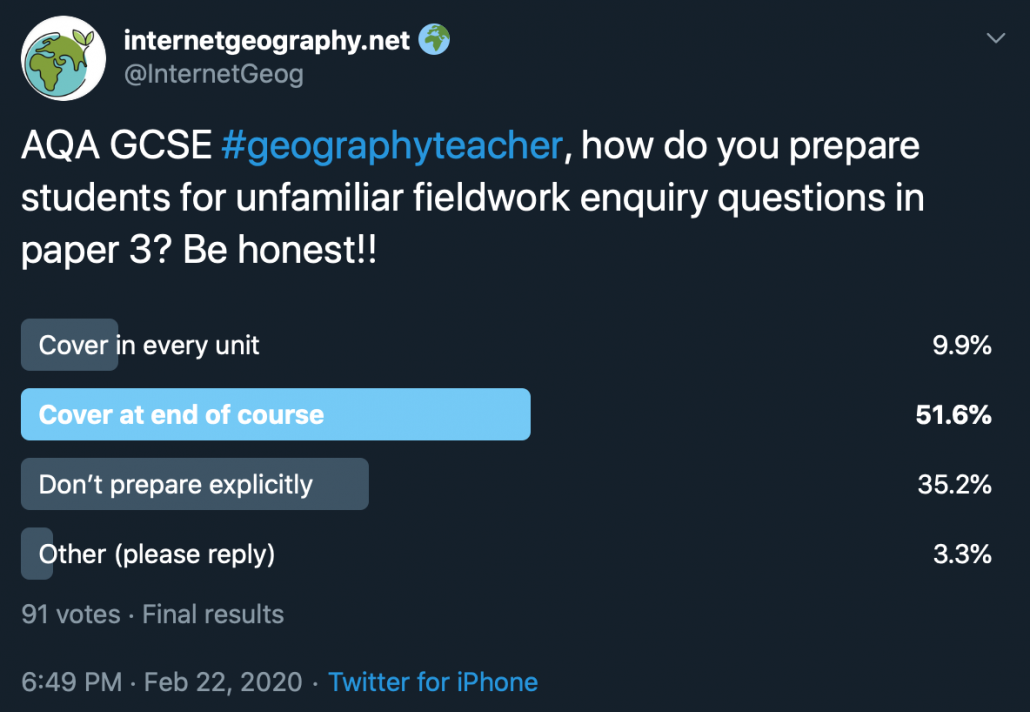
Like many geography teachers across the country, I have been guilty of focussing on the individual enquiry’s students need to complete while paying limited lip service to addressing fieldwork from an unfamiliar context. Having asked geography teachers on Twitter how they prepared students for unfamiliar fieldwork enquiry questions, the results did not surprise me.
It is probably fair to say, even based on this limited sample, geography departments across the country tend to focus on the two compulsory fieldwork investigations but spend little or no time on other aspects of geographical enquiry. Having re-read the AQA GCSE geography examiner’s report for paper three, it is clear that enquiry skills, particularly in the unseen context, is an area for development. Misunderstandings such as the difference between data collection technique and data presentation technique are also highlighted.
In all honesty, and after considerable reflection, I think we are doing both our students and our discipline a disservice if we are not including geographical enquiry throughout the curriculum. However, we face significant challenges in addressing this. Many are finding the increase in the content covered in the new GCSE curriculum a problem to get through. Additionally, an increasing number of schools are reverting to a two-year key stage 4.
Despite these challenges and without ripping up the curriculum and starting again, simple tweaks can be made to the curriculum, our practice and delivery that will allow us to better address geographical enquiry. We should do this not just for the sake of meeting the needs the expectations of the specification but more importantly, to make our students better geographers.
Let’s get tweaking…
In the AQA specification students will be questioned on fieldwork from an unfamiliar context including, but not limited to:
identifying geographical questions/hypothesis
identifying risk and strategies for managing this
identifying appropriate investigation techniques
identifying appropriate presentation techniques
completing unfinished data presentation
describing/explaining data
completing data analysis (mean, median, mode etc.)
forming conclusions
There are many opportunities to embed unfamiliar fieldwork throughout the AQA GCSE Geography course, providing students with multiple opportunities to hone their enquiry skills. Students exposed to unfamiliar fieldwork, little and often, are more likely to develop the skills, knowledge and understanding to complete effective fieldwork investigations and improve their enquiry skills.
Most units in the AQA GCSE Geography specification provide opportunities for addressing unfamiliar fieldwork. At an appropriate point within a unit, when students have acquired a strong foundation of subject knowledge, geographical enquiry can be introduced.
So, how might this look in practice?
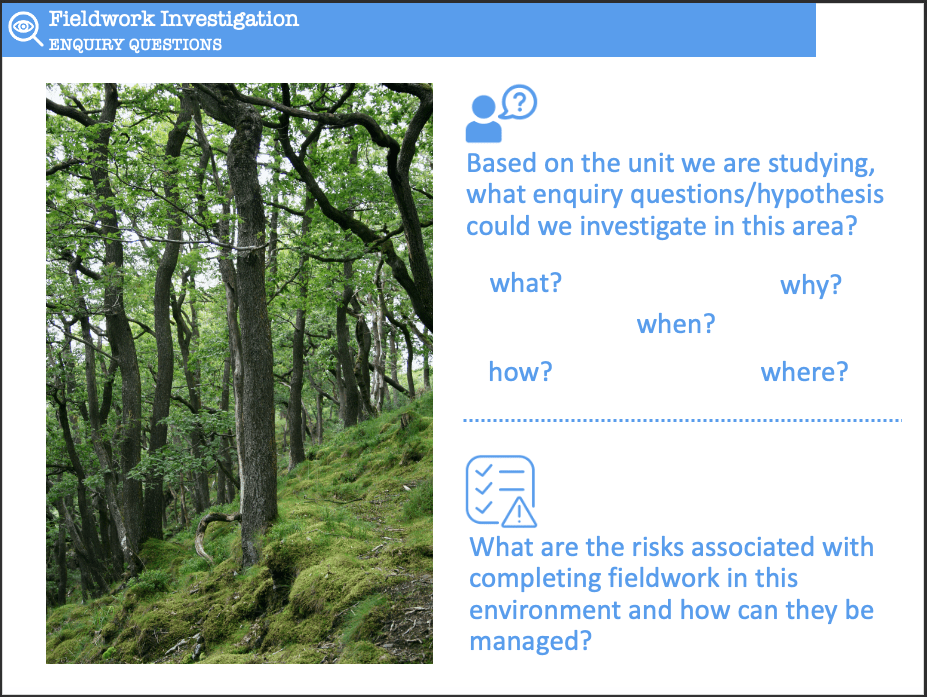
If the first GCSE unit covered is ecosystems, introduce an unfamiliar fieldwork enquiry by showing your students an image of a deciduous forest ecosystem (once they have studied this aspect of the course). Next, model several examples of geographical questions/hypothesis for this environment, then ask them to develop more. Paired or group work might be appropriate at this stage. You could also address the risks associated with completing fieldwork in this environment and examine risk management along with some basic data presentation and interpretation.
Identify enquiry questions and risks associated with the deciduous forest
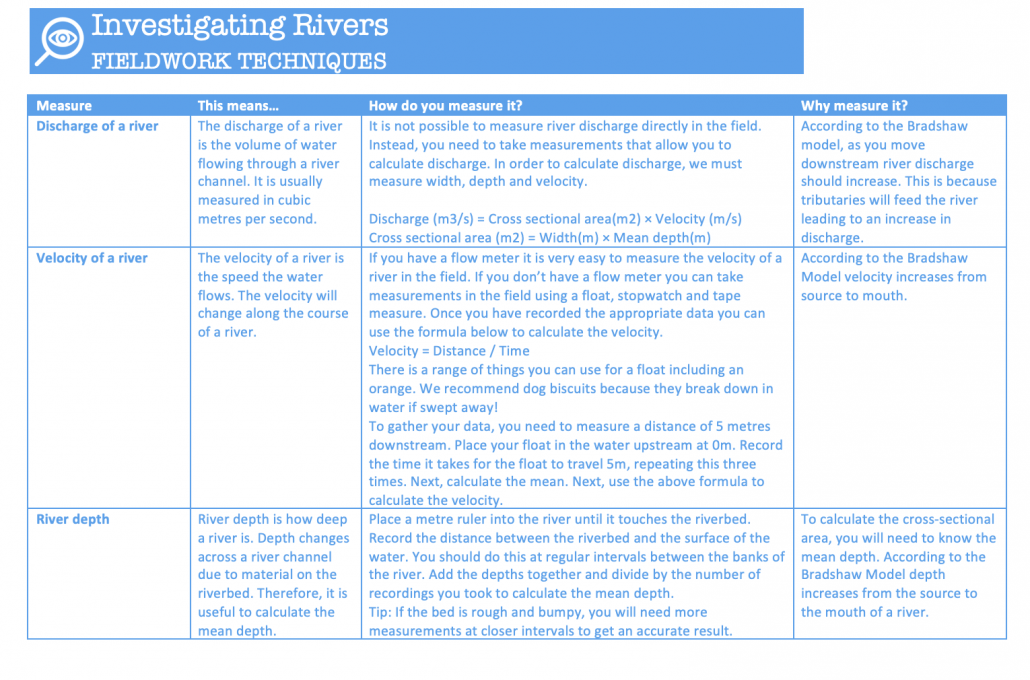
In the next unit, present the students with another image and ask them to formulate questions independently, identify risks along with strategies for managing the risk and complete data presentation and interpretation. Next, spend time examining the fieldwork techniques that will support investigating the geographical question(s)/hypothesis. The students can then select appropriate data collection techniques for their enquiry questions/hypothesis (perhaps from a list of methods suitable for the environment) and justify their choice.
River fieldwork techniques
For homework, they can re-visit their ecosystems enquiry and identify suitable data collection techniques (again, from a list of possible approaches), explaining their choice.
As you move through units, expose your students to further aspects of the enquiry processes, including:
data presentation
data processing
describing, analysing and explaining data
forming conclusions
evaluation
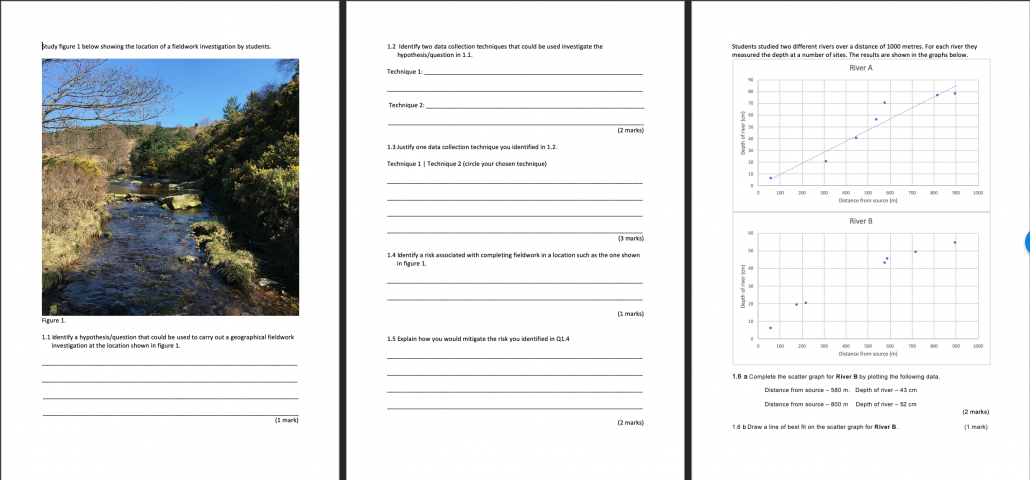
In addition to addressing unfamiliar fieldwork in class, assessments should include unfamiliar enquiry questions from the beginning of the course. Start small and build throughout the course.
Unfamiliar fieldwork questions – rivers
Below is an outline of resources available to Internet Geography Plus subscribers to support with the enquiry process.
I will be sharing further thoughts on how to embed enquiry in the geography curriculum in future posts.
Comments are welcome below!
Anthony
Internet Geography Plus resources to support with enquiry
To support the above approach, we are developing a range of resources for AQA units that cover fieldwork in unfamiliar contexts. These will include:
• exam questions and mark schemes covering unfamiliar fieldwork contexts
• a PowerPoint resource to support the process of tackling unfamiliar fieldwork contexts in a range of units
• examples of techniques used in a variety of fieldwork investigations
• example fieldwork enquiries
Our first set of resources, available to Internet Geography Plus subscribers include:
Did you know? Our Geography Curriculum Tracking Tool allows you to plan for progression in developing enquiry skills. The tracking tool is useful, not just for planning for progression, but is handy if you suffer a ‘deep dive’.
If you have any resources to share in this area, please send them over to [email protected].
Questions based on students’ individual enquiry work
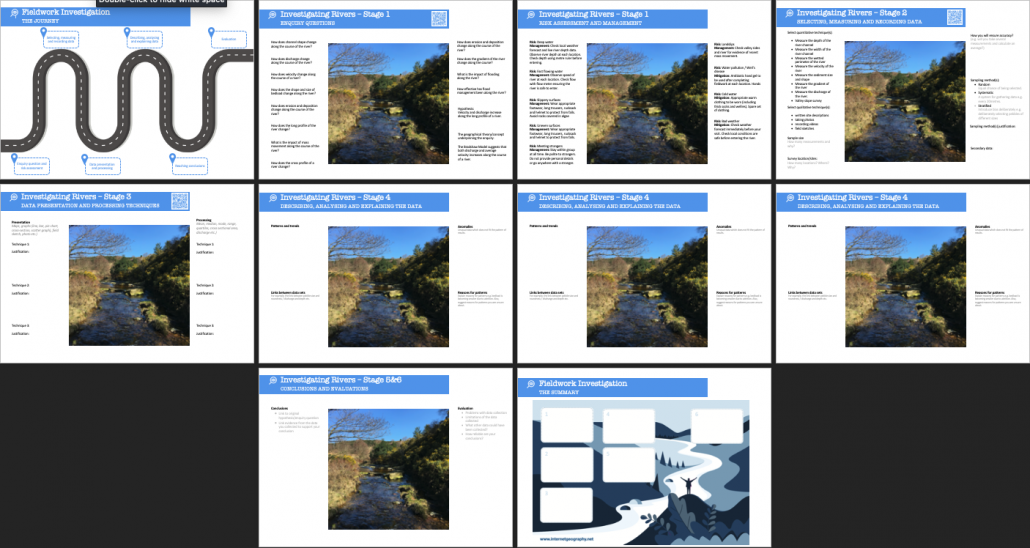
We are currently developing resources to support students in the enquiry process. These guides will take the students through the enquiry sequence and will provide examples of what they need to consider. The A3 resources are fully editable so you can customise them to meet the needs of your students. Each resource pack also contains an overview of the enquiry process and a summary document they can complete at the end of the investigation to support revision.
Fieldwork investigation guide – rivers (available to download in the Internet Geography Plus area)
https://www.internetgeography.net/wp-content/uploads/2020/02/Identify-enquiry-questions-and-risks-associated-with-the-deciduous-forest.png697927Anthony Bennetthttps://www.internetgeography.net/wp-content/uploads/2024/01/Internet-Geography-Logo.pngAnthony Bennett2020-02-23 18:49:112026-06-16 15:06:49Strategies for embedding geographical enquiry into the GCSE curriculum
Communities along the Calder Valley in West Yorkshire are assessing the damage following severe flooding caused by Storm Ciara.
The Environment Agency said about 100mm of rain fell in a 12-18 hour period, leading to “raging torrents” in places.
Calderdale Council said 500 homes and about 400 businesses had been flooded.
The area was devastated by flooding at Christmas in 2015 and millions of pounds were invested in flood defences.
However, some of those, including a £30m scheme in Mytholmroyd, are not due to be completed until the summer.
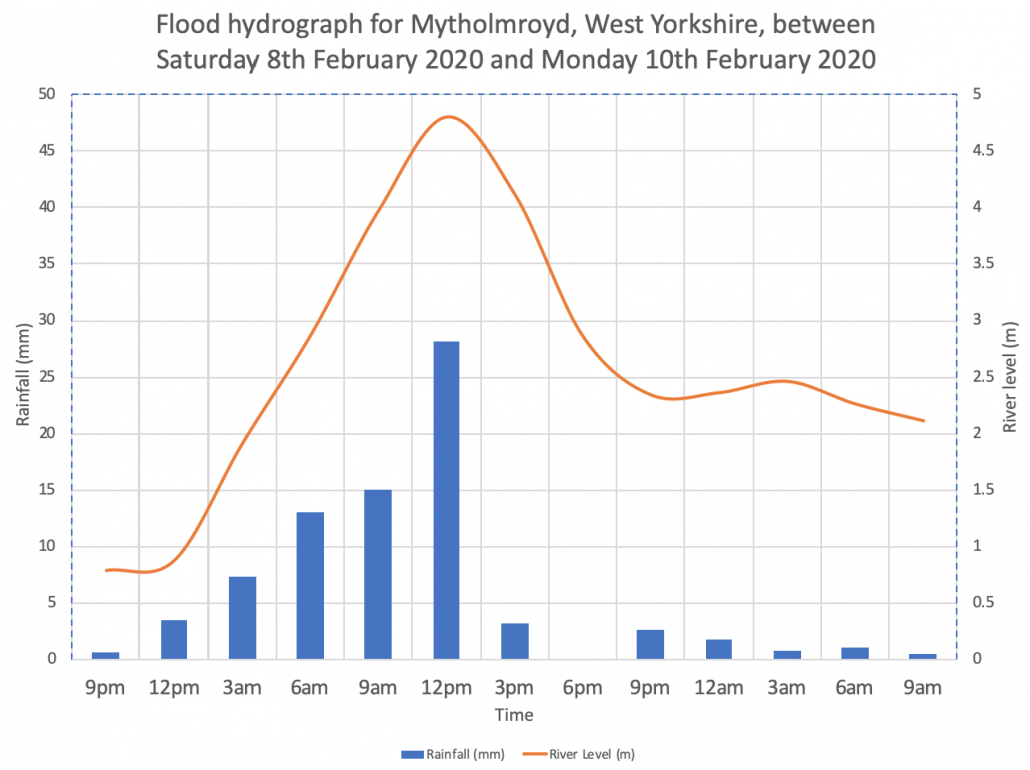
The flood hydrograph below shows the level of the River Calder at Mytholmroyd, West Yorkshire along with rainfall levels. Bankfull discharge for the river at this point is around 3.8m.
The graph shows a very short lag time. Rainwater is quickly entering the river channel. Poor management of moorland in the upper stages of the river was blamed for the flood event that affected the area in 2015.
Flood Hydrograph for Mytholmroyd
You can download the spreadsheet containing the raw data and hydrograph here.
I thought it would be really useful to map the impacts of Storm Ciara, given it affected almost all of the British Isles. I’ve set up a map in Google My Maps and hope you can contribute to it by adding at least one impact you are aware of. This could be something that occurred in your local area or somewhere else in the country. If you have images or videos to contribute you can upload them too! I’ve put together a quick video guide to show how you can contribute to the map. Please watch the video below so you have a clear idea of how to contribute to the map.
https://www.internetgeography.net/wp-content/uploads/2020/02/Mapping-the-Impacts-of-Storm-Ciara.png567995Anthony Bennetthttps://www.internetgeography.net/wp-content/uploads/2024/01/Internet-Geography-Logo.pngAnthony Bennett2020-02-10 14:58:072020-02-10 15:07:41Mapping the Impacts of Storm Ciara
If you’ve not seen 7.7 Billion People and Counting Horizon documentary by Chris Packham, you really should. Chris presents the causes and effects of exponential population growth on Earth in a way that is accessible.
The episode is full of synoptic links and effectively brings together many units of the GCSE specification including development/economic challenges, urban environments, resources and ecosystems.
It really is worth showing this programme to GCSE groups to help them see the big picture of their GCSE course. No other programme, to my knowledge, does it as well as this one.
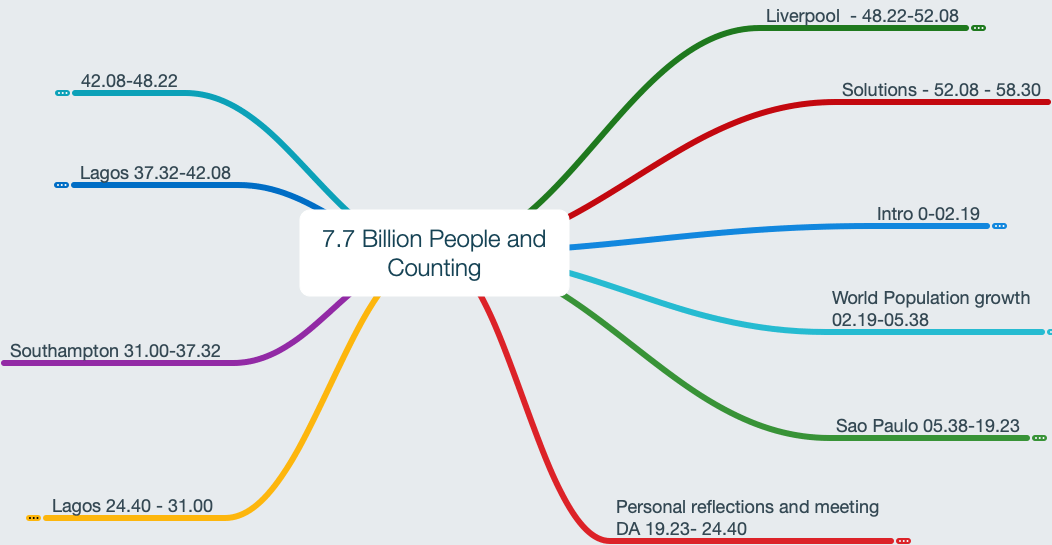
The diagram below provides a breakdown and timings for the episode if you want to ‘cherry-pick’ elements of the programme.
Outline and timings for 7.7 Billion People and Counting
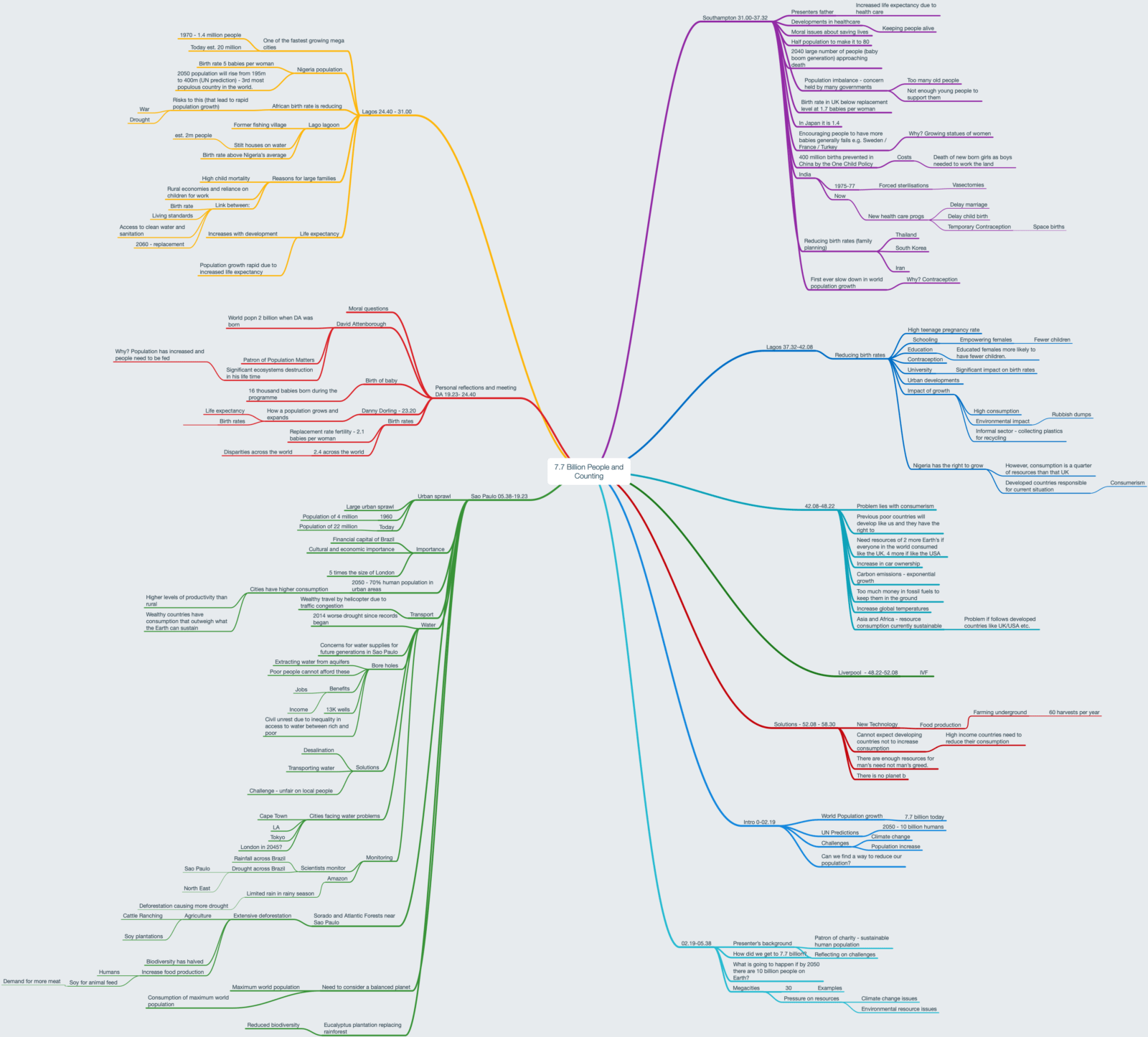
A more detailed break down is provided below.
Detailed outline and timings for 7.7 Billion People and Counting
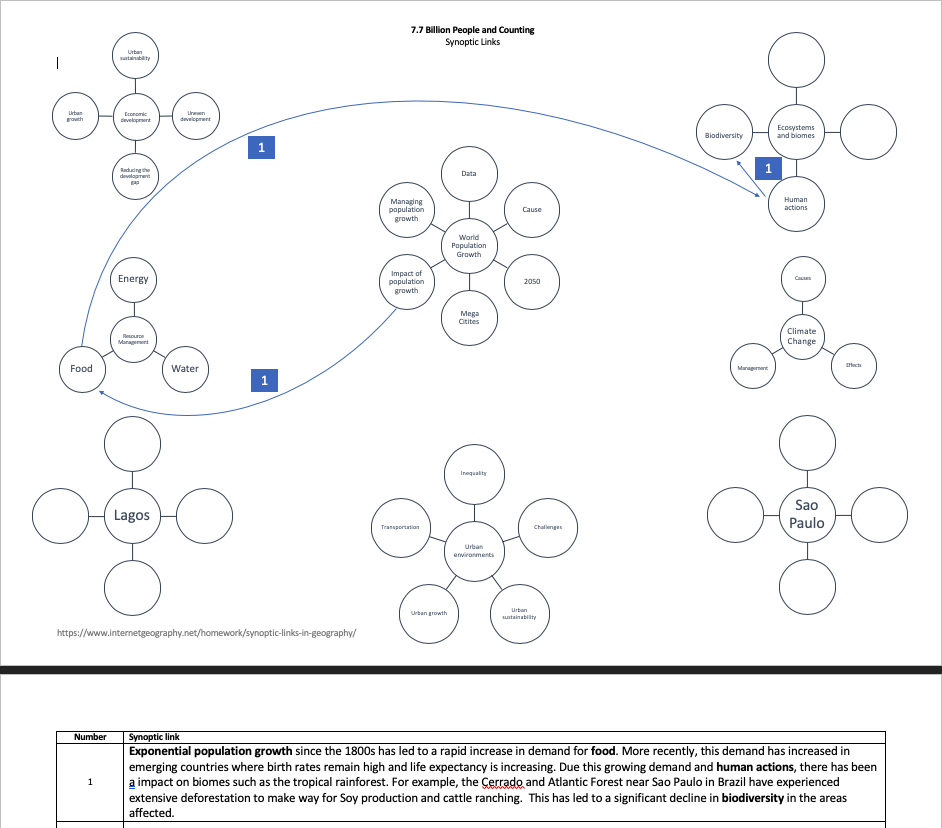
We’ve also developed an exercise for students to investigate synoptic links explored in the programme.
7.7 Billion People and Counting Synoptic Links
In this exercise, students are to complete the unpopulated circles around key concepts and case studies. Once they have done this they are to develop links between the different aspect of geography covered in the programme. An example of this has been included (see line 1 above). The students then discuss how these different elements are connected.
If you have any resources you’ve developed around this programme we’d really appreciate it if you shared then with us to post on the site. Please email them to [email protected].
These resources are available due to support by Internet Geography Plus subscribers. Please help us further develop the site by taking out a low-cost subscription.
https://www.internetgeography.net/wp-content/uploads/2020/01/7.7-Billion-People-and-Counting-2.png5451052Anthony Bennetthttps://www.internetgeography.net/wp-content/uploads/2024/01/Internet-Geography-Logo.pngAnthony Bennett2020-01-22 15:24:262020-01-22 15:39:377.7 Billion People and Counting
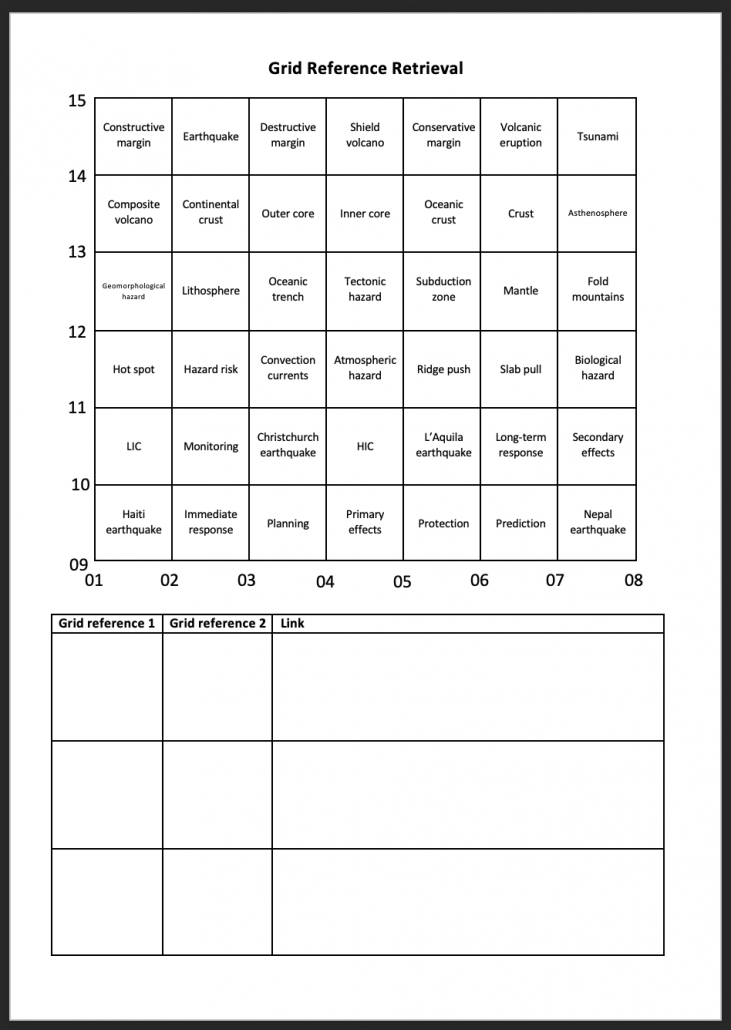
Grid reference retrieval is a simple way of encouraging students to recall information and make links between different elements within a unit of study. It provides the opportunity for students to re-visit grid references then make connections between what they have been learning.
A pre-requisite of completing an activity like this requires the students to have already studied the unit, so it is ideal for revisiting learning and making links.
Grid reference retrieval can also be further developed to include multiple units, encouraging students to make synoptic links.
Another way this activity can be developed is to colour code the squares and allocated points to the colours. More challenging elements should carry a higher tariff to encourage students to tackle these elements of the unit.
There are a range of different ways this resource can be used in the classroom, including:
students working independently
providing students with grid references (could be differentiated by ability)
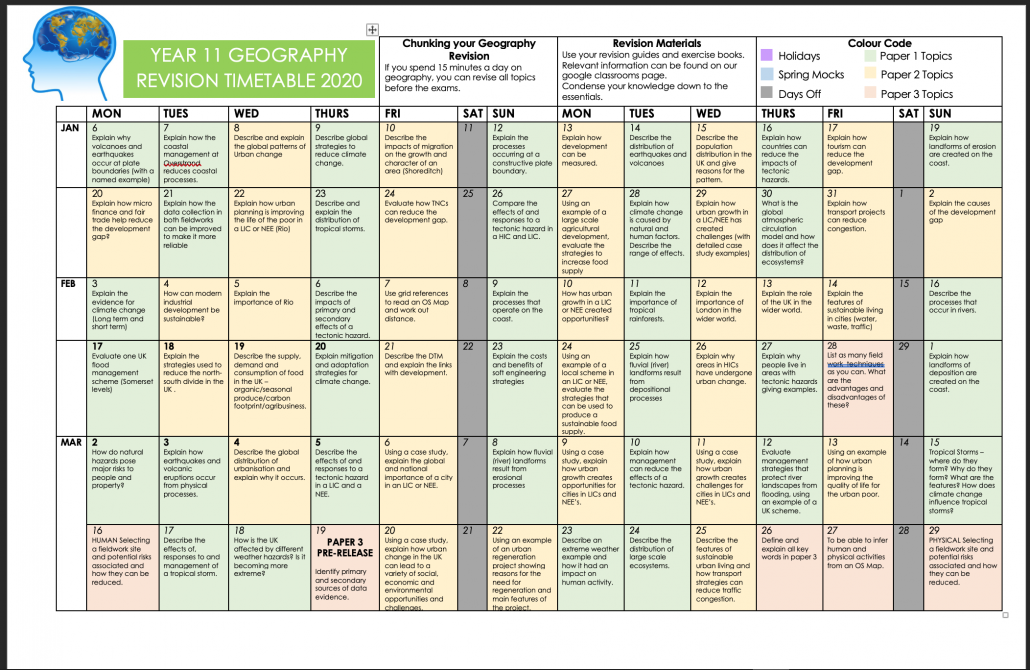
Last year, we shared a fantastic revision timetable for AQA GCSE Geography developed by Laura Gregson (@grego_geog), inspired by @MrThorntonTeach.
This year, Charlotte Clarke (of @HornseyGeog) has been the first to share a version for 2020. There are some repeated questions that cover areas Charlotte’s students need to revisit. However, it is fully editable, so you can customise it for your students. If you do customise it, please send us a copy to share here via [email protected]