From drought in England to catastrophic flooding in Nepal, summer 2026 has produced some remarkable geography. But the biggest stories haven’t only been about natural hazards. Tourism, trade and the challenges facing our cities have also made the headlines.
Here are six geographical stories that have shaped the summer.
England runs short of water
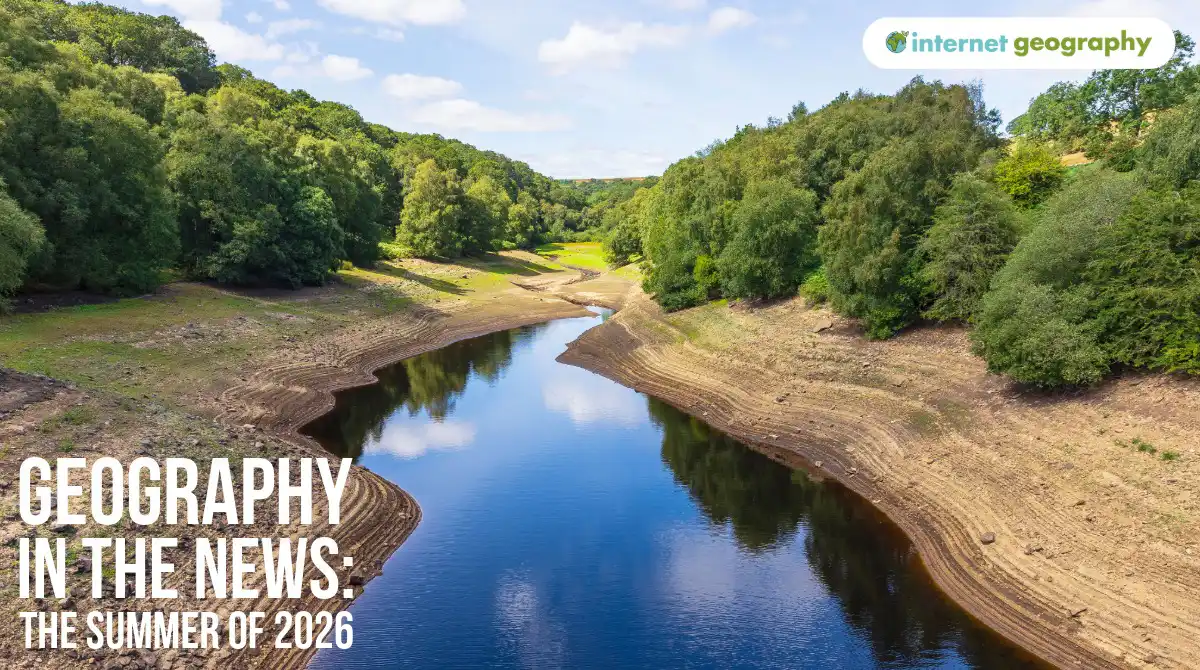
For millions of people in England, summer 2026 has been dominated by heat and a lack of rainfall.
England experienced four heatwaves during summer 2026, accompanied by exceptionally dry conditions. July was the driest on record for England and Wales, while repeated periods of hot weather increased demand for already limited water supplies. By mid-August, more than 70% of England was experiencing drought conditions.
Reservoir levels and river flows fell, water-use restrictions were introduced in some areas, and farmers faced difficulties as soils dried. Low river levels affected wildlife, while dry vegetation increased the risk of wildfires.
Persistent areas of high pressure contributed to the conditions by bringing sinking air, limited cloud cover and little rainfall.
The drought also created a human geographical problem. Homes, farms, businesses and the natural environment all need water.
When there isn’t enough water available, who should get priority?
Edinburgh starts charging visitors
Tourists visiting Edinburgh this summer encountered something new.
On 24 July, the city introduced a 5% visitor levy on the cost of the first five nights of paid accommodation.
Tourism is extremely important to Edinburgh’s economy. Visitors support hotels, restaurants, shops and thousands of jobs, particularly during the city’s famous summer festivals.
However, large numbers of tourists also put additional pressure on transport, public spaces and local services. Money raised by the levy will be used to support the city’s infrastructure, culture and heritage.
Edinburgh is not alone. Popular destinations across Europe are looking for ways to manage overtourism, including concerns about overcrowding and holiday accommodation making housing less affordable for local people.
It creates an interesting geographical conflict:
How can cities benefit from tourism without damaging the quality of life of the people who live there?
Heat and drought disrupt Europe
England has not been alone in experiencing extreme summer weather.
Parts of Europe experienced repeated periods of extreme heat and drought, while hot, dry vegetation contributed to wildfires across southern Europe.
Drought also caused water levels to fall along important European rivers, including the Rhine.
This matters economically as well as environmentally. The Rhine is one of Europe’s most important transport routes. When water levels fall, cargo vessels may have to carry smaller loads to avoid running aground.
Businesses then need more vessels to move the same quantity of goods, or must shift freight to roads and railways, thereby increasing transport costs.
This demonstrates how closely physical and human geography are connected:
Less rainfall → lower river levels → reduced cargo loads → higher transport costs → impacts on businesses and consumers.
Extreme heat reaches East Asia
Extreme temperatures have not been limited to Europe.
Parts of East Asia recorded temperatures exceeding 40°C during summer 2026.
Extreme heat is particularly challenging in large cities. Concrete, tarmac and buildings absorb heat during the day and release it slowly, contributing to the urban heat island effect, where urban areas can be warmer than their rural surroundings.
People are adapting by changing working hours, creating more shaded areas and using air conditioning.
However, not everyone can adapt equally well. Wealthier households and countries are generally better able to afford cooling, well-designed buildings and reliable electricity.
Extreme heat is therefore not simply a weather story. It is also about cities, development and inequality.
Catastrophic flooding hits Nepal
One of the most devastating events of the summer occurred in Nepal on 26 August.
High in the Himalayas, a huge mass of ice and rock collapsed from a glacier. The collapse produced a powerful surge of water, mud, ice and rock that travelled rapidly downstream through steep valleys.
Along the Trishuli River, water levels reportedly rose by around nine metres in just 30 minutes, leaving communities downstream with very little time to escape.
By 30 August, more than 700 people had died, and around 2,500 remained missing. Roads, bridges, homes and hydroelectric infrastructure were destroyed or damaged.
Nepal’s steep mountain valleys increase vulnerability because settlements and important transport routes are often concentrated along narrow valley floors.
Scientists are investigating exactly why the glacier collapsed. Rising temperatures, driven by climate change, are causing widespread changes in glaciers across the Himalayas and are likely to increase the likelihood of events such as ice and rock collapses. However, scientists cannot yet say that climate change directly caused this particular event.
The disaster demonstrates that the severity of a hazard depends not only on the physical process, but also on exposure, vulnerability and the amount of warning people receive.
A powerful earthquake strikes Indonesia
Not every major geographical event this summer has been connected to weather and climate.
A powerful magnitude 7.7 earthquake struck the Flores Sea in eastern Indonesia in August.
Indonesia experiences frequent earthquakes because it lies close to several tectonic plate boundaries within the Pacific Ring of Fire.
Movement along faults releases accumulated pressure, sending seismic waves through the Earth and causing the ground to shake.
The earthquake damaged buildings and infrastructure, forcing people from their homes.
However, magnitude alone does not determine the severity of an earthquake disaster. Building quality, population density, emergency services, infrastructure and levels of development all influence how badly communities are affected.
What does the summer of 2026 tell us about geography?
At first, these six stories seem very different.
What does a tourist paying extra for a hotel in Edinburgh have to do with a cargo ship on the Rhine or a glacier collapsing in Nepal?
Geography helps us see the connections.
Weather affects water supplies, ecosystems and transport. Transport affects businesses and trade. Tourism creates jobs but can place pressure on housing and services. Natural processes create hazards, but people’s wealth, infrastructure and preparedness influence their impacts.
Summer 2026 demonstrates why physical and human geography cannot always be separated.
They constantly interact.
Understanding our changing world means understanding people, places, environments and the connections between them.