
Extreme weather in the UK: June 2026 heatwave
In late June 2026, the UK experienced one of its most significant heatwaves on record. The event is a useful GCSE Geography example of a recent extreme weather event in the UK because it caused record-breaking temperatures, health warnings, school closures, rail disruption, pressure on hospitals and growing concern about water supplies.
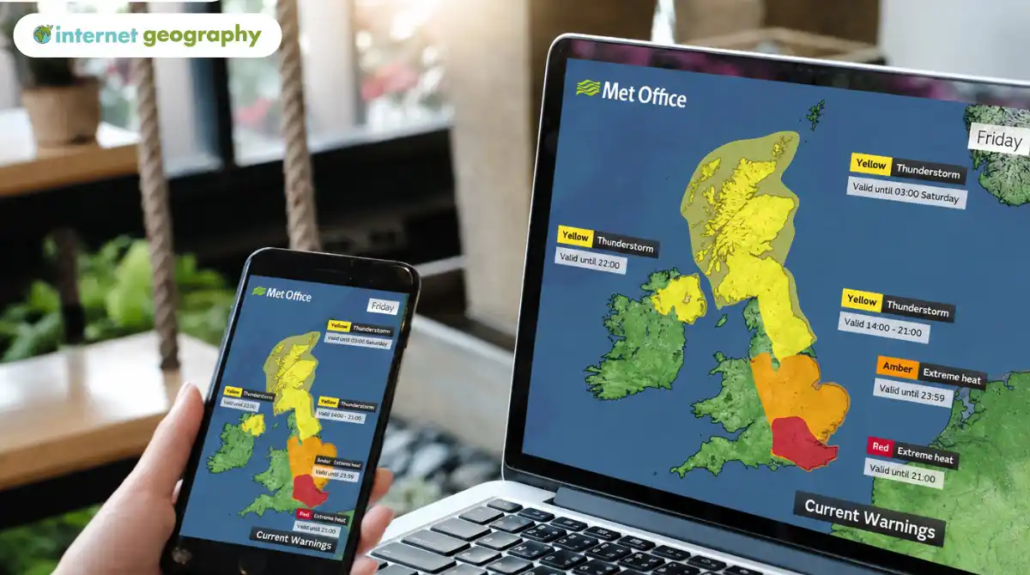
The heatwave affected much of England and Wales, but the most extreme conditions were in southern and central England, south-east England and parts of Wales. The Met Office issued red extreme heat warnings for three consecutive days, the first time this had happened since the current UK weather warning system began. The red warning for Friday 26 June covered parts of London, the Home Counties and south-east England, where temperatures were expected to exceed 36°C and possibly reach 37°C.
The heatwave broke UK June temperature records. On 25 June 2026, the UK provisionally recorded 36.7°C at Merryfield in Somerset, beating the June record for the second day in a row. Wales also provisionally recorded its hottest June day, with 35.9°C at Bute Park in Cardiff. The same location recorded a provisional UK June highest overnight minimum temperature of 23.5°C, showing that the heat continued through the night and gave people little chance to cool down.
What is a heatwave?
A heatwave is a period of unusually hot weather lasting several days. In the UK, the Met Office defines a heatwave as at least three consecutive days when daily maximum temperatures meet or exceed the local heatwave threshold. These thresholds vary across the UK because some areas are normally warmer than others.
Heatwaves are not only about daytime temperatures. Warm nights can be especially dangerous because the human body has less chance to cool down and recover. Humidity can also make heat feel more uncomfortable because sweat evaporates less easily, reducing the body’s ability to cool itself.
Causes of the July 2026 heatwave
The heatwave was caused by a combination of weather conditions and longer-term climate change.
A large area of high pressure developed over or near the UK. High pressure brings sinking air, clear skies and settled weather. With little cloud, strong June sunshine heated the ground for long periods each day. The high pressure also helped draw very warm air northwards from continental Europe towards the UK.
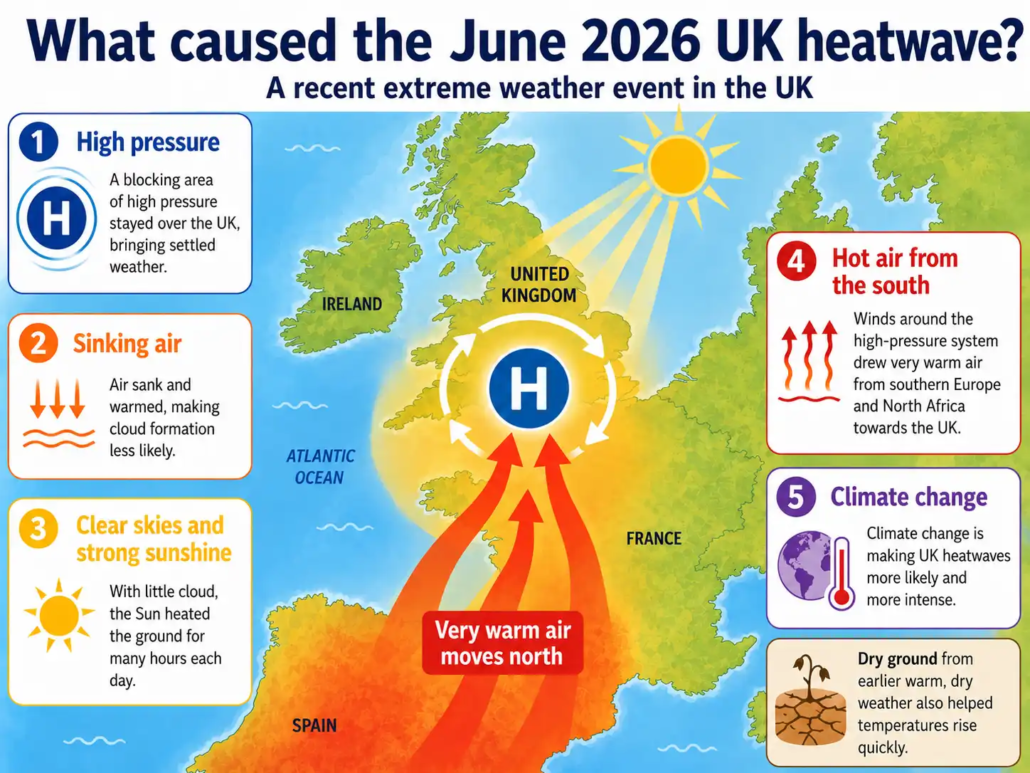
The wider European heatwave was linked to a slow-moving atmospheric pattern known as an Omega block. This type of blocking pattern can trap hot air over the same region for several days, allowing temperatures to build. Reuters reported that the European heatwave pushed temperatures up to 18°C above seasonal norms in some areas, with the UK experiencing several days of record-breaking June heat.
The heatwave also followed a very dry spring. Dry ground heats up more quickly than wet ground because less energy is required to evaporate water from the soil. This helped temperatures rise rapidly during the hot spell. The Environment Agency reported that the dry spring had already affected crops, especially in the east and south-east of England, before the late-June heatwave added further pressure.
Climate change made the event more severe. The Met Office stated that human-induced climate change has made heatwaves like this more likely and more intense. This means that when the same type of weather pattern develops today, it can produce higher temperatures than it would have done in the past.
Social impacts
The heatwave created serious health risks. The UK Health Security Agency issued red heat-health alerts for six English regions: London, the South East, the South West, the East of England, the West Midlands, and the East Midlands. A red heat-health alert means the heat can affect the wider population, not just people usually considered vulnerable.
Schools were directly affected. Reuters reported that more than 1,000 schools in Britain closed, either fully or partially, during the heatwave, with some classrooms reaching temperatures over 40°C. This disrupted lessons, childcare and exam preparation, and it showed how many UK school buildings are not designed for extreme heat.
Hospitals also struggled. The Guardian reported that hospitals in England declared critical incidents as heat affected medical equipment, IT systems and cooling systems. Reported problems included disruptions to radiotherapy machines, MRI scanners, and hospital cooling systems, with some wards reaching temperatures of up to 35°C.
No official UKHSA figure for heat-related deaths from the 2026 heatwave had been published at the time of writing. However, the red heat-health alerts show that the event was considered a risk to life, including for healthy people.
Economic impacts
The heatwave caused major transport disruption. Network Rail urged passengers travelling to, from or within extreme heat warning areas to travel only if absolutely necessary. This was because high temperatures can cause rails to expand and increase the risk of track buckling. To reduce risk, trains were expected to run more slowly and on amended timetables.
Rail disruption affected commuters, businesses and leisure travel. Al Jazeera reported that on one day of the heatwave, 2,600 rail services were cancelled or delayed, showing how extreme heat can quickly affect the economy by preventing people from travelling to work and appointments.
The NHS also faced economic pressure because cancelled appointments, equipment failure and emergency demand all increase costs. The Scottish Sun reported that three hospitals declared critical incidents and at least 362 outpatient appointments were cancelled, although this figure should be treated as a reported figure rather than a final national total.
Farming was affected too. The Environment Agency said irrigation demand was high, and some reservoirs used by farmers were only 50% to 60% full. The dry spring had already affected crops in eastern and south-eastern England, and the heatwave increased pressure on water use and livestock needs.
Environmental impacts
The heatwave increased pressure on rivers, reservoirs and water supplies. The Environment Agency reported that heatwave conditions were adding pressure to water use, especially where reservoirs were already low. Some irrigation reservoirs were only 50% to 60% full, which mattered because farmers needed more water at the same time as supplies were under pressure.
The dry weather increased stress on crops and grassland, especially in the east and south-east of England. Lower soil moisture makes it harder for plants to grow and can reduce crop yields. Livestock farmers also faced pressure because animals need more water in hot weather and grass growth can slow during dry periods.
The heatwave also increased wildfire risk. Dry vegetation catches fire more easily, particularly on grassland, heathland and moorland. Although major national wildfire totals for this event had not yet been confirmed, the combination of high temperatures, dry ground and strong sunshine created conditions in which fires could start and spread more easily.
How was the June 2026 heatwave managed?
The main short-term management strategy was the use of warning systems. The Met Office issued red extreme heat warnings, while the UKHSA issued red heat-health alerts. These warnings gave schools, hospitals, transport operators, care homes, local authorities and the public time to prepare.
Transport operators used risk-reduction measures. Network Rail advised people in areas under an extreme heat warning to avoid non-essential rail travel, check before travelling, and carry water. Slower trains and amended timetables reduced the risk of accidents from heat-damaged tracks.
Schools used short-term adaptations such as closing fully or partially, changing timetables, moving pupils out of the hottest rooms and following government heat guidance. The Department for Education reminded schools that children are at greater risk of heat-related illness than adults and pointed them to UKHSA guidance for hot weather.
London also used the heatwave to launch a longer-term response. The Mayor of London introduced Heat Ready London, the capital’s first city-wide heat plan. The plan said around one million London homes may be at high risk of overheating. It also identified 1,361 schools, 60 hospitals, and 351 care homes in high-heat-risk areas. The plan focuses on protecting vulnerable people, retrofitting buildings, expanding cooling spaces and making infrastructure more resilient.
Why this matters
The July 2026 heatwave shows that extreme weather in the UK is not only about storms and floods. Heat can close schools, disrupt railways, damage health services, affect farming and increase pressure on water supplies.
It also shows that the UK is still adapting to a warming climate. Many schools, hospitals, homes and transport systems were built for a cooler climate. As heatwaves become more frequent and intense, the UK will need stronger warning systems, cooler buildings, more shaded urban spaces, better water management and infrastructure designed to cope with higher temperatures.
Online Resources
Met Office – June 2026 heatwave: A recap of the temperature records