
Do you remember Storm Éowyn? What about Storm Babet, Storm Ciarán or Storm Arwen?
Over the last few years, named storms have become a familiar part of the UK weather forecast. When one is approaching, its name can quickly appear everywhere – on television forecasts, weather apps, social media and news websites.
Some have been particularly memorable. Storm Arwen brought destructive winds to the UK in November 2021, with a gust of 98 mph recorded at Brizlee Wood in Northumberland. More than one million homes lost power during the storm. Storm Babet brought exceptional rainfall and severe flooding in October 2023, while Storm Éowyn in January 2025 became the UK’s most powerful windstorm for more than a decade. A gust of 100 mph was recorded at Drumalbin in South Lanarkshire.
But have you ever wondered who actually chooses the names?
And, perhaps more importantly, what does a storm have to do before it earns one?
Meet the storms of 2026–27
The official storm names for the 2026–27 season have now been announced.
There are 21 names on this year’s list:
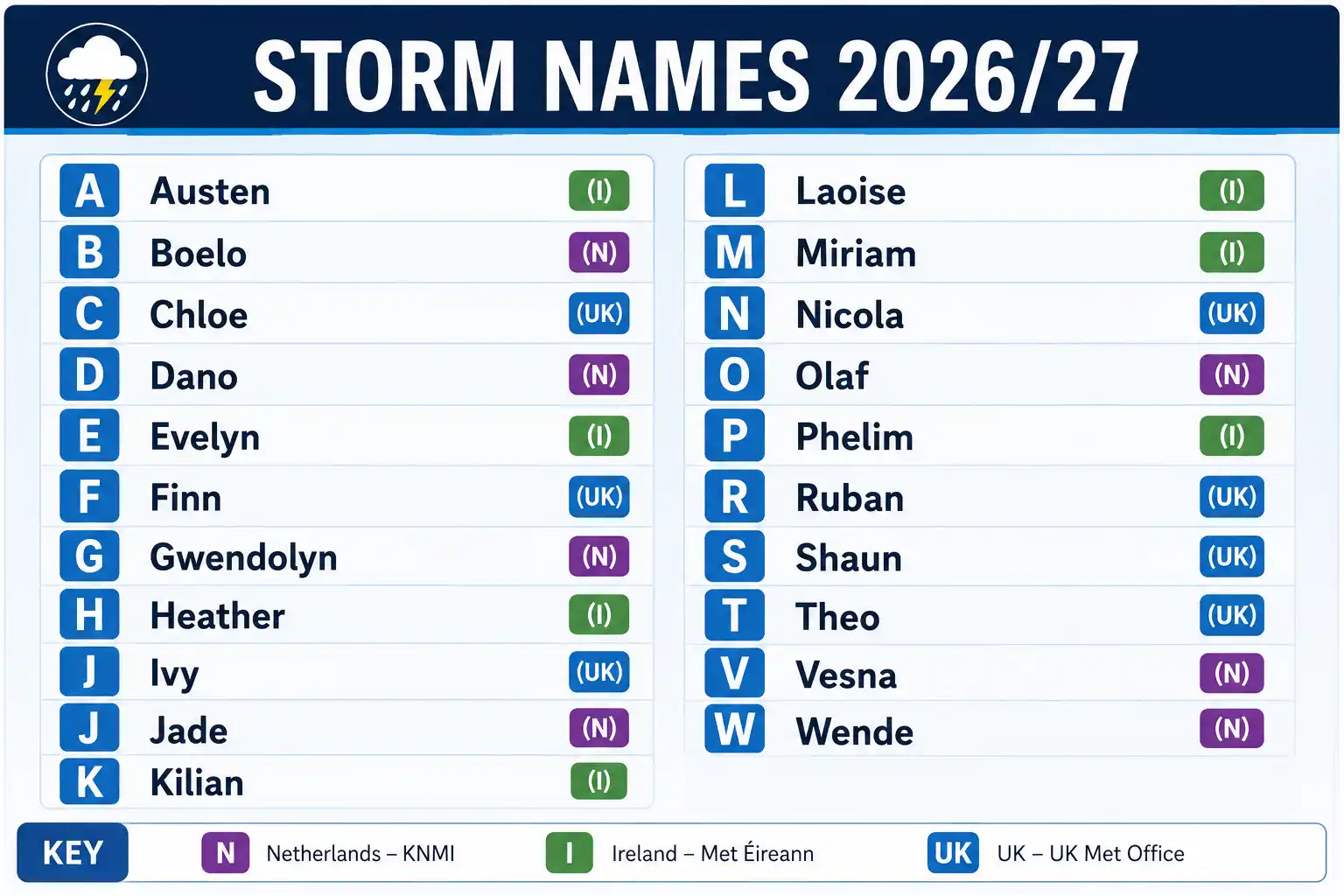
You may have spotted something unusual. There is no Q, U, X, Y or Z.
These letters are left out to keep the system consistent with international storm-naming conventions, since relatively few names begin with them.
The names are used in alphabetical order. Therefore, if the first storm of the season is named by this group, it will be Storm Austen. If enough severe storms occur to reach S, we could eventually meet Storm Shaun.
However, reaching the end of the alphabet is far from guaranteed. During 2025–26, the group only reached D.
Three countries, one list
Britain does not choose its storm names on its own.
The UK’s Met Office works with Met Éireann, the Irish meteorological service, and the Royal Netherlands Meteorological Institute (KNMI).
Together, they form the western European storm-naming group.
The UK and Ireland began working together on storm naming in 2015. The Netherlands joined them in 2019, partly because many of the storms affecting the Netherlands approach from the west.
For 2026–27, each weather service contributed seven names, producing the combined list of 21.
This means that some names may look or sound less familiar in the UK. For example, Laoise is pronounced roughly Lee-sha, while the Dutch name Boelo is pronounced Boo-loh.
It also means that a storm does not receive a different name each time it crosses a national border. If Ireland names a storm that subsequently moves towards Britain and the Netherlands, the same name follows it.
That makes communicating information about dangerous weather much easier.
Who chooses the names?
You do.
Well… possibly.
Members of the public are invited to suggest names, and tens of thousands are submitted. More than 40,000 suggestions were sent to the Met Office for consideration ahead of the 2026–27 list.
However, choosing the final names involves more than pulling suggestions out of a hat.
Weather services consider whether a name is easy enough to pronounce, whether it could have an unfortunate meaning in another participating country and whether it is associated with a significant public figure. Political, controversial and commercial names are also avoided.
The result is a surprisingly personal list.
Chloe, for example, was nominated more than 130 times. One nomination came from the mother of a five-year-old girl who loves weather – and who apparently manages to create something of a storm herself when she is tired.
Finn was suggested in honour of a two-year-old described by his family as “wild and a force to be reckoned with”.
Then there is Ivy.
Ivy isn’t a meteorologist, scientist or famous explorer. She is a nine-month-old Labrador puppy whose family affectionately describes her as the “absolute destructor”.
On that basis, Storm Ivy might be an appropriate name.
Theo is another animal-inspired choice. He was a cat who became frightened and hid before thunderstorms, causing his owner to joke that he could predict the weather.
Other names have much more serious stories behind them. The Dutch name Jade was submitted hundreds of times as a tribute to 19-year-old Jade Kops, who died from cancer in 2026.
Ireland looks back at 90 years of forecasting
Ireland has taken a slightly different approach to some of its choices this year.
In 2026, Met Éireann celebrates the 90th anniversary of the Irish Meteorological Service, which was established in 1936. Four of Ireland’s seven names therefore recognise important people from its history.
Austen honours Austen H. Nagle, the first director of the Irish Meteorological Service.
Evelyn remembers Evelyn Murphy, the first woman to present the weather on Ireland’s national television service.
Kilian recognises a former director of Met Éireann, while Miriam commemorates its first female meteorologist.
The remaining Irish choices, Heather, Laoise and Phelim, were suggested by members of the public.
There’s something different about Shaun
One name on the UK list is particularly recognisable.
Shaun.
Not just any Shaun, either.
Shaun the Sheep.
The Met Office teamed up with British animation studio Aardman, the company behind Shaun the Sheep and Wallace & Gromit, for an unusual public vote.
People were asked to choose between two Aardman characters – Shaun or Timmy – for a place on the official list.
Shaun won.
There is a serious geographical purpose behind the fun. The collaboration was designed to introduce storm naming and weather warnings to new audiences, particularly families and younger people.
If the 2026–27 season reaches its eighteenth name, Storm Shaun will therefore become a real weather event rather than an animated adventure.
Does every storm get a name?
No.
Britain experiences many areas of low pressure every year, but most never receive names.
A storm is normally named by the western group when forecasts suggest it could cause medium or high impacts in the UK, Ireland or the Netherlands.
This will often be associated with the possibility of amber or red weather warnings.
Strong wind remains one of the main reasons for naming a storm, but wind speed alone does not determine whether one receives a name.
Meteorologists consider its likely impacts.
Heavy rainfall and the risk of flooding can therefore result in a storm being named. Significant snowfall can also be considered.
This explains why some relatively windy days remain nameless while another weather system becomes a named storm.
Who gets to name an approaching storm?
Imagine a powerful Atlantic depression developing west of Ireland.
Which of the three countries gets to name it?
Generally, the weather service expecting the greatest impacts, or the country likely to experience the severe weather first, will assign the next name from the list.
Once named, everyone uses it.
There is another twist.
Europe has several storm-naming groups. If a storm has already been named by another European meteorological service, it normally keeps that name as it moves towards the UK.
That is why not every storm affecting Britain follows the alphabetical sequence on the UK-Ireland-Netherlands list.
During the 2025–26 season, for example, the western group named Amy, Bram, Chandra and Dave. However, Britain was also affected by Benjamin, Claudia and Goretti, which had been named elsewhere in Europe.
The atmosphere, unsurprisingly, pays little attention to national borders.
Why bother naming storms at all?
Imagine hearing this warning:
“A rapidly deepening area of low pressure will cross the country overnight.”
Now compare it with:
“Storm Shaun will cross the country overnight.”
Which one are you more likely to remember?
That is the idea behind storm naming.
Names give meteorologists, emergency services, journalists and the public a simple way of talking about the same weather system.
They also make it easier to search for forecasts and warnings online and to follow the development of a storm as it approaches.
Evidence suggests this works.
After Storm Goretti in January 2026, Met Office research found that 93% of people within the amber warning area were aware of the warnings. Of those people, 88% took some form of action, including staying at home, avoiding driving or shopping earlier.
Naming a storm might sound like a bit of fun, but its real purpose is much more serious: reducing risk by making people pay attention to severe weather warnings.
A stormy decade
The UK’s storm-naming system is still relatively young.
The Met Office and Met Éireann launched the Name Our Storms project in September 2015. Since then, names such as Arwen, Eunice, Babet, Ciarán and Éowyn have entered everyday conversation during periods of severe weather.
Some seasons have been much busier than others.
The 2023–24 season was exceptionally active, with the western group naming 12 storms, beginning with Agnes in September 2023 and eventually reaching Storm Lilian in August 2024.
By comparison, only four names from the western group’s list were needed during 2025–26.
That is an important point.
Publishing 21 names does not mean meteorologists are predicting 21 storms.
The list is simply ready if they are needed.
So, will we meet Storm Shaun?
Nobody knows.
Weather forecasting has improved enormously, but meteorologists cannot predict exactly how many severe storms will affect north-west Europe over the following 12 months in September.
Perhaps Austen will arrive this autumn.
Perhaps we will make it as far as Chloe, Finn or Ivy.
For Shaun to get his moment in the weather forecast, however, the western European group would have to work its way through 17 earlier names first.
If that happens, Shaun the Sheep appearing on the weather forecast might be amusing.
The weather responsible for putting him there probably won’t be.