
Introduction
In late May 2026, the UK experienced an exceptional early-season heatwave. This was unusual because it occurred in spring, before the main summer heatwave season. The event affected much of England and Wales, with the highest temperatures recorded in southern and central England.
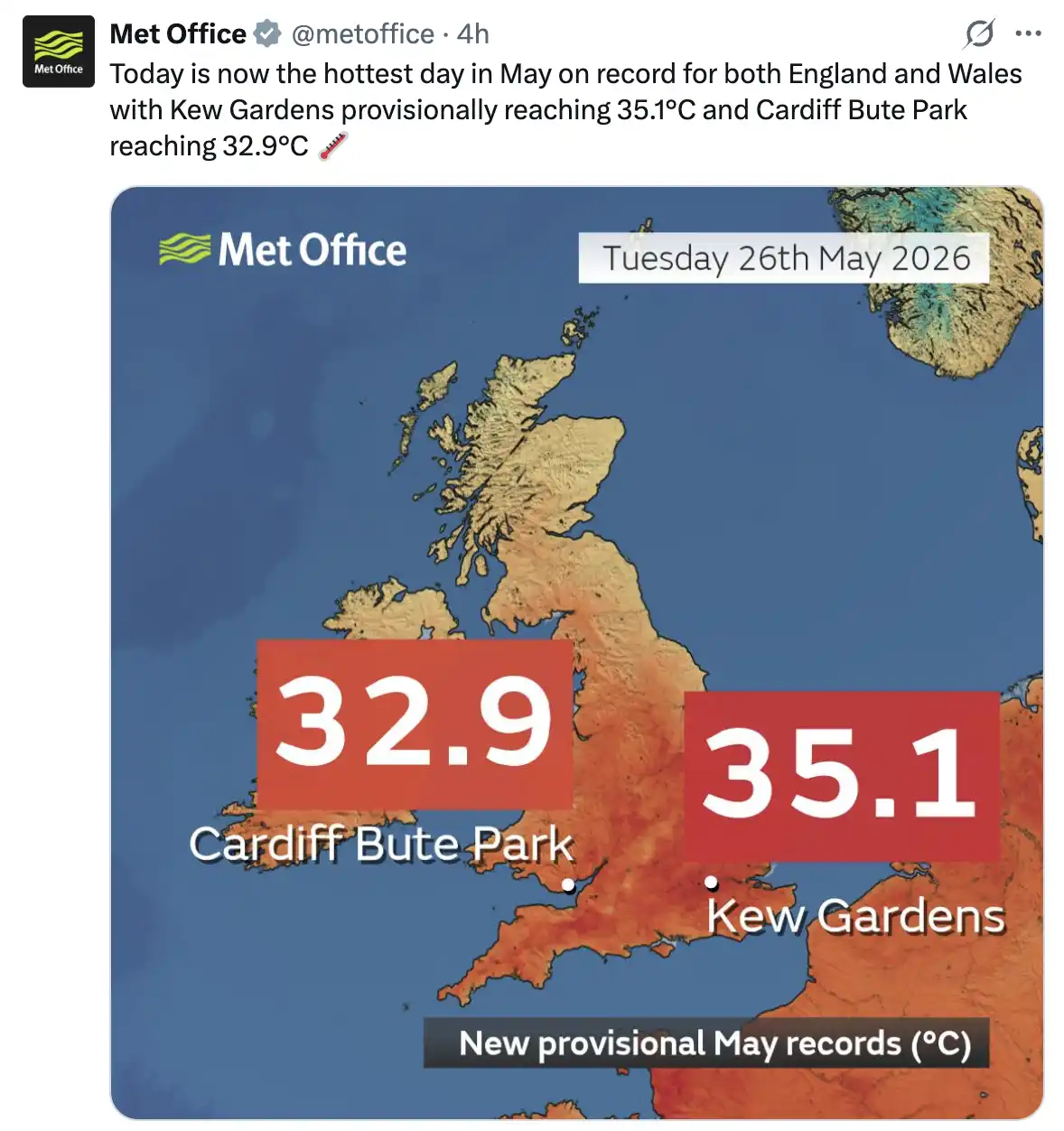
Met Office announcement (May 26th 2026) on X.com
On Tuesday, 26 May, Kew Gardens in south-west London recorded a provisional temperature of 35.1°C, breaking the UK record for the hottest May day for the second day in a row. This beat the previous day’s record of 34.8°C, also recorded at Kew Gardens. Before this heatwave, the UK’s warmest May day was 32.8°C, recorded in 1922 and 1944.
Wales also broke its May temperature record for the second consecutive day. A provisional temperature of 32.3°C was recorded at Cardiff’s Bute Park, beating the previous day’s Welsh May record of 32.2°C at Hawarden Airport in Flintshire.
By Tuesday, much of England and Wales was officially in a heatwave. In the UK, a heatwave is recorded when a place reaches or exceeds its local threshold temperature for three consecutive days. These thresholds vary across the UK, from 25°C in northern and western areas to 28°C in London and the Home Counties.
The heatwave also produced a tropical night, during which the temperature did not fall below 20°C overnight. At Kenley Airfield in south London, temperatures did not fall below 21.3°C. Warm nights are important because they make it harder for people, homes and buildings to cool down, increasing the risk of heat-related illness.
Causes
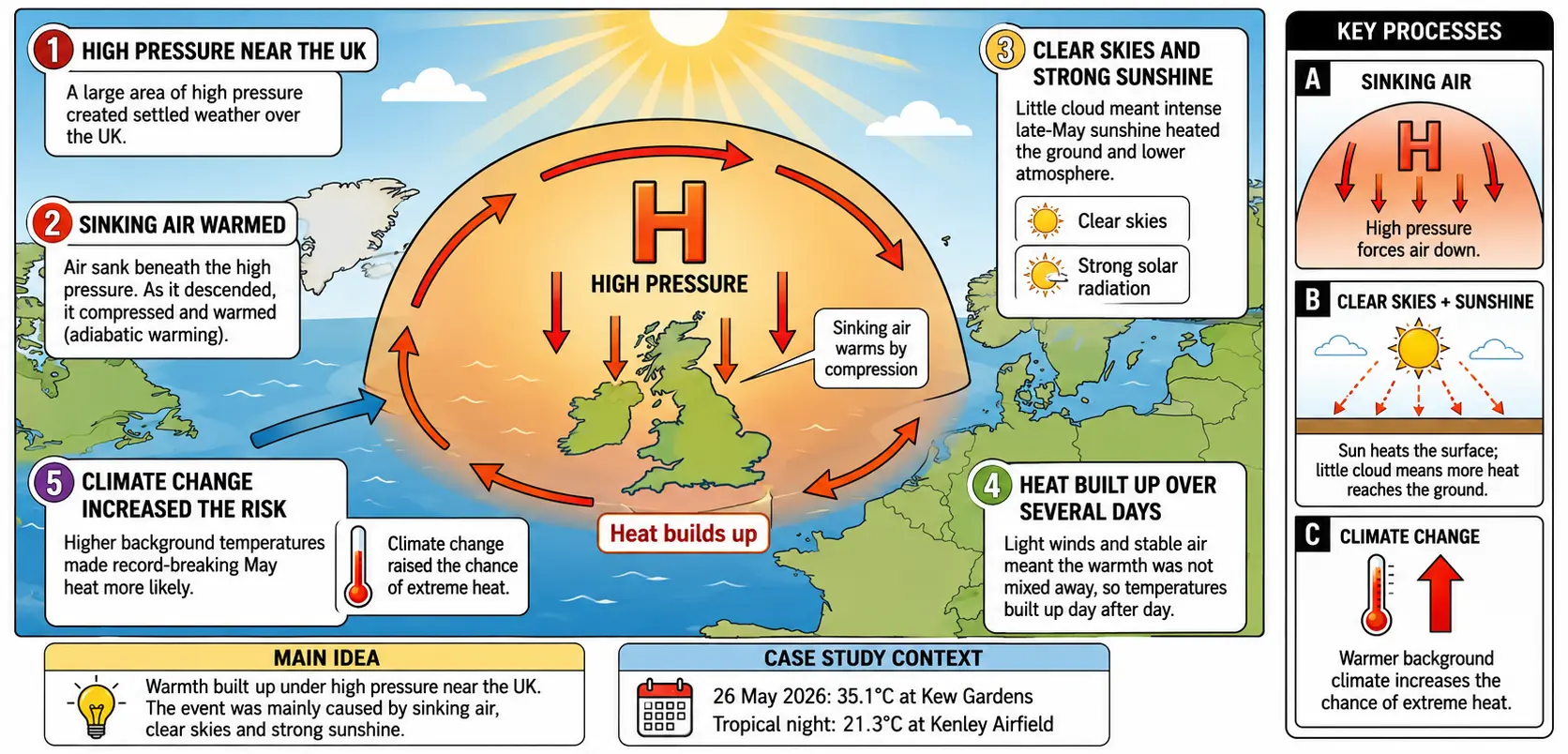
The immediate cause of the May 2026 heatwave was the buildup of warm air beneath an area of high pressure near the UK.
High pressure creates settled weather because air sinks towards the ground. As the air sinks, it is compressed and warms. This process helped temperatures rise rapidly across England and Wales. High pressure also brought clear skies, strong sunshine and light winds, allowing heat to build during the day.
Cause of the 2026 UK heatwave
The heatwave was not simply caused by hot air being brought directly from southern Europe or North Africa. Much of the air affecting the UK had come from the Atlantic, but it warmed as it sank beneath a high-pressure system. This helped create unusually high temperatures for May.
Urban areas such as London were particularly affected because of the urban heat island effect. Buildings, roads and pavements absorb heat during the day and release it slowly at night. This can make cities warmer than surrounding rural areas, especially during periods of calm, sunny weather.
Climate change also increased the likelihood of this type of event. Human activities such as burning fossil fuels, industry, transport and agriculture have increased greenhouse gas concentrations in the atmosphere. This has enhanced the greenhouse effect and raised average global temperatures.
Climate change does not create every individual weather pattern. However, it means that when high pressure develops, background temperatures are now higher. This makes extreme heat more likely and increases the chance that temperature records will be broken. The early-season heat in May 2026 is consistent with the long-term trend of rising temperatures linked to human-caused climate change.
Cause of the May 2026 heatwave summary
1. High Pressure and the “Heat Dome” (Anticyclonic Conditions)
The primary cause of the heatwave is a large, stable area of high pressure sitting over Western Europe and to the north of the UK.
- What happens in a high-pressure system? Air is actively sinking toward the Earth’s surface. As air sinks, it warms adiabatically (meaning it warms as increasing atmospheric pressure compresses the air molecules).
- The “Heat Dome” Effect: Sinking air acts like a lid on the atmosphere. It prevents clouds from forming, leading to completely clear skies and prolonged, intense solar radiation (sunshine) heating the ground. Over the course of a week, this trapped air built up into a compounding “heat bubble” or heat dome.
2. Air Mass Origin (Tropical Continental Tendencies)
To understand weather anomalies in the UK, geographers look at trajectories—where the air mass travelled from before reaching us.
- Sinking Atlantic Air: Interestingly, parts of this air mass originally formed over Canada and the cooler western Atlantic. However, because it was drawn into the high-pressure system, the air was forced to sink and warm rapidly over several days.
- The Southern Track: As the air moved closer to Europe, it wrapped tightly around the high-pressure system, tracking south toward Iberia (Spain/Portugal) and North Africa. Here, it moved over hot land and warm ocean waters, absorbing vast amounts of heat.
- Southerly Winds: Driven by the rotation of the high pressure, this superheated, dry air mass was then funnelled straight north into the UK. This creates a temporary weather pattern very similar to a Tropical Continental air mass, which always brings hot, dry weather to Britain.
Social, economic and environmental impacts
Social impacts
The heatwave increased risks to people’s health, especially for babies, young children, older adults, people with long-term health conditions, and people living in overheated homes.
The UK Health Security Agency issued six amber heat-health alerts covering much of England. These alerts warned that significant impacts were likely across health and social care services, with increased demand caused by the high temperatures. Heat can cause dehydration, heat exhaustion and heatstroke. It can also worsen existing health conditions, particularly respiratory and cardiovascular illnesses.
Warm nights increased the health risk. When nighttime temperatures remain high, people have less chance to recover from daytime heat. This is particularly serious for older people, people who live alone and those in poorly ventilated homes.
The heatwave also affected everyday life at home. Many UK homes are designed to retain warmth in winter rather than stay cool in summer. During the heatwave, demand for cooling products such as fans, ice cubes, sunscreen, blackout blinds and parasols increased. This shows how extreme heat can make everyday activities more uncomfortable and lead to additional costs for households.
Water safety became a major social issue. During hot weather, more people are likely to enter rivers, lakes, reservoirs and the sea to cool down. However, open water can remain dangerously cold even when air temperatures are very high. This can cause cold water shock, making it difficult for people to breathe, swim or get out safely.
During the bank holiday weekend, eleven people died at swimming spots in different locations around England. These included young people who got into difficulty in inland water and a man in his 60s who died after trying to help relatives in the sea. These deaths show that heatwaves can increase risk indirectly by encouraging people to take risks around open water.
Economic impacts
The heatwave disrupted rail services. High temperatures can cause overhead lines to expand and sag, while rails can buckle when track temperatures become too high. Network Rail introduced speed restrictions on some routes to keep trains safe.
South Western Railway warned that services across its network could be cancelled, delayed by up to 60 minutes, or revised due to heat-related speed restrictions. High track temperatures also disrupted LNER services between Peterborough and London King’s Cross, and there was major disruption to Great Northern, Thameslink and Southern services.
This created economic costs because commuters and businesses faced delays, longer journey times and reduced productivity. Transport operators also faced additional pressure as they managed disruption and safety risks.
The heatwave also affected the water supply in Kent and Sussex. South East Water asked customers to use water only for essential purposes after demand rose sharply during the hot weather. Across its supply area, 670 million litres of drinking water were used in one day, almost 100 million litres more than average for that time of year.
In parts of Kent, dozens of homes were left without water for several days. The outages peaked when about 800 properties in the villages of Charing, Challock and Molash were without water. High demand caused storage reservoirs to run low in parts of the county.
This created costs for the water company, which had to increase output from treatment works, use tankers and provide emergency bottled water. It also affected households and businesses that experienced low pressure or a temporary loss of supply.
Some businesses benefited from the heatwave. Retailers reported increased demand for fans, ice cubes, sunscreen, barbecues, cool boxes, parasols and outdoor leisure products. Cafes, ice cream sellers, coastal resorts and tourist attractions may also have benefited from increased spending.
However, other sectors were negatively affected. Outdoor workers, delivery drivers, construction workers and agricultural workers faced more difficult and potentially unsafe working conditions. Employers may have needed to change working hours, provide more breaks or reduce workloads during the hottest parts of the day.
Environmental impacts
The heatwave increased pressure on water resources. Higher temperatures increase evaporation from soils, gardens, rivers and reservoirs. At the same time, water demand rises as people drink more, water gardens, fill paddling pools and try to keep cool.
In Kent, high demand contributed to storage reservoirs running low in some areas. This shows how heatwaves can strain local water supply systems, especially during bank holiday weekends when demand may be higher than usual.
The heatwave also increased the risk of grass fires and wildfires. Hot, dry weather can dry out vegetation, creating fuel for fires. Fires can damage habitats, kill wildlife, destroy green spaces and threaten nearby homes. Smoke from fires can also reduce air quality, affecting people with asthma or other respiratory conditions.
A grass fire near Arthur’s Seat in Edinburgh showed how hot, dry conditions can increase fire risk even outside southern England. Local residents were advised to keep windows and doors shut because of smoke.
The heatwave was also followed by a risk of thunderstorms. The Met Office issued yellow thunderstorm warnings for parts of England. Thunderstorms after intense heat can bring sudden heavy rainfall, lightning, hail and gusty winds.
Heavy rain after hot, dry weather can cause rapid surface runoff because dry ground may absorb water less effectively. This can increase the risk of localised flooding. Lightning can also increase the chance of fires, especially where vegetation has dried out.
How management strategies reduced risk
Several management strategies were used during the May 2026 heatwave to reduce risk to people, services and infrastructure. These included heat-health alerts, weather warnings, public health advice, transport management, water supply measures, water safety warnings and fire safety warnings.
UKHSA heat-health alerts
The UK Health Security Agency issued six amber heat-health alerts across much of England. These were not Met Office amber weather warnings. They were health-focused alerts designed to warn the NHS, social care providers, local authorities and the public that high temperatures were likely to create significant health impacts.
Amber heat-health alerts were important because they showed that the heat could affect the wider health and social care system, not just the most vulnerable individuals. They helped hospitals, care homes, schools and local authorities prepare for increased heat-related risks.
The alerts also encouraged people to check on older relatives, friends and neighbours, particularly those who live alone or have long-term health conditions. This helped reduce risk because vulnerable people may be less able to keep themselves cool or recognise the signs of heat illness.
Met Office weather warnings
The Met Office forecast the heatwave in advance, helping people and organisations prepare for unusually high temperatures. Forecasting allowed transport operators, water companies, health services, schools, care homes and local authorities to plan ahead.
The Met Office also issued a yellow weather warning for thunderstorms for parts of England after the hottest conditions. This warned that isolated thunderstorms could bring disruption, including lightning, hail, gusty winds and heavy rainfall.
It is important to be precise: there was not an amber Met Office weather warning for heat. The amber alerts were issued by UKHSA for health impacts, while the Met Office warning linked to this event was a yellow thunderstorm warning.
Weather warnings reduce risk by giving people and organisations time to prepare, change plans, avoid unnecessary travel, and respond to potential disruption.
NHS and public health advice
Public health advice was issued to help people stay safe during the heatwave. People were advised to keep hydrated, stay out of the strongest sun, close curtains or blinds in rooms facing the sun, wear suitable clothing and avoid strenuous activity during the hottest part of the day.
The NHS warned that babies, children and older adults were at greater risk of dehydration. Advice was also given on recognising heat exhaustion and heatstroke.
This advice helped reduce risk because many heat-related illnesses can be prevented if people take action early. Drinking enough water, staying in the shade and avoiding intense activity during peak heat can reduce the chances of dehydration, heat exhaustion and heatstroke.
Rail speed restrictions
Transport operators used rail speed restrictions to reduce the risk of accidents on the railway network. Network Rail introduced speed restrictions on some routes because high temperatures can cause rails to buckle and overhead lines to expand and sag.
These restrictions caused delays and cancellations, but they were used to keep passengers safe. South Western Railway warned that trains could be delayed by up to 60 minutes, cancelled or revised. Other services, including LNER, Great Northern, Thameslink and Southern, were also disrupted by high track temperatures.
This shows that some management strategies reduce risk but can also create economic costs and inconvenience. Slower trains reduced the risk of accidents, but they also caused disruption for commuters and businesses.
Water supply management
Water companies introduced emergency measures to manage the rise in demand. In Kent and Sussex, South East Water asked customers to use water only for essential purposes such as drinking, washing and cooking.
Customers were asked to avoid non-essential water use, including hosepipes, sprinklers, jet washers, car washing and paddling pools. This was intended to reduce pressure on the water network during peak demand.
South East Water also increased output from water treatment works, used tankers to move water around the network and provided bottled water to affected communities. Bottled water was delivered to areas such as Challock in Kent after some homes experienced little or no water.
These measures helped reduce the risk of further supply interruptions, although they did not prevent all disruptions. Some homes still experienced low pressure or loss of supply because demand was extremely high.
Water safety warnings
Water safety warnings were issued because more people entered open water to cool down. The Royal Life Saving Society warned that warmer weather often leads to an increase in accidental drownings. The Met Office also warned about the risk of cold water shock, as rivers, reservoirs, lakes and the sea can remain very cold even when air temperatures are high.
These warnings were important because four people died at swimming spots in England during the bank holiday weekend. The warnings encouraged people to take extra care near open water, avoid jumping into unknown water and swim only in safer, supervised areas.
Water safety warnings reduce risk by reminding people that open water can be dangerous, even during hot weather. They also help people understand that high air temperatures do not mean water temperatures are safe.
Fire safety warnings
Fire services warned people about the increased risk of grass fires and wildfires. Hot, dry conditions can dry out vegetation, making fires more likely to start and spread.
People were advised to avoid activities that could start fires, such as using disposable barbecues on dry grass, lighting fires or dropping cigarettes. Local residents near the grass fire at Arthur’s Seat in Edinburgh were advised to keep windows and doors shut because of smoke.
Fire safety warnings reduce risk by lowering the chance of fires starting and helping people protect themselves from smoke and poor air quality.
Evaluation of the management strategies
The management strategies used during the May 2026 heatwave helped reduce risk, but they did not remove the impacts completely.
Heat-health alerts and public health advice helped people and services prepare for the health risks of extreme heat. Met Office forecasts and thunderstorm warnings gave advance notice of dangerous weather conditions. Rail speed restrictions reduced the risk of accidents, even though they caused delays. Water supply measures helped manage demand, but some homes still experienced low pressure or loss of supply. Water safety warnings were important, but several deaths still occurred, showing that warnings do not always prevent people from taking risks.
Overall, the response shows that the UK can manage some heatwave risks through forecasting, warnings and emergency planning. However, the event also shows that longer-term adaptation is needed, including better-designed homes, more resilient railways, improved water infrastructure and greater public awareness of heat and open water dangers.
Summary
The May 2026 UK heatwave is a useful example of a recent extreme weather event in the UK. It was caused by high pressure, sinking air, clear skies, strong sunshine and rising background temperatures linked to climate change.
The event had significant social impacts, including health risks, heat-health alerts, and water-safety deaths. It had economic impacts, including rail disruption, water supply problems and increased demand for cooling products. It also had environmental impacts, including pressure on water resources, wildfire risk and the possibility of localised flooding from thunderstorms.
Actual management strategies used during the event included UKHSA amber heat-health alerts, Met Office forecasts and yellow thunderstorm warnings, NHS and public health advice, rail speed restrictions, water supply measures, water safety warnings and fire safety warnings. These strategies reduced some risks, but the heatwave still caused disruption, health concerns, water supply problems and deaths linked to open water.
Summary
Flashcards
Coming soon
Quiz
Coming soon


