
How the Drainage Basin Operates Within the Water Cycle
A drainage basin operates as an open system within the water cycle. Water continually moves among different stores and flows through the basin before reaching the sea. Understanding how this system works helps explain river discharge, flooding and changes in river flow.
The Drainage Basin as a System
A drainage basin is the area of land drained by a river and its tributaries. It functions as a system because it has:
- Inputs – water entering the system
- Stores – places where water is held
- Transfers (flows) – processes that move water
- Outputs – water leaving the system
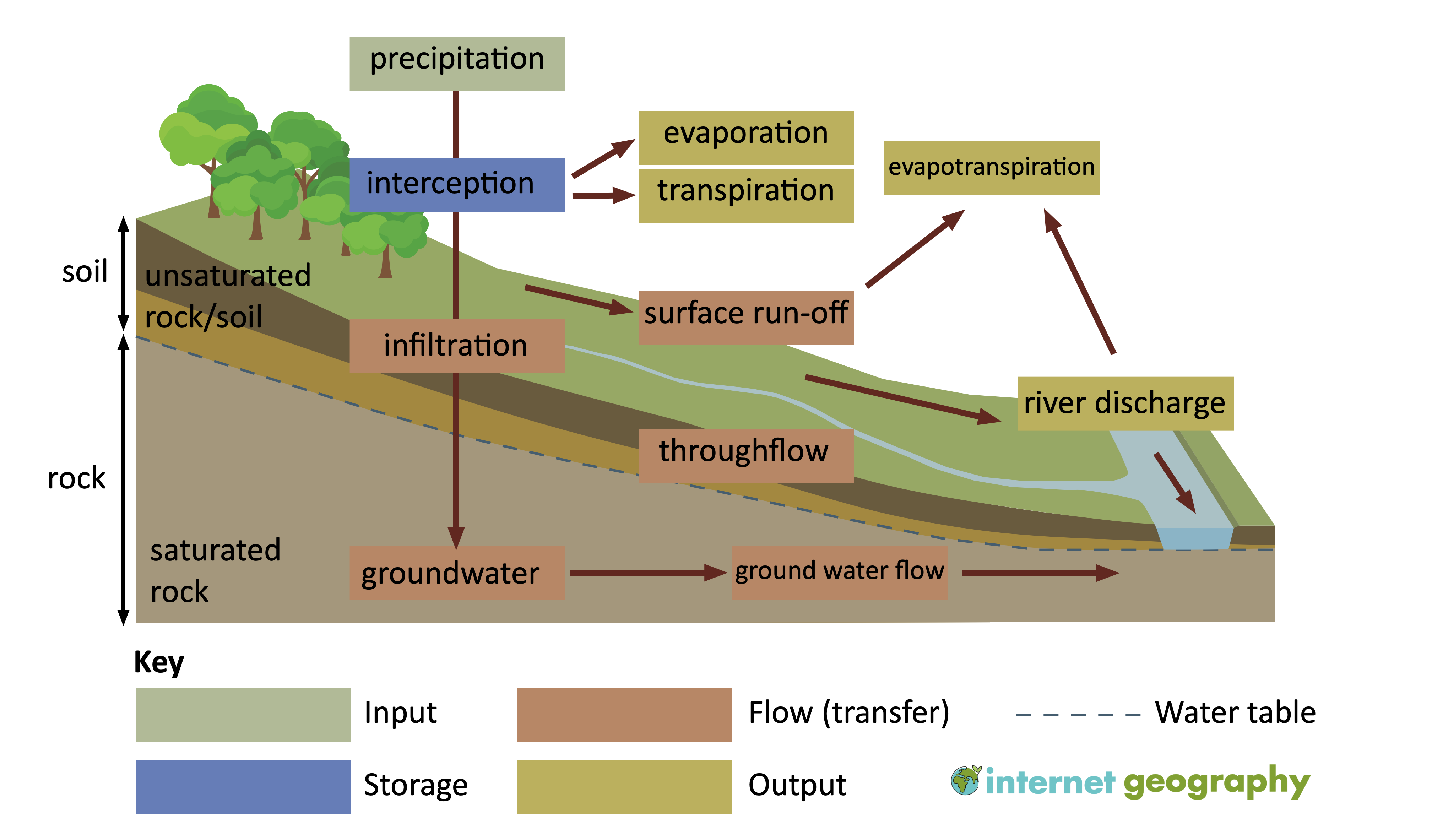
The Drainage Basin System
Inputs to the Drainage Basin
Precipitation
- The main input of water into the drainage basin
- Includes rain, snow, sleet and hail
- The amount, type and intensity of precipitation influence river discharge and flood risk
Stores of Water in the Drainage Basin
Water can be stored in several locations within the basin:
- Interception storage – water held on vegetation such as leaves and branches
- Surface storage – water stored in puddles, lakes and rivers
- Soil moisture storage – water held in the soil
- Groundwater storage – water stored in permeable rock below the surface
- Channel storage – water held within the river channel
These stores delay the movement of water through the basin.
Transfers (Flows) Within the Drainage Basin
Water moves between stores and through the drainage basin by several processes:
- Infiltration – water soaking into the soil
- Percolation – water moving downwards through soil into rock
- Surface runoff (overland flow) – water flowing over the land surface into rivers
- Throughflow – water moving sideways through soil towards the river
- Groundwater flow – water moving slowly through rock into the river channel
- Channel flow – the movement of water within the river channel towards the river mouth
Outputs from the Drainage Basin
- The main output is river discharge, where water flows out of the drainage basin at the mouth of the river
- Evaporation and transpiration return water to the atmosphere and reduce the amount of water in the basin
Factors Affecting How a Drainage Basin Operates
The operation of a drainage basin is influenced by:
- Geology – permeable rock increases infiltration; impermeable rock increases surface runoff
- Vegetation – increases interception and infiltration
- Relief – steep slopes increase surface runoff
- Soil type – sandy soils allow infiltration; clay soils reduce it
- Human activity – urbanisation increases surface runoff and flood risk
Drainage Basins and Flooding
Flooding is more likely when:
- Rainfall is intense or prolonged
- The ground is already saturated
- Infiltration rates are low
- Surface runoff is high
These factors cause river discharge to increase rapidly.


