Water quality and pollution management in the UK
Water pollution needs to be managed

Polluted or low-quality water reduces the amount available for use. This increases pressure on water resources, especially in areas where demand exceeds supply (water deficit).
Although the quality of water in the UK has improved significantly since the late twentieth century, the overall condition of surface water bodies remains poor. In 2009, a higher proportion of surface water bodies were classified as having high or good ecological status under the Water Framework Directive (WFD). This proportion declined during the following decade, and since 2019 has remained at around one third, with little or no overall change up to 2024. As a result, the majority of surface water bodies in the UK continue to be classed as moderate, poor or bad.
Surface water bodies include rivers, lakes, canals, estuaries and coastal waters. Rivers and lakes generally perform worse, while estuaries and coastal waters are more likely to achieve higher ecological status due to greater water movement and dilution of pollutants.
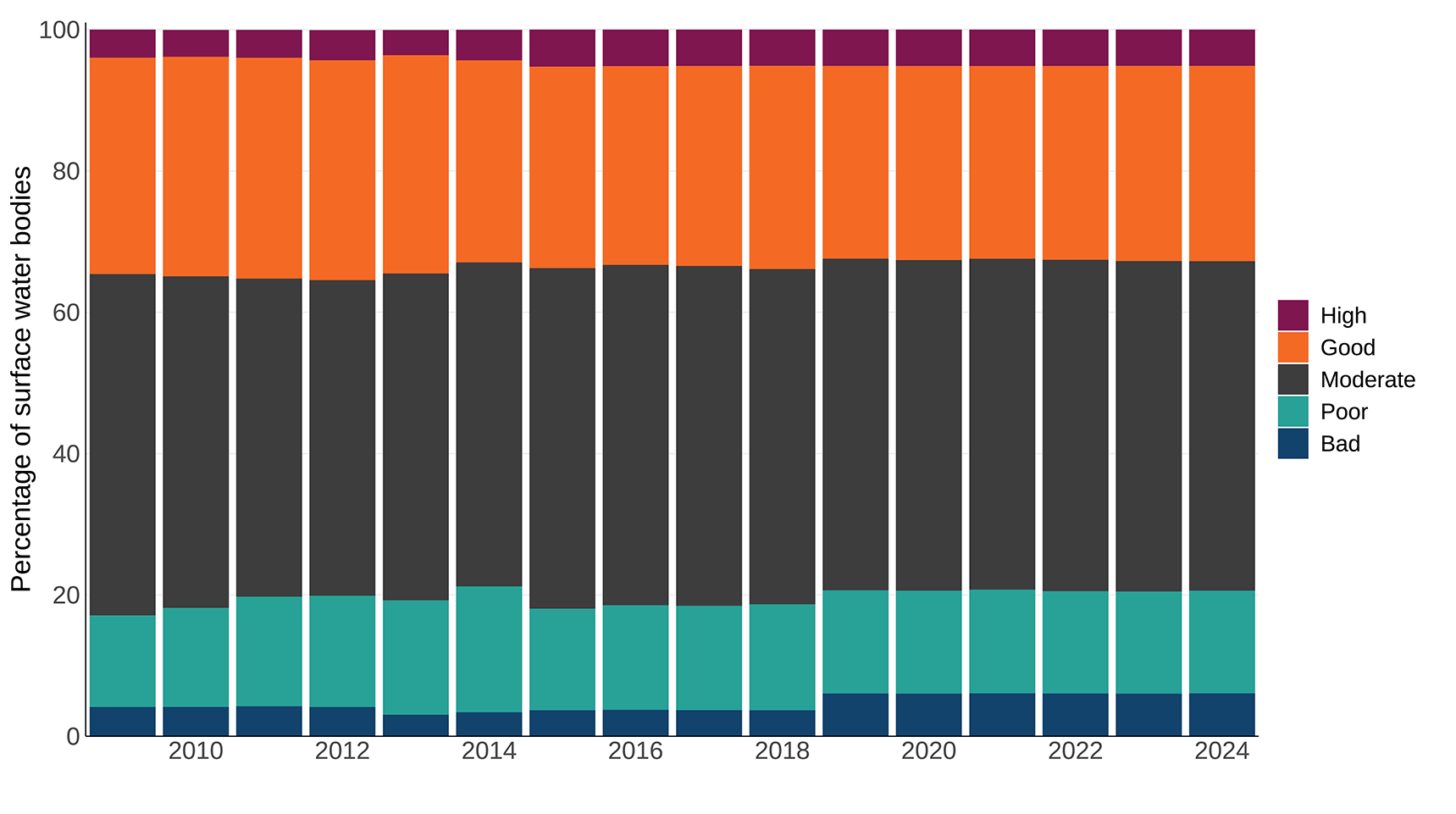
Status classification of UK surface water bodies under the Water Framework Directive, 2009 to 2024. Source – DEFRA – http://jncc.defra.gov.uk/page-4250
The main reasons for this are:
Groundwater is an important source of drinking water in the UK. While it is generally less visibly polluted than surface water, many groundwater bodies do not meet ‘good chemical status’ and require treatment, particularly where nitrates from agriculture or pollutants from historic industry are present.
Nearly 50% of the groundwater used for public supply in the UK is affected by pollution. This has led to many sources being closed or having to undergo expensive treatment to make them safe for public consumption.
Water pollution has both environmental and social impacts:
A range of strategies are used to manage water quality and reduce pollution:
Despite these measures, official monitoring shows that progress in improving surface water quality has stalled in recent years, with little change in the proportion of water bodies achieving high or good ecological status since 2019.
Where are the areas of water deficit and surplus in the UK?




Use the images below to explore related GeoTopics.


