You are here: The Final Countdown > Home > Week 2
Mind Map
Create a mind map to summarise hot deserts or cold environments. We’ve got a guide to creating mind maps if you need support.

The Final Countdown is here to help you prepare for your final AQA GCSE geography exam. Following our weekly exercises will prepare you to take on the examiner.
This week, you will revise either hot deserts or cold environments (depending on what you studied in school).
Hot Deserts
Use one of the three strategies below to revise these areas.
Cold Environments
Use one of the three strategies below to revise these areas.
Create a mind map to summarise hot deserts or cold environments. We’ve got a guide to creating mind maps if you need support.
Create flashcards to summarise hot deserts or cold environments. We’ve got a guide to creating flashcards if you need support.
Create a knowledge organiser to summarise hot deserts or cold environments. We’ve got a guide to creating a knowledge organiser if you need support.
This week you will use the interactive revision resources on Internet Geography to review last week’s revision. Have a go at the quizzes covering ecosystems and the tropical rainforest.
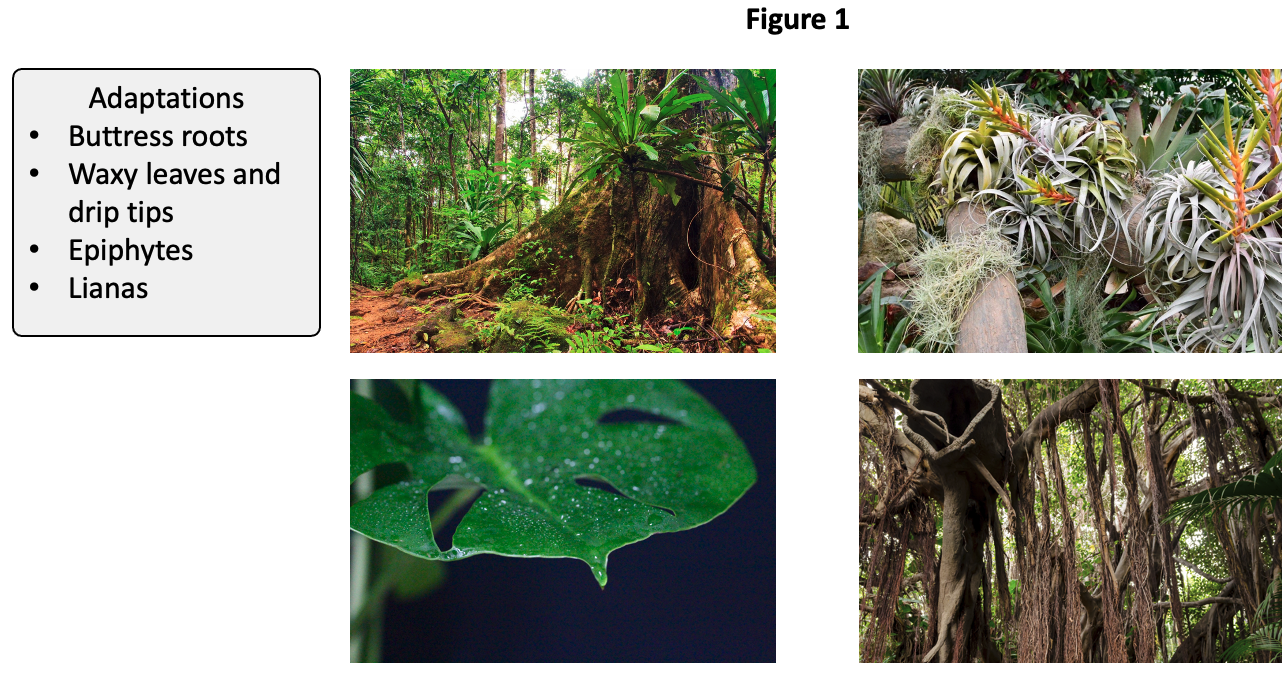
Using Figure 1 and your own knowledge, explain how plants have adapted to the physical conditions of the tropical rainforest. [6 marks]
Support
The command word for this question is explain. You should:
When you complete this question, you must make reference to what is shown in the images to reach the higher marks. You will not get any more than 2 marks if you do not use Figure 1. To do this, make explicit references to Figure 1, eg, ‘I can see… in Figure 1… which means that…’
This question is worth 6 marks. This means it is level-marked. The mark scheme would include:
Level 3 – Detailed (5-6 marks)
AO1 Demonstrates comprehensive and accurate knowledge of the way plants adapt to living in the rainforest.
AO2 Demonstrates a thorough understanding of how the different adaptations allow plants to live in the rainforest.
AO4 Demonstrates detailed use of Figure 1.
Level 2 – Clear (3-4 marks)
AO1 Demonstrates specific and clear knowledge of the ways plants adapt to living in the rainforest.
AO2 Demonstrates some understanding of the way plants adapt to living in the rainforest.
AO4 Demonstrates some use of Figure 1.
Level 1 – Clear (1-2 marks)
AO1 Demonstrates limited knowledge of the ways plants adapt to living in the rainforest.
AO2 Demonstrates a limited understanding of the way plants adapt to living in the rainforest.
AO4 Demonstrates little or no use of Figure 1.
0 Marks
No relevant content
Example Answer
The plant in Figure 1 has drip tips. Due to high rainfall, leaves often have drip tips that channel water to the tip, preventing the leaf from breaking. Leaf stems are also flexible, allowing leaves to track the sun. It also has a waxy upper surface, which protects the leaf from heat, allowing the plant to thrive.
Figure 1 also shows lianas, vines that climb trees to reach sunlight for photosynthesis. They need to do this because the dense canopy blocks sunlight from reaching the rainforest floor. Therefore, vine growth enables the plant to overcome the challenges posed by the rainforest environment.
Epiphytes are featured in Figure 1. These are plants that live on branches in the rainforest canopy. This means they obtain their moisture and nutrients from the air, rain, water, or debris accumulating around them.
Finally, the image shows trees with wide buttress roots. They have these because they grow incredibly tall (over 20-40m in some cases), as there is considerable competition for sunlight. In addition, roots grow wide rather than deep because nutrients are concentrated in the topsoil.
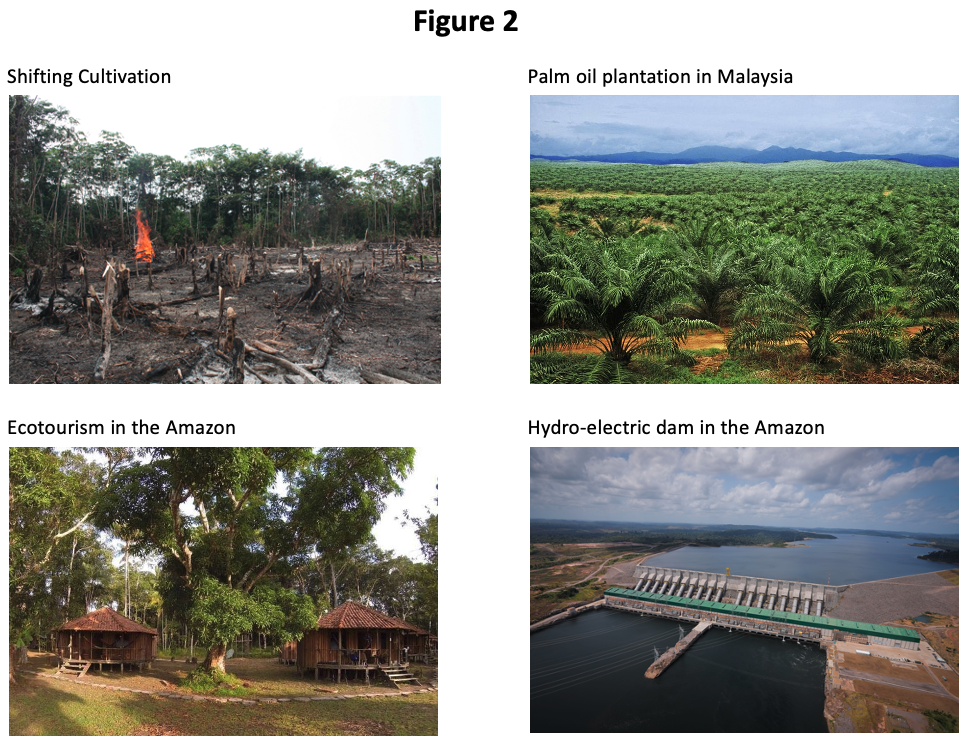
Some economic activities in tropical rainforests have major environmental impacts. To what extent do you agree? Use Figure 2 and a case study to explain your answer. [9 marks]
Support
The command words for this question is to what extent. This means you need to judge whether some economic activities in tropical rainforests have major environmental impacts. You should:
When you complete this question, you must make reference to what is shown in the images to reach the higher marks. You will not get any more than 3 marks if you do not use Figure 2. To do this, make sure you refer to what is shown in Figure 2.
Top Tip: The image shows two activities that are low-impact on the rainforest (ecotourism and slash-and-burn) and two that have a high impact on the rainforest (HEP and palm oil plantations).
This question is worth 9 marks. This means it is level-marked.
Example Answer
Please note – the example below is very comprehensive. You would not have time to write as much for each section, but the structure is worth considering.
The economic activities shown in Figure 2 have varying environmental impacts. Some have major environmental impacts, whereas others have little or no impact.
Small-scale shifting cultivation, or slash-and-burn, has traditionally had a relatively small impact on tropical rainforests because, when the soil becomes exhausted, people move on and clear another area, leaving the original forest to regenerate.
In contrast, palm oil plantations can lead to the deforestation of huge swathes of rainforest. Large areas of rainforest are cut down to make way for commercial plantations, but the land can only sustain crops for a relatively short period of time. After a few years, farmers must clear additional rainforest for new plantations. Deforestation for plantations can also contribute to soil erosion, as there is still no ground cover to protect the soil. Healthy topsoil is eroded and can clog rivers and other waterways. Since the soil is no longer as healthy due to erosion and the lack of biodiversity, chemicals in the form of fertilisers, insecticides, pesticides, etc, are added to the soil to promote better growth of oil palm trees. The chemicals used can leach into the ground and pollute both land and water.
Ecotourism can bring environmental benefits to an area. It tends to be small-scale with a focus on conservation and minimising negative environmental impacts. Tourism may take the form of replanting and other conservation projects. It can also help educate tourists and locals about the importance of sustainable use of rainforest areas.
HEP dams have caused huge environmental devastation in some areas of the tropical rainforest. Large areas of the Amazon have been deforested and flooded to construct dams, such as the Belo Monte Dam. Often, dams have a short lifespan and may become blocked by soil washed down from deforested slopes.
Other large-scale economic activities, such as mining, logging, and commercial farming, also have significant environmental impacts. Each involves removing rainforest vegetation cover. This exposes the soil, which is then eroded by heavy equatorial rainfall. Following these activities, it is exceptionally difficult for the rainforest ecosystem to recover.
In conclusion, small scale, local sustainable economic activities have a relatively small environmental impact compared to large-scale commercial projects. Despite economic benefits, clearing rainforest threatens the survival of many plant and animal species and can lead to serious environmental degradation. Widespread deforestation damages the whole biosphere with severe long-term consequences.


