You are here: The Final Countdown > Home > Week 4
Mind Map
Create a mind map to summarise the areas above. We’ve got a guide to creating mind maps if you need support.


The Final Countdown is here to help you prepare for your final AQA GCSE geography exam. Following our weekly exercises will prepare you to take on the examiner.
This week you will revise weather hazards and climate change. It would help if you covered the following:
Use one of the three strategies below to revise these areas.
Create a mind map to summarise the areas above. We’ve got a guide to creating mind maps if you need support.
Create flashcards to summarise the areas above. We’ve got a guide to creating flashcards if you need support.
Create a knowledge organiser to summarise the areas above. We’ve got a guide to creating a knowledge organiser if you need support.
Complete the revision quizzes covering hazards and tectonic hazards (you completed revision activities on this area last week!)
Question 1
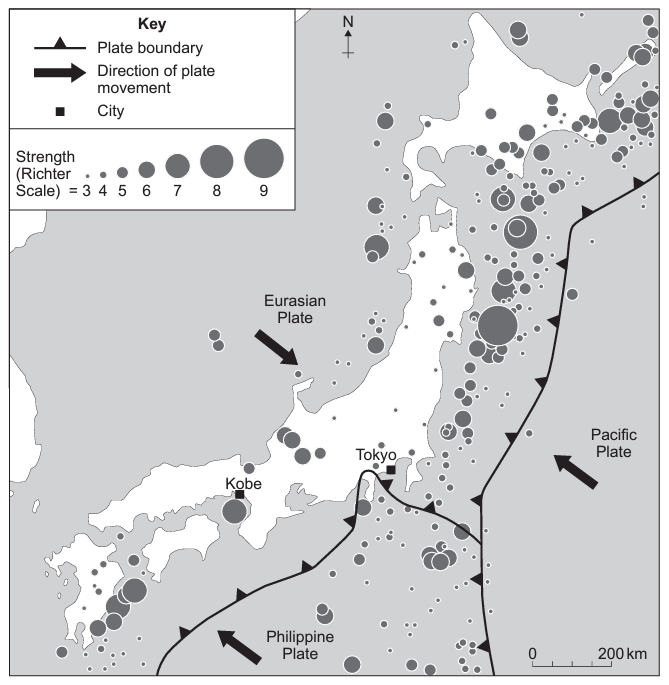
Using Figure 4 and your own understanding, suggest how plate movements causes tectonic hazards along destructive plate margins. [6 marks]
Figure 4
Support
The command word for this question is suggest. In your answer, you should set out the likely causes of volcanoes and earthquakes from the provided source, demonstrating an understanding of the processes involved and the associated hazards.
To achieve a level 3, you must make reference to Figure 4. Also, make sure you cover both volcanoes and earthquakes to reach level 3. If you cover only one, you will not receive higher than a high level 2 (4 marks).
As this question is worth 6 marks. This means it is level marked. The mark scheme would include:
Level 3 – Detailed (5-6 marks)
AO2 Shows thorough geographical understanding of processes causing tectonic hazards.
AO3 Demonstrates coherent application of knowledge and understanding in analysing why tectonic activity occurs in Japan.
Level 2 – Clear (3-4 marks)
AO2 Shows some geographical understanding of the processes causing tectonic hazard(s).
AO3 Demonstrates reasonable application of knowledge and understanding in analysing why tectonic activity occurs in Japan.
Level 1 – Clear (1-2 marks)
AO2 Shows limited geographical understanding of the processes causing tectonic hazard(s).
AO3 Demonstrates limited application of knowledge and understanding in analysing why tectonic activity occurs in Japan.
0 Marks
No relevant content
Example Answer
Japan is located along a destructive tectonic plate margin where an oceanic plate and a continental plate move toward each other.
The lighter, thicker Eurasian plate (continental crust) is subducted by the heavier, denser Pacific plate (oceanic crust). The oceanic plate melts as it sinks below the continental plate due to friction in the subduction zone and the heat of the mantle. The crust becomes molten magma. This is then forced to the Earth’s surface, causing volcanic eruptions at sites such as Mount Fuji.
One explanation for plate movement at a destructive plate margin is slab pull. Oceanic plates are heavy, so gravity acts upon them, pulling them down.
Alternatively, convection currents beneath Earth’s crust transport heat, which rises through the surface and cools. These convection currents are thought to drive the oceanic and continental plates toward each other.
The movement of the oceanic plate is not smooth. Due to friction, the plate gets stuck. Pressure then builds up. The plate will eventually slip, causing an earthquake. Japan has experienced a number of earthquakes, such as the 2011 Tohoku earthquake.
Question 2
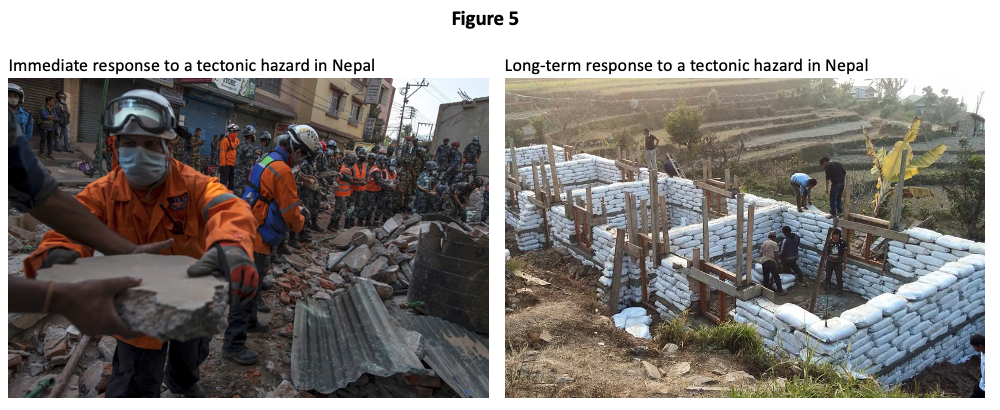
Immediate responses to a tectonic hazard are more important than long-term responses. Do you agree? Using Figure 5 and one or more examples, explain your answer. [9 marks +3]
Support
The command is “do you agree” and to “explain your answer”, so the focus of the question is an evaluation of the degree to which immediate responses are more or less important than responses in the long-term. e.g. Fully agree, disagree, partially agree. What is important in answering a question like this is to decide whether you agree and explain your choice, supported by evidence.
This question is worth 9 marks, plus an additional 3 for spelling, punctuation, and grammar. The mark scheme would be something like this:
Level 3
7-9 marks
AO1 Demonstrates detailed knowledge of the responses to a tectonic hazard with good use of exemplification.
AO2 Shows thorough geographical understanding of places, environments and processes.
AO3 Demonstrates thorough application of knowledge and understanding in judging the importance of immediate and long-term responses to a tectonic hazard using source and example.
Level 2
4-6 marks
AO1 Demonstrates clear knowledge of the responses to a tectonic hazard.
AO2 Shows some geographical understanding of places, environments and processes.
AO3 Demonstrates reasonable application of knowledge and understanding in judging the importance of immediate and long-term responses to a tectonic hazard, using source and/or example.
Level 1
1-3 marks
AO1 Demonstrates limited knowledge of responses to a tectonic hazard.
AO2 Shows slight geographical understanding of places, environments and processes.
AO3 Demonstrates limited application of knowledge and understanding in judging the importance of immediate and/or long-term responses to a tectonic hazard, using source and/or example.
0 marks
No relevant content
When you answer this question, make sure you make reference to Figure 5, and the examples you have studied.
Example Answer
With regard to the importance of immediate and long-term responses to a tectonic hazard, both are crucial for effectively mitigating its effects. While immediate responses play a critical role in saving lives and providing immediate relief during a disaster, long-term responses are necessary to ensure the recovery and reconstruction of affected communities.
Immediate responses include providing water supplies, medicines, first aid and essential supplies for survival. It also includes rescuing those trapped by collapsed buildings, as shown in Figure 5. This was particularly important in Nepal, an LIC, where poor building construction led to many people being trapped in rubble. Long-term responses include rebuilding programmes, constructing new houses using durable materials, and replacing those destroyed, as shown in Figure 5. This allows people to plan for the future and may also provide employment for local builders, electricians, carpenters, and related trades.
This is also evident in HICs, as reflected in the response to the 2011 Tohoku earthquake and tsunami in Japan. Immediate responses, such as the evacuation of coastal areas, were crucial in reducing casualties during the disaster. However, the long-term response, including the reconstruction of infrastructure, homes, and communities, was also vital in ensuring the recovery of the affected areas.
Furthermore, investing in long-term responses can also help to reduce the risk and impact of future hazards. For example, following the Tohoku disaster, Japan implemented new building codes and installed early warning systems to better prepare for future earthquakes and tsunamis.
In conclusion, both immediate and long-term responses to a tectonic hazard are essential to effectively mitigate its effects. While immediate responses play a critical role in saving lives and providing immediate relief, long-term responses are necessary for the recovery and reconstruction of affected communities and to reduce the risk and impact of future hazards.


