
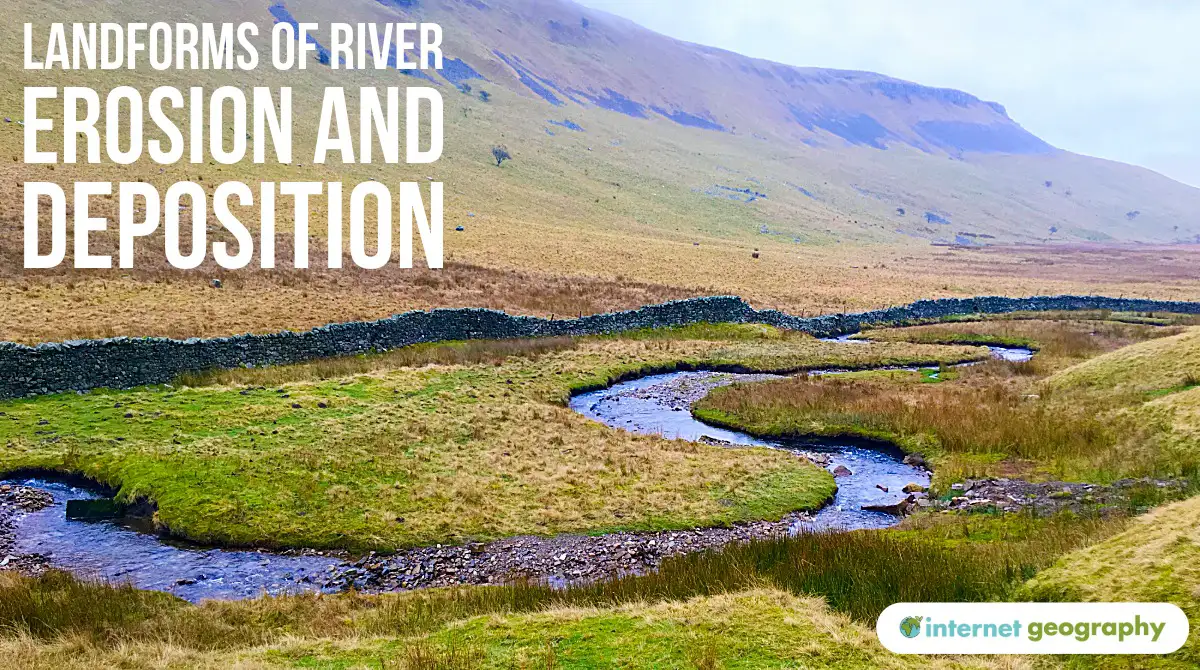
Characteristics and formation of meanders and oxbow lakes
As a river enters its middle course, the gradient becomes gentler, and the channel widens and deepens. The river now carries more water and has greater energy, but instead of eroding vertically, it mainly erodes sideways (laterally). This combination of lateral erosion, transportation and deposition leads to the development of distinctive landforms, particularly meanders and oxbow lakes.
Meanders
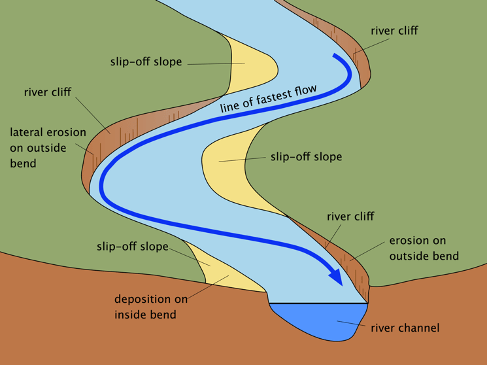
A diagram to show the main features of a meander
A meander is a wide, sweeping bend in a river. Meanders develop as the river’s energy becomes concentrated on the outer edges of bends, while slower-moving water on the inside of bends allows material to be deposited. Over time, these bends become more pronounced and migrate across the floodplain.
The outer bend of a meander has the fastest flow and the greatest energy. Here, lateral erosion is most active, mainly through hydraulic action and abrasion. This undercuts the riverbank, creating a steep-sided feature known as a river cliff or river bluff. The channel is also deepest on the outside of the bend.
In contrast, the inner bend has slower-moving water. As velocity decreases, the river loses energy and begins to deposit its load. This forms a gently sloping bank, called a slip-off slope or point bar, composed of sand and gravel.
Meanders grow and shift position due to helicoidal flow, a corkscrew-like movement of water within the channel. Faster surface water is directed towards the outer bend, increasing erosion, before spiralling downwards and across the channel. Sediment is then deposited on the inner bend. This process exaggerates the bend and causes the meander to migrate sideways across the floodplain over time.
Oxbow lakes
An oxbow lake is a horseshoe-shaped lake formed when a meander is cut off from the main river channel. Oxbow lakes are common in the lower and middle courses of rivers, where meanders are large and well-developed.
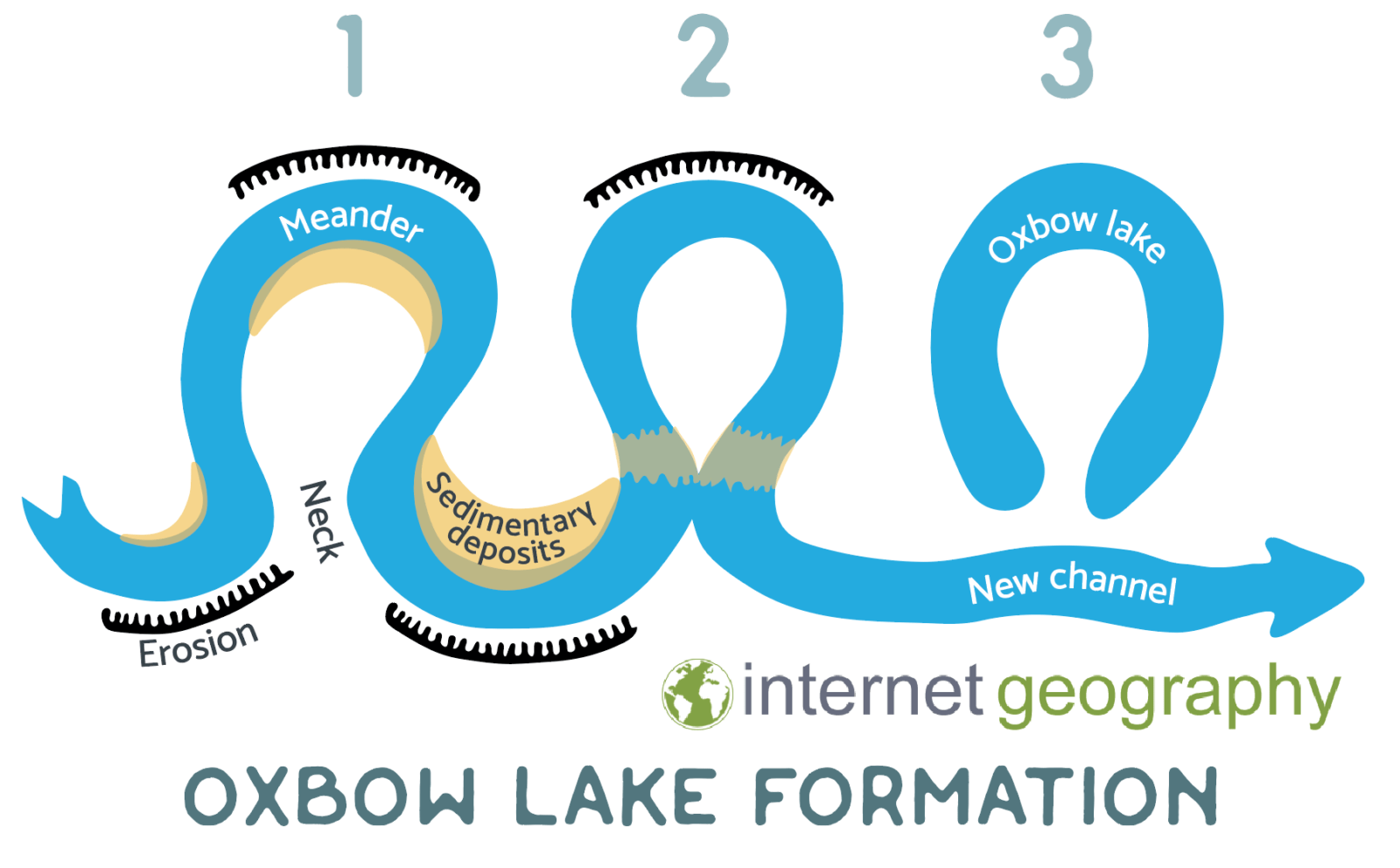
The formation of an oxbow lake
- As a meander continues to grow, erosion on the outer bends causes the two ends of the bend to move closer together, narrowing the meander neck. During periods of high discharge, such as during a flood, the river has enough energy to break through this narrow neck and take a shorter, straighter route.
- Once the main flow of the river has diverted into the new channel, the old meander loop is no longer supplied with fast-moving water.
- Deposition quickly occurs at the entrances to the abandoned bend, sealing it off from the river. The remaining loop becomes an oxbow lake.
Over time, oxbow lakes may gradually fill with fine sediment and vegetation, eventually forming a marshy area known as a meander scar on the floodplain.
Key processes to remember
Meanders and ox-bow lakes form through the interaction of erosion, transportation and deposition.
- Erosion dominates on the outside of bends where velocity is highest.
- Deposition occurs on the inside of bends where the river loses energy.
- Helicoidal flow links these processes together, helping to shape and enlarge meanders.


