Deforestation in the tropical rainforest

62 countries have tropical rainforest within their borders. The graph below shows the top 19 countries. There are no early records of the extent of tropical rainforest, however, the UN Food and Agriculture Organisation estimates that around half of the world’s tropical rainforest has been cleared. The scale and rate of acceleration are of great concern.
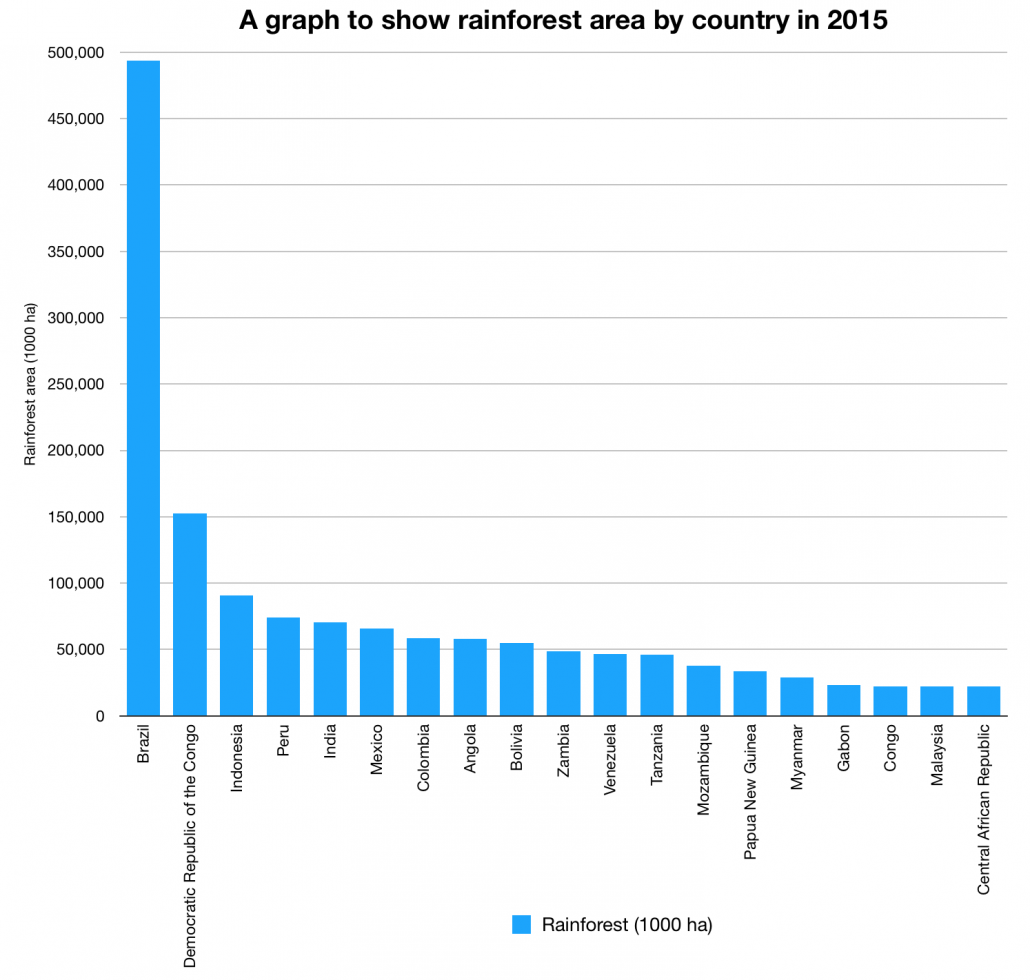
A bar graph to show the rainforest area by country
The graph below shows that rates of deforestation increased in all three continents containing tropical rainforest. These were Asia (Indonesia, Thailand and Malaysia), Africa (Mali and Madagascar) and South America (Bolivia, Guatemala and Peru). The rate of deforestation in Indonesia and Peru is alarming. The rate of deforestation in Indonesia was twice as great between 2005 and 2010 compared to 2000 and 2005. In Peru, it nearly doubled.
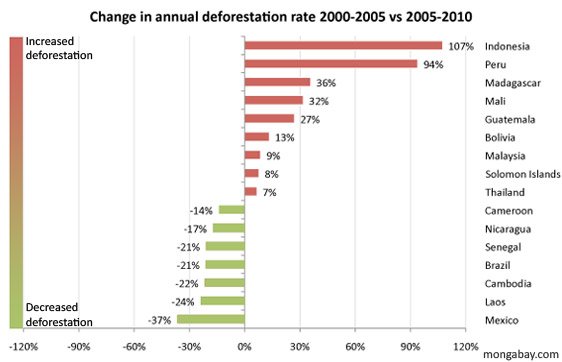
Change in annual deforestation rate
The rate of deforestation declined in seven countries. Deforestation in Brazil has fallen to a record low. Over half of the remaining rainforest in Brazil is in some way protected. However, an area three times the size of the UK has been cleared since 1970. This accounts for 20% of the original forest.
The rate of reductions in other countries reflects that other countries have already put measures in place to protect their rainforests. In some cases, for example in Mexico, considerable efforts are being made to save what little rainforest is left. But it is only the rate that has decreased. Deforestation continues in all the countries shown in the graph above. Indeed, it is still happening in all 62 countries.
Today, global Rates of deforestation are:
The image below shows some of the causes and effects of deforestation in the Amazon Rainforest.

How do humans affect the rainforest
Slash and burn
Most clearances are still by the local people and tribes needing land on which to grow crops. They clear the forest by ‘slash and burn’. Vegetation is cut down and then burned. The ash acts as a fertiliser adder nutrients to the soil. When the soil begins to turn infertile (usually after 3-5 years) the people move on. This is called shifting cultivation. It is a sustainable method of farming in the rainforest. It ensures the forest will recover.
Road Building
The Transamazon Highway has allowed increased access to the Amazon Rainforest.
Logging
Commercial logging is the major cause of primary rainforest destruction in South East Asia and Africa. Worldwide, it is responsible for the destruction of 5 million ha. per year. Logging roads enable landless people to enter the forest. In Africa, 75% of land being cleared by peasant farmers has been previously logged.
Cattle Ranching
Ranching is a major cause of deforestation, particularly in Central and South America. In Central America, two-thirds of lowland tropical forests have been turned into pasture since 1950.
Hydroelectric Power
An unlimited supply of water and ideal river conditions have led to the development of hydroelectric power stations (HEP Stations).
Farming
There are nearly 3 million landless people in Brazil alone. The government has cleared large areas of the Amazon Rainforest and encouraged people to move there. The scheme has not been successful. Farmers stay on the same land and attempt to farm it year after year. Nutrients in the soil are quickly exhausted as there is no longer a humus layer to provide nutrients. The soil becomes infertile and nothing will grow.
Mining
The mining of iron ore, bauxite, gold, oil and other minerals have benefited many LEDCs. However, it has also devastated large areas of rainforest e.g. The Amazon.
Deforestation is causing many problems at a range of scales:
Local:
Ecosystem
Soil Erosion
National:
Deforestation can consume a country’s only natural resource. If deforestation is not managed in a sustainable manner a country’s only natural resource could be lost forever.
Global:
Global Warming
Rainforest canopies absorb carbon dioxide which is a gas in the atmosphere. When the rainforests are burned and cleared, the carbon is released. Also, when trees are cut down they can no longer absorb carbon dioxide. This means more carbon dioxide is in the atmosphere. Carbon dioxide allows heat through the atmosphere (suns rays). However, it will not allow reflected energy to escape from the atmosphere. This is called the greenhouse effect and causes global warming.




Use the images below to explore related GeoTopics.


