
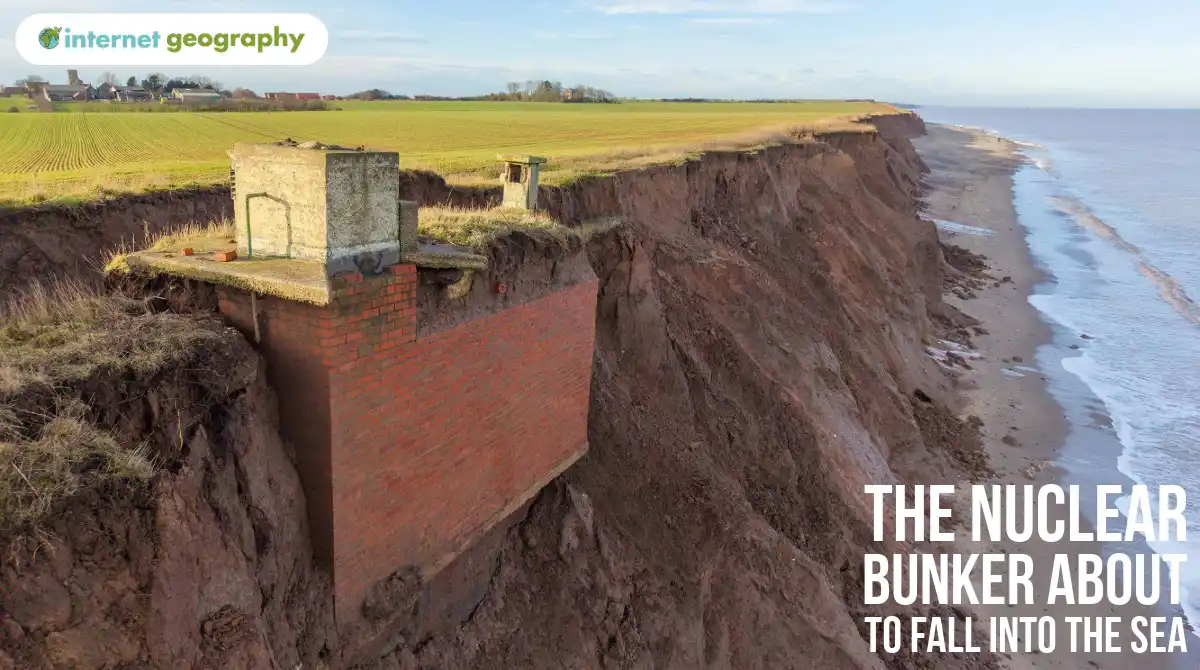
On the Holderness Coast in East Yorkshire, a strange and dramatic sight has appeared at the edge of the cliffs: a Cold War nuclear bunker that is now just days away from collapsing onto the beach below.
This story has grabbed attention not because of war or conflict, but because it shows coastal erosion in action. It is a powerful real-life example of how coastlines are constantly changing.
What is the Tunstall ROC bunker?
The brick structure near the village of Tunstall is known as the Tunstall Royal Observer Corps (ROC) Post. It was built in 1959 during the Cold War and was designed as a monitoring station. If a nuclear explosion had occurred, people inside the bunker would have recorded information and passed it on to other posts across the UK.
When the bunker was built, it was located more than 100 metres inland. Today, it sits right on the edge of the cliff, with nothing but cliff material and air beneath it.
Why is the Holderness Coast eroding so fast?
The Holderness Coast is one of the fastest-eroding coastlines in Europe, losing around 2 metres of land per year. This occurs because weak geology, powerful waves, and mass movement interact.
Weak geology
The cliffs along this coast are composed of boulder clay, a soft material deposited by glaciers at the end of the last Ice Age. Boulder clay absorbs water easily and becomes heavy and unstable, making it very vulnerable to erosion.
Powerful marine processes and slumping
Waves constantly attack the base of the cliffs through hydraulic action (air being forced into cracks) and abrasion (rocks hitting the cliff). This erodes the foot of the cliff, undercutting it and making it unstable.
As rainwater seeps into the boulder clay, the cliff becomes heavier, and friction decreases. This leads to rotational slumping, a type of mass movement in which large sections of the cliff collapse forward and downward in a curved motion. The slumped material falls onto the beach below, where it is gradually removed by waves. Once this happens, the cliff is exposed again, and the cycle continues.
This combination of marine erosion and mass movement explains why the coastline retreats so quickly.
A coastline that keeps changing
Over thousands of years, the Holderness Coast has lost several kilometres of land, and more than 20 villages have been swallowed by the North Sea. The Tunstall bunker is a striking symbol of this process, showing that even solid, human-built structures are no match for natural coastal processes.
Local residents have been watching and filming the bunker’s final days as it slowly approaches collapse. It provides clear evidence that erosion is not merely a historical phenomenon; it is occurring at present.
Why isn’t the coastline protected?
Not all coastlines are defended. Along much of the Holderness Coast, the approach is managed retreat, where the sea is allowed to erode the land naturally.
Building sea defences here would be extremely expensive, and protecting one stretch of coast could make erosion worse further down the shoreline by stopping the natural movement of sediment.